
Climate change in India is often discussed through images of melting glaciers, record-breaking heatwaves and devastating floods. Yet one of the most profound climate stories is unfolding far from global headlines — in cattle sheds, village commons and dairy farms where millions of rural families depend on livestock for survival.
India possesses the largest cattle population in the world. For millions of small farmers, livestock is not merely an agricultural asset but a financial safety net, a source of daily income and, in many cases, the difference between resilience and destitution.
But rising temperatures are beginning to test this delicate relationship between animals, environment and economy.
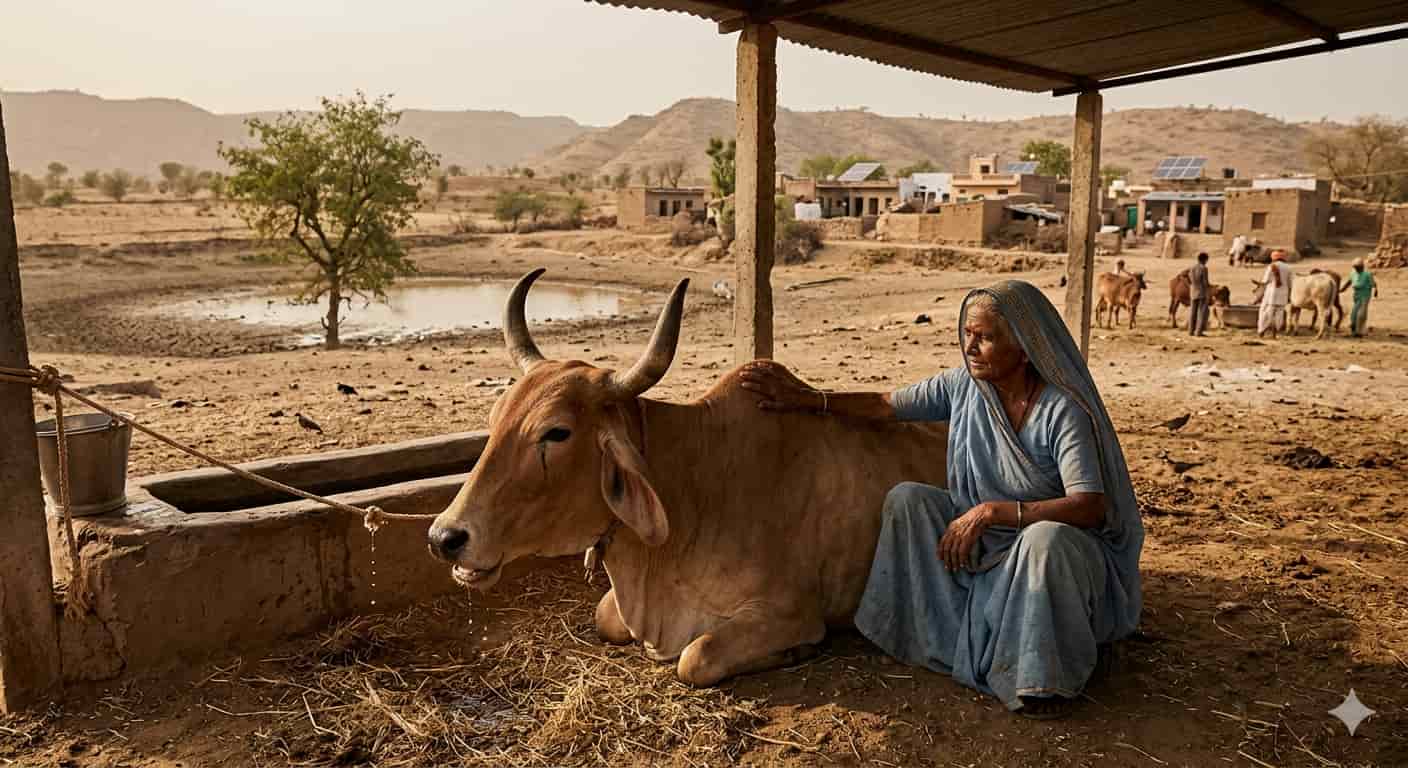
Across parts of Rajasthan, Haryana and Uttar Pradesh, dairy farmers increasingly report falling milk yields during prolonged heat spells. In coastal regions, erratic rainfall patterns are affecting fodder availability. In drought-prone districts, water scarcity is forcing difficult decisions about herd sizes.
This is not just an animal health issue. It is a rural livelihood issue. It is also a climate adaptation story that is only beginning to receive serious attention.
The economic importance of India’s livestock economy
Livestock plays a surprisingly large role in India’s rural economy. The sector contributes significantly to agricultural GDP and supports the livelihoods of more than 100 million rural households.
India is also the world’s largest milk producer, a remarkable achievement driven largely by smallholders owning just two or three animals rather than large industrial farms.
This decentralised structure has historically been seen as a strength. It spreads income opportunities widely and reduces vulnerability to large market shocks.
However, climate change introduces a new kind of systemic risk — one that affects millions simultaneously.
Unlike crop failures, which may affect certain regions more than others, rising temperatures affect animals across geographies. Heat stress reduces feed intake, affects fertility cycles and lowers milk production. The cumulative economic impact can therefore be substantial.
Heat stress: The silent productivity killer
One of the most significant threats to cattle productivity is heat stress.
Cows function best within a specific temperature range. When temperatures rise beyond comfort thresholds, animals expend more energy regulating body temperature instead of producing milk.
The biological consequences are measurable. Reduced appetite leads to lower nutrient intake. Hormonal changes affect reproduction. Immunity can weaken, increasing susceptibility to disease.
For small farmers operating with narrow financial margins, even a small drop in milk output can translate into major income losses.
In particularly severe heatwaves, milk yields may drop by 10 to 25 per cent depending on breed, management practices and duration of heat exposure.
This creates cascading effects. Lower milk output means lower daily cash flow. Reduced income can affect household spending on education, health and nutrition.
In other words, climate change affecting cattle can indirectly affect human development outcomes.
Why indigenous breeds may matter more in a warmer future
Interestingly, climate pressures may revive interest in indigenous cattle breeds.
India’s traditional breeds, though often producing less milk than exotic or crossbred varieties, tend to be more heat tolerant and disease resistant. Their resilience may become a critical advantage in a warming climate.
Crossbred cattle introduced to boost productivity have delivered impressive gains in milk output over past decades. However, they are often more sensitive to temperature stress and require better cooling, nutrition and veterinary care.
This creates a strategic dilemma for policymakers and farmers alike.
Should India continue prioritising maximum productivity through crossbreeding? Or should resilience become equally important?
Some experts argue that the future may lie in balancing both through selective breeding programmes that combine productivity with climate resilience.
Water scarcity and the livestock dilemma
Climate change also interacts with another growing constraint: water availability.
Livestock require water directly for drinking and indirectly through fodder production. As groundwater levels decline and rainfall patterns become erratic, maintaining adequate water supplies is becoming more difficult.
In drought-prone areas, farmers often face difficult trade-offs between allocating scarce water to crops or animals.
Such pressures may reshape livestock management patterns over time, potentially leading to smaller herds or shifts towards animals requiring less water.
The fodder crisis few people talk about
Another emerging climate risk is fodder availability.
Fodder production depends heavily on rainfall patterns and cropping cycles. Erratic monsoons can reduce fodder yields or increase price volatility.
India already faces a structural fodder deficit in some regions. Climate variability could worsen this imbalance.
This raises an important but under-discussed policy question: should climate adaptation strategies include dedicated investments in climate-resilient fodder systems?
Possible solutions could include drought-resistant fodder crops, improved storage systems and community fodder banks.
Gender dimensions of livestock vulnerability
Livestock management in India has a strong gender dimension.
In many rural households, women play primary roles in feeding, milking and caring for animals. Climate impacts on livestock therefore often translate into increased workloads for women.
Longer distances to fetch water or fodder, increased animal care needs during heat stress, and declining income from milk sales can all affect women disproportionately.
Recognising livestock adaptation as a gender issue may therefore be critical for designing effective interventions.
Methane debates and the global climate narrative
Livestock also sits at the centre of a global climate debate due to methane emissions.
Cattle produce methane through enteric fermentation, making livestock a significant contributor to agricultural greenhouse gas emissions globally.
This has led some international commentators to advocate reducing cattle numbers as part of climate mitigation strategies.
However, such arguments often fail to consider the socioeconomic realities of countries like India.
Unlike industrial livestock systems in some developed countries, India’s cattle economy is deeply intertwined with smallholder livelihoods, nutritional security and organic farming systems.
This creates a policy tension between global mitigation narratives and local development priorities.
A more complex climate equation than it appears
Some researchers argue that blanket comparisons between livestock emissions in developed and developing countries can be misleading.
India’s per-animal productivity remains lower than in industrial dairy systems. This means emissions per litre of milk may be higher, but total system dynamics differ due to multifunctional roles cattle play, including manure production and draught power in some regions.
Moreover, livestock often functions as a form of climate insurance for small farmers. During crop failures, milk sales may provide steady income.
This complexity suggests that simplistic solutions such as herd reduction may not be appropriate in all contexts.
Adaptation strategies emerging on the ground
Across India, farmers are already experimenting with adaptation strategies, often without formal support.
Some are modifying cattle sheds to improve ventilation. Others are installing low-cost cooling systems such as sprinklers or shade nets. Adjusting feeding times to cooler parts of the day is another common adaptation.
In some areas, dairy cooperatives are beginning to provide advisory services on climate management.
These local innovations highlight an important insight: adaptation often begins from the ground up rather than through top-down policy.
The role of technology in protecting livestock
Technology may also play a growing role.
Wearable sensors for cattle health monitoring, mobile veterinary advisory platforms and climate information services are slowly entering the livestock sector.
Early warning systems for heatwaves could allow farmers to take preventive measures such as increasing water availability or adjusting feeding schedules.
However, technology adoption faces familiar barriers including cost, awareness and digital access.
Financing climate resilience in livestock systems
A critical but often overlooked challenge is financing adaptation.
Small farmers may understand the need for improved sheds or cooling systems but lack capital to invest.
This raises questions about whether climate finance mechanisms should extend beyond renewable energy projects to include livestock adaptation.
Insurance products tailored to livestock climate risks could also become more important as extreme weather events increase.
A neglected policy conversation begins to emerge
Despite the sector’s importance, livestock adaptation has historically received less policy attention than crop agriculture.
This may partly reflect the visibility bias of climate impacts. Crop failures are immediate and visible. Livestock productivity declines may be gradual and harder to measure.
However, this is beginning to change.
Around the midpoint of emerging discussions on climate-resilient rural development, one recent analysis titled Cattle and Community in a Changing Climate has drawn attention to how climate stress could reshape livestock-dependent livelihoods and highlighted the need for more integrated adaptation strategies that consider both animal productivity and community resilience.
Such research is helping broaden the climate adaptation conversation beyond crops and infrastructure towards rural production systems as a whole.
The cooperative model as a resilience tool
India’s dairy cooperative model may offer an institutional advantage in managing climate risks.
Cooperatives can aggregate resources for veterinary services, provide extension support and facilitate dissemination of adaptation practices.
They may also help stabilise incomes through collective procurement and marketing.
Strengthening cooperative capacity for climate advisory services could therefore represent a relatively low-cost adaptation pathway.
The nutritional security dimension Livestock also intersects with nutrition.
Milk remains one of India’s most important protein sources, particularly for vegetarian populations. Any climate-induced disruption to dairy production could therefore have nutritional implications.
This highlights how climate impacts on livestock are not only economic but also linked to public health outcomes.
Urban demand and rural vulnerability
Rising urban demand for dairy products adds another layer of complexity.
India’s expanding middle class is increasing consumption of milk, cheese and processed dairy products. This creates pressure to maintain or increase production even as climate risks grow.
Balancing demand growth with sustainable and climate-resilient production will require careful planning.
The counterargument: is climate impact overstated?
Not everyone agrees that climate change will fundamentally disrupt India’s livestock sector.
Some analysts argue that farmers have historically adapted to environmental variability and will continue to do so. Others point to genetic improvements and better management practices as reasons for optimism.
There is also evidence that productivity gains through better feeding and animal health management could offset some climate losses.
These perspectives serve as important reminders against deterministic narratives.
However, most experts agree that while adaptation is possible, it will not be automatic. It will depend on investments, information and institutional support.
Climate justice and small livestock holders
The livestock story also raises climate justice questions.
Small farmers contributing little to global emissions often face disproportionate climate risks. Supporting their adaptation is therefore not just an economic issue but also an equity issue.
International climate finance discussions increasingly emphasise such justice dimensions.
Whether livestock adaptation receives adequate attention in global climate funding remains an open question.
The path forward: integrating livestock into climate planning
A growing consensus suggests livestock must be more systematically integrated into climate policy.
This could include improved climate risk mapping for livestock regions, targeted breeding programmes, expanded veterinary infrastructure and climate-smart fodder systems.
Equally important will be strengthening data systems. Livestock climate impacts remain less studied compared to crops, limiting evidence-based policymaking.
The bigger picture: climate change as a rural transformation force
Ultimately, climate impacts on cattle may be part of a larger rural transformation story.
As environmental conditions change, rural production systems may gradually shift. Some regions may specialise more in livestock. Others may diversify away.
Such transitions are rarely linear. They involve complex interactions between markets, culture, ecology and policy.
Understanding these dynamics will be essential for managing change without disrupting livelihoods.
A frontline that deserves more attention
If climate change has frontlines, they are not only coastlines or glaciers. They are also cattle sheds, village water points and dairy collection centres.
They are the places where global environmental change meets everyday survival.
India’s livestock sector illustrates how climate change is not just an environmental issue but a development issue, a livelihood issue and a resilience issue.
As climate risks intensify, the ability to protect both animals and the communities that depend on them may become an increasingly important test of adaptation policy.
The future of India’s rural resilience may depend as much on how it supports its livestock keepers as on how it builds its solar parks.
And in that quiet intersection between cattle and climate lies one of the most important but least discussed stories of India’s climate future.