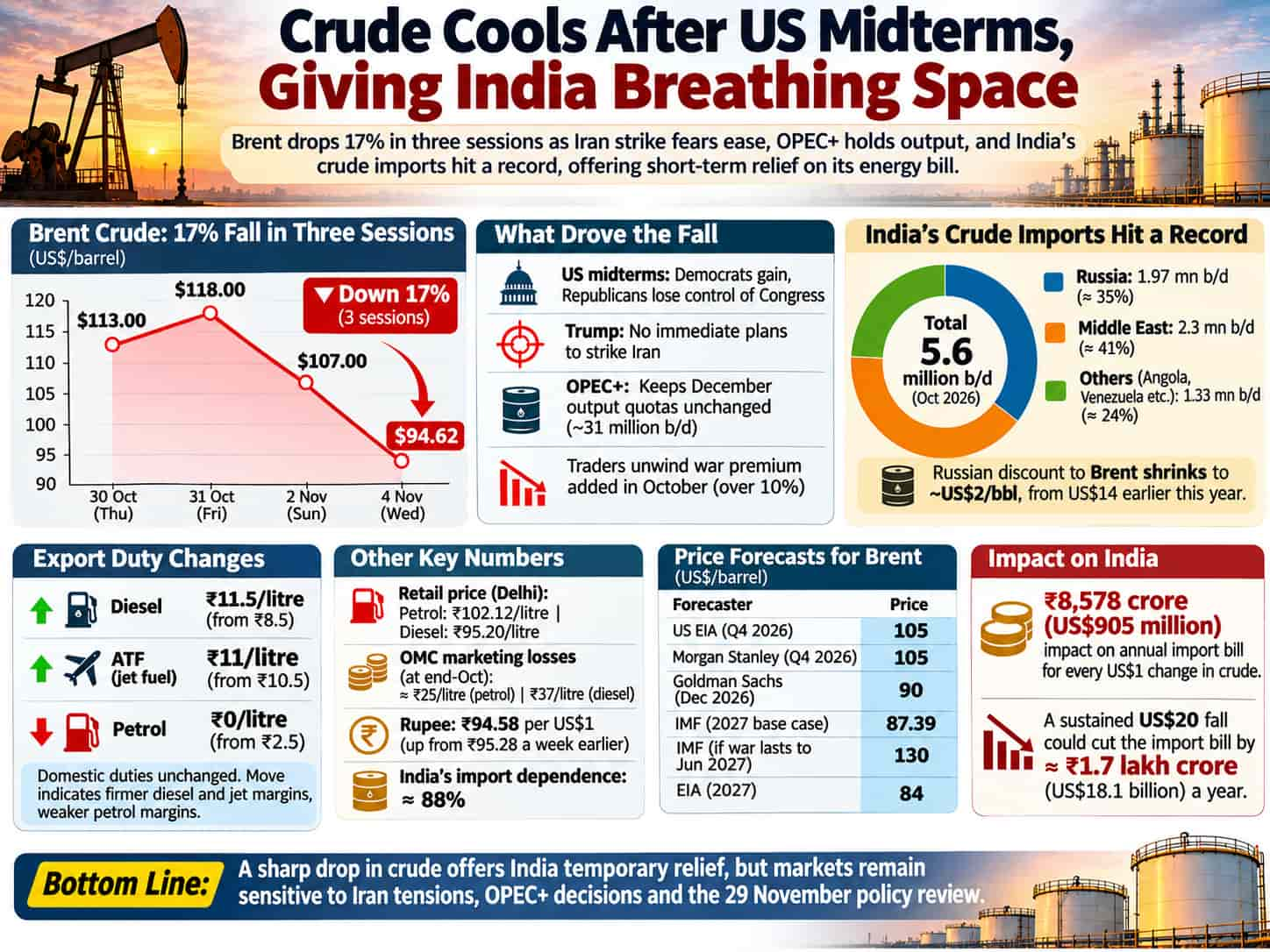
Brent settled at US$94.62 on Wednesday, down 8.7% on the day. From about $113 at the close on Friday 30 October, that is a fall of 17% in three sessions. West Texas Intermediate fell 8.3% to US$88.12.
Politics did the work. Washington confirmed limited strikes on Iran’s Qeshm island on Monday 2 November, and Brent briefly rose above US$107. The next day, President Trump told the Financial Times he has no immediate plans to strike Iran, which traders read as ruling out a major escalation.
On Wednesday 4 November, Vice President Vance blamed the Iran war for the Republican losses. Traders had pushed Brent up more than 10% in October to price an escalation after the election. They have now unwound it.
The relief may not last. A senior Iranian official said the two sides are far from a deal. “The market has swapped an escalation premium for a peace premium, and neither is backed by a signed agreement,” said an analyst tracking global crude markets.
For India, each US$1 on the basket is worth about ₹8,578 crore (USUS$905m) a year. A sustained US$20 fall would cut the annual import bill by about ₹1.7 lakh crore (USUS$18.1 billion).
OPEC+ holds and looks to 2027
The seven core OPEC+ members kept December quotas at September’s level on 1 November, about 31 million barrels a day combined. Several Gulf members still pump below quota because of export disruptions, so the decision changes little.
The real test is the 29 November ministerial meeting, which is expected to set 2027 quotas after a capacity review due by mid-November. The International Energy Agency (IEA) and other forecasters warn of a surplus in 2027 if Gulf flows normalise. For India, that would soften the basket later.
 Record imports, vanishing discounts
India imported a record 5.6 million barrels a day in October, as per Kpler data. Middle Eastern supply was about 2.3 million, down from 2.7 million in September. Russia supplied 1.97 million, about 35% of the total and well below July’s peak of 2.82 million. Angola and Venezuela gained share.
The discount that drew India to Russian crude has almost vanished. One report puts the Urals discount to Brent at about US$2 a barrel, against US$14 earlier this year. “We buy Russian barrels for security of supply now, not for the discount,” said an executive at a leading Indian refiner.
Kpler expects Russian flows to soften in November-December if Black Sea attacks lift freight. The 16 October US waiver under the Graham Act gives buyers more room.
Export duty raised on diesel, dropped on petrol
The government raised the special additional excise duty on diesel exports to ₹11.5 a litre (USUS$0.12) from ₹8.5 (USUS$0.09), and on aviation turbine fuel (ATF) to ₹11 (USUS$0.12) from ₹10.5 (USUS$0.11). The petrol export duty was cut to zero from ₹2.5 (USUS$0.03). Domestic duties are unchanged.
The duty follows export margins, so the changes point to firmer diesel and jet margins and weaker petrol ones. Exporters keep less of the diesel premium.
Pumps frozen, rupee firms
Delhi petrol is still ₹102.12 (USUS$1.08) a litre and diesel ₹95.20 (USUS$1.01). Reports put state retailers’ marketing losses near ₹25 (USUS$0.26) a litre on petrol and ₹37 (USUS$0.39) on diesel at the end of October, when the basket was near US$118. Losses should narrow as crude falls. Retailers still hold costlier inventory, so relief will lag.
The rupee closed at ₹94.58 on Wednesday, up from ₹95.28 a week earlier, on cheaper crude, a weaker dollar and foreign inflows.
Where forecasters see prices heading
Near term, Brent has dropped below most fourth-quarter calls. The US Energy Information Administration (EIA) forecasts US$105 for the quarter. Morgan Stanley also sees US$105, while Goldman Sachs targets US$90 for December. Those calls were made as war risk was rising and may now be revised.
Long term, the IMF assumes US$87.39 for 2027 and a Hormuz reopening from March 2027, with US$130 if the war lasts to June 2027. The EIA sees US$84 for 2027.
What it means for energy security
With 88% import dependence, politics in Washington reaches Indian pump economics through Brent within days. The next checkpoints are OPEC+’s capacity review in mid-November, the export-duty review around the same time, and the 29 November ministerial meeting.