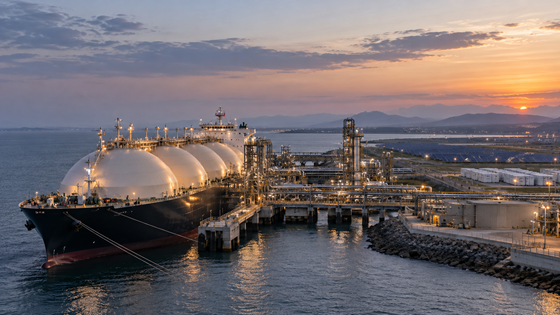

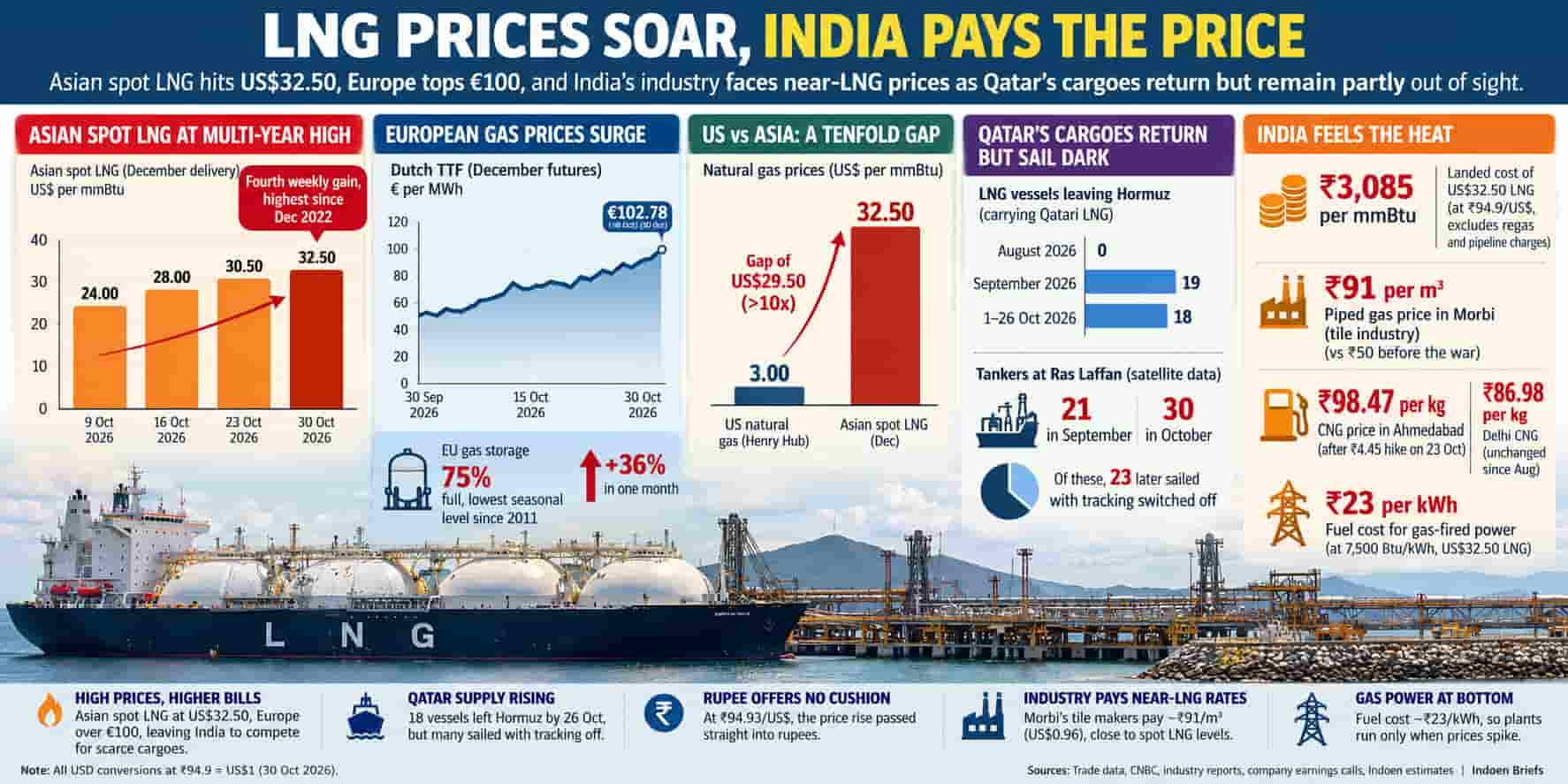
Asian spot LNG for December delivery averaged US$32.50 per mmBtu in the week to 30 October. A week earlier it was US$30.50. This was the fourth weekly rise and the highest level since mid-December 2022, as per recent trade data. Houthi attacks on Saudi energy and transport sites raised supply fears. Spot tenders from Vietnam and India added demand. Colder forecasts for Asia and Europe did the rest.
Two things held prices back. Demand in north-east Asia stayed subdued, and Qatari loadings are recovering. One Asian market source warned that gas above US$30 pushes buyers in China and South Asia to cut imports or switch fuels. India was among the spot buyers this week. Freight adds to the bill. Pacific LNG shipping rates rose to US$44,500 a day, and Atlantic rates to US$28,000.
US gas trades near US$3 per mmBtu. The gap to Asian spot is about US$29.50, more than tenfold. That spread explains why every spare US cargo is chased, and why Indian importers must pay up.
An analyst tracking global LNG markets said: “At these prices, someone has to cut demand. Europe’s storage gap decides whether it is Europe, or buyers in South Asia.”
Europe’s record-low buffer
Dutch TTF December futures rose 4.9% to €102.78 per MWh on 30 October. They had crossed €100 two days earlier. EU storage is about 75% full, the lowest seasonal level since records began in 2011, as per a media report. Prices are up about 36% in a month.
For India, this means Atlantic cargoes will keep heading to Europe. A cold January would pull more away. Indian buyers would then bid against European utilities already paying over €100.
 Qatar’s cargoes sail dark
Qatar’s LNG is returning, but out of sight. An industry analysis estimates that 18 vessels carrying Qatari LNG left Hormuz between 1 and 26 October. September had 19 in the full month. August had none. Identified exports are still about one-fifth of pre-war levels.
But satellite imagery shows 30 tankers berthed at Ras Laffan in the period, against 21 in September. Of these, 23 later sailed with their tracking switched off. Qatari flows to China and India rose sharply in October.
This is the first surprise. Published export counts may understate real supply. If so, part of the US$32.50 price reflects scarcity that is smaller than it looks. Earlier in October, projections had put Qatar’s monthly exports at only 0.6 million tonnes. That figure now looks low.
The relief has limits. Force majeure continues through December for Italy’s Edison and some Pakistani buyers. For India, more Qatari cargoes would mean more oil-linked volumes, the cheapest it can buy.
Landed cost: The full dollar move reaches India
The rupee closed at ₹94.93 on 30 October, the same as a week earlier. It traded between ₹94.89 and ₹95.28 during the week. So the rise from US$30.50 to US$32.50 passed straight into rupees. Spot LNG now equals about ₹3,085 per mmBtu (US$32.50), against ₹2,895 (US$30.50) a week ago. That is a rise of 6.6 %. Regasification and pipeline charges come on top.
Contract prices tell another story. With the Indian crude basket near record highs, oil-linked term LNG on a 12–13% slope works out near US$14 per mmBtu, on Indoen’s estimate. Spot is about 2.3 times that. Last week’s Indoen analysis showed why Qatar’s contracts matter.
Gas-fired power is hit hard. At US$32.50, fuel alone for a plant with a heat rate near 7,500 Btu per kWh costs about ₹23 per kWh (US$0.24), on Indoen’s estimate. Such plants sit at the bottom of the merit order. They run only when evening prices spike, as Indoen reported from Tamil Nadu.
Industry pays near-LNG prices
Morbi shows what spot gas does to a consumer. Gujarat’s tile cluster now pays about ₹91 per cubic metre (US$0.96) for piped gas. Before the war it paid about ₹50 (US$0.53), as per management comments on Kajaria Ceramics’ 26 October earnings call. On an energy basis, that is about ₹2,550 per mmBtu (US$27), on Indoen’s estimate. It is close to spot LNG and nearly four times the US$7 cap on domestic gas.
Propane’s discount to piped gas has narrowed to about 5% after two propane price increases. Tile makers have passed costs on. About 11 points of Kajaria’s 24% quarterly revenue growth came from price. Management expects gas to ease in FY28.
City gas customers are partly shielded, because APM gas still supplies distributors at US$7. That shield is thinning. Adani Total Gas raised CNG by ₹4.45 per kg (US$0.05) to ₹98.47 (US$1.04) in Ahmedabad on 23 October. It was the company’s seventh hike this year. Delhi CNG has stayed at ₹86.98 (US$0.92) since late August. The ₹11.49 gap (US$0.12) shows how unevenly costs have been passed on.
Adani Total Gas’s quarterly profit still rose 6% to ₹173 crore (US$18 million).
An executive at a leading Indian gas utility said: “Price revisions only partly offset the input cost. We pass on what we must and absorb what we can.”
The November domestic gas price is due on the last day of the month. October’s formula gave US$11.22, but ONGC and Oil India realise only US$7. With the Indian crude basket at its highest monthly level since 2012, the formula price will probably rise again. The cap shields distributors and fertiliser plants. It also leaves producers carrying the difference.
Policy: PNGRB clears a path for GAIL Gas
The Petroleum and Natural Gas Regulatory Board has approved the transfer of six city gas areas from GAIL (India) to its subsidiary GAIL Gas, as per a media report. They include areas around Patna, Ranchi and Varanasi. The move clears the way for a planned ₹3,000 crore (US$315 million) IPO.
The consequence is a separate listed vehicle to raise capital for network growth. The timing is awkward. Investors will study margins when distributors face rising input costs and political pressure on CNG prices.
The energy-security question
India wants gas at 15% of its primary energy mix by 2030. The share was 7.2% in FY2025. About half of demand is met by imports, and the marginal cargo is bought at spot. This week, that meant paying about 2.3 times the term price while Europe bid above €100.
Not everything points up. Qatari loadings are recovering, and high prices are already cutting demand in Asia. A mild winter would ease both Europe and Asia. Watch Qatar’s next force majeure notices, Houthi attacks on Gulf infrastructure and the November APM notification.