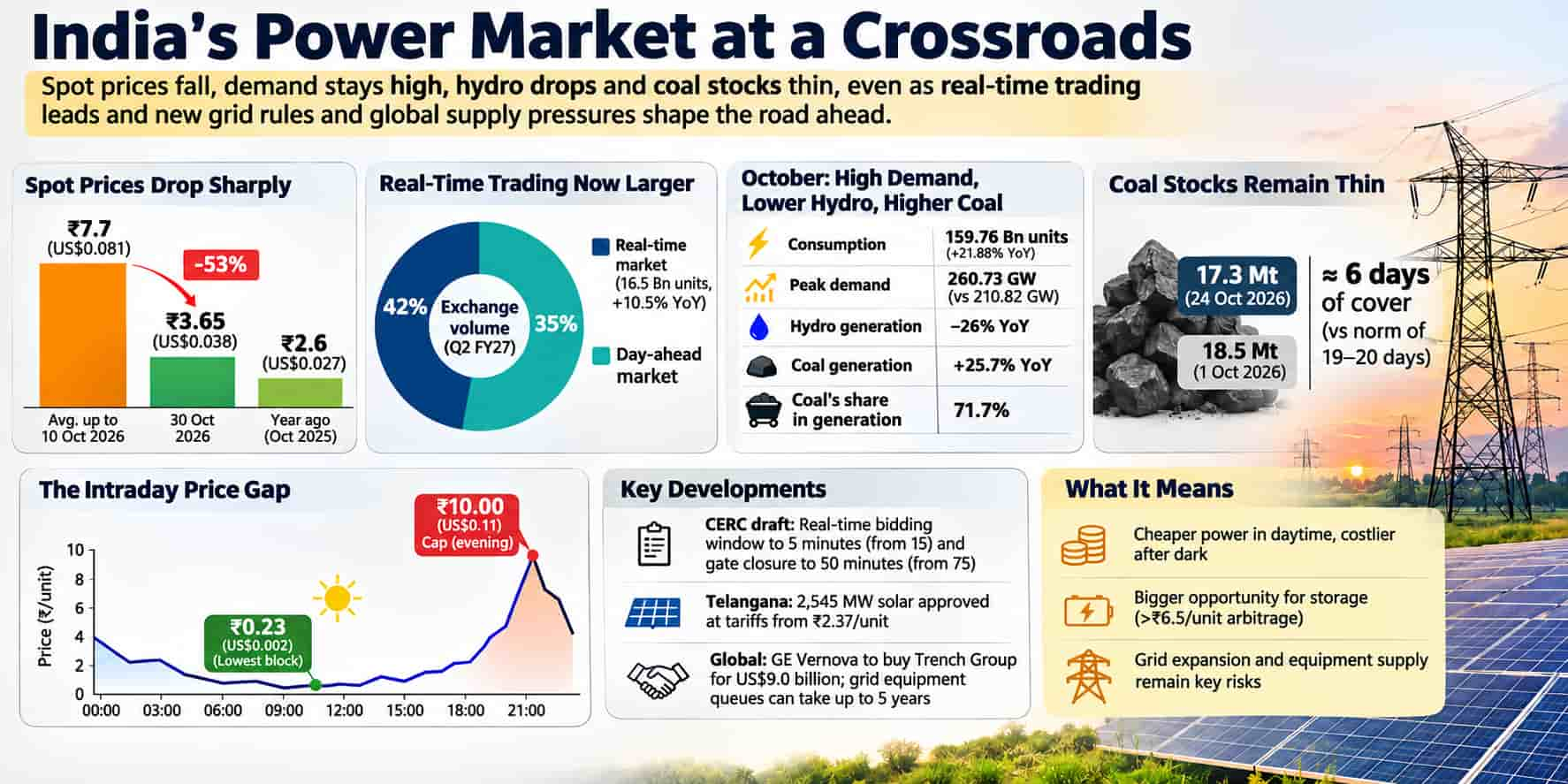
Day-ahead prices averaged ₹7.7 (US$0.081) a unit up to 10 October, against ₹2.6 (US$0.027) a year earlier, rating agency data shows. By 30 October the day’s average clearing price had slipped to ₹3.65 (US$0.038). Sell bids averaged about 21.9 GW against buy bids of 13.7 GW.
Rain and cyclones cut demand in central India, and the exchange says real-time prices touched near zero in several blocks during the quarter. All-India peak demand has eased to about 234 GW from 260 GW on 5 October.
The average hides the real story. On the same day, prices ranged from ₹0.23 (US$0.002) in the cheapest block to the ₹10 (US$0.11) cap in the evening, a gap of about 44 times. Power is cheap while the sun shines and scarce after dark.
October closes hot, with hydro down and coal up
India’s consumption reached 159.76 billion units in October, up 21.88% from 131.07 billion units a year earlier. Peak demand was 260.73 GW against 210.82 GW. Hydro generation fell 26% on weak rains linked to El Niño. Coal-fired generation rose 25.7%, lifting coal’s share to 71.7%, as per recent trade data.
October nearly matched September’s 162 billion units, in a month that is usually a transition period. Cooler weather did not bring a pause in consumption.
Coal stock at domestic-coal plants stood at 17.3 million tonnes on 24 October, down from 18.5 million tonnes at the start of the month. That is about six days of cover against a norm of 19–20 days. Stocks fell even as peak demand dropped by about 26 GW. As Indoen reported, Coal India’s October output jumped 19%, yet plant stocks barely moved off six days.
“The exchange tells you what happened to demand this fortnight. The coal yard tells you what could happen to supply in December. They run on different clocks,” said an analyst tracking India’s power markets.
 Real-time trading overtakes the day-ahead market
Real-time trades made up 42% of the exchange’s volume in the September quarter, ahead of the day-ahead market at 35%, for the second quarter running. Real-time volume was about 16.5 billion units, up 10.5%, with a record 315 million units on one day in September. Management says buyers are moving to real time because prices are lower and renewable sellers bring surplus power there.
That shift matters for rule-making. The Central Electricity Regulatory Commission’s draft grid code proposes cutting the real-time bidding window from 15 minutes to five and gate closure from 75 to 50 minutes. Comments closed last week. Market coupling, which targets the day-ahead market, has seen no final regulation since the April draft and June hearings. The exchange expects at least 1.5 to 2 years of preparation after notification.
There is a counter-view. Regulators argue a single price improves efficiency and competition. The exchange, which says it holds about 99% of both segments, argues coupling is hard in real time.
“Real-time markets are where variable renewables find a price. Rules written only for the day-ahead market will govern a shrinking part of trade,” said a senior official at a central power sector agency.
States buy cheap solar, and the evening gap deepens
Telangana’s regulator approved procurement of 2,545 MW of solar for its discoms at tariffs starting at ₹2.37 (US$0.025) a unit, with 1,745 MW already commissioned. It told discoms to ensure developer delays do not raise consumer costs, according to a media report. Such contracts deliver power in the hours when exchange prices are lowest. Each one widens the daytime glut and the evening premium.
Global: Grid equipment gets slower and pricier
GE Vernova said on 28 October it will buy Trench Group, a maker of high-voltage bushings and HVDC components, for US$9.0 billion. It reported a record US$197 billion backlog. A US federal study cited in trade press found extra-high-voltage transformer procurement can take up to five years.
For India, the consequence is delay and cost. Its 765 kV and HVDC corridors draw on the same global suppliers, so queues abroad can lengthen delivery here. Indoen has tracked Hitachi Energy’s US$335 million transformer supply-chain bet as part of the same squeeze.
The transition test
The week points to a grid that is flush at noon and stretched at night. Price gaps of this size reward storage. The exchange says solar-hour prices averaged ₹2.3 (US$0.024) in the first half of the year, leaving arbitrage of over ₹6.5 (US$0.068) a unit. As Indoen noted last week, Gujarat’s October peak showed how fast the evening can tighten.
The emergency order on captive coal plants runs to 31 December. November’s weather will show whether cheap spot power is a trend or a pause.