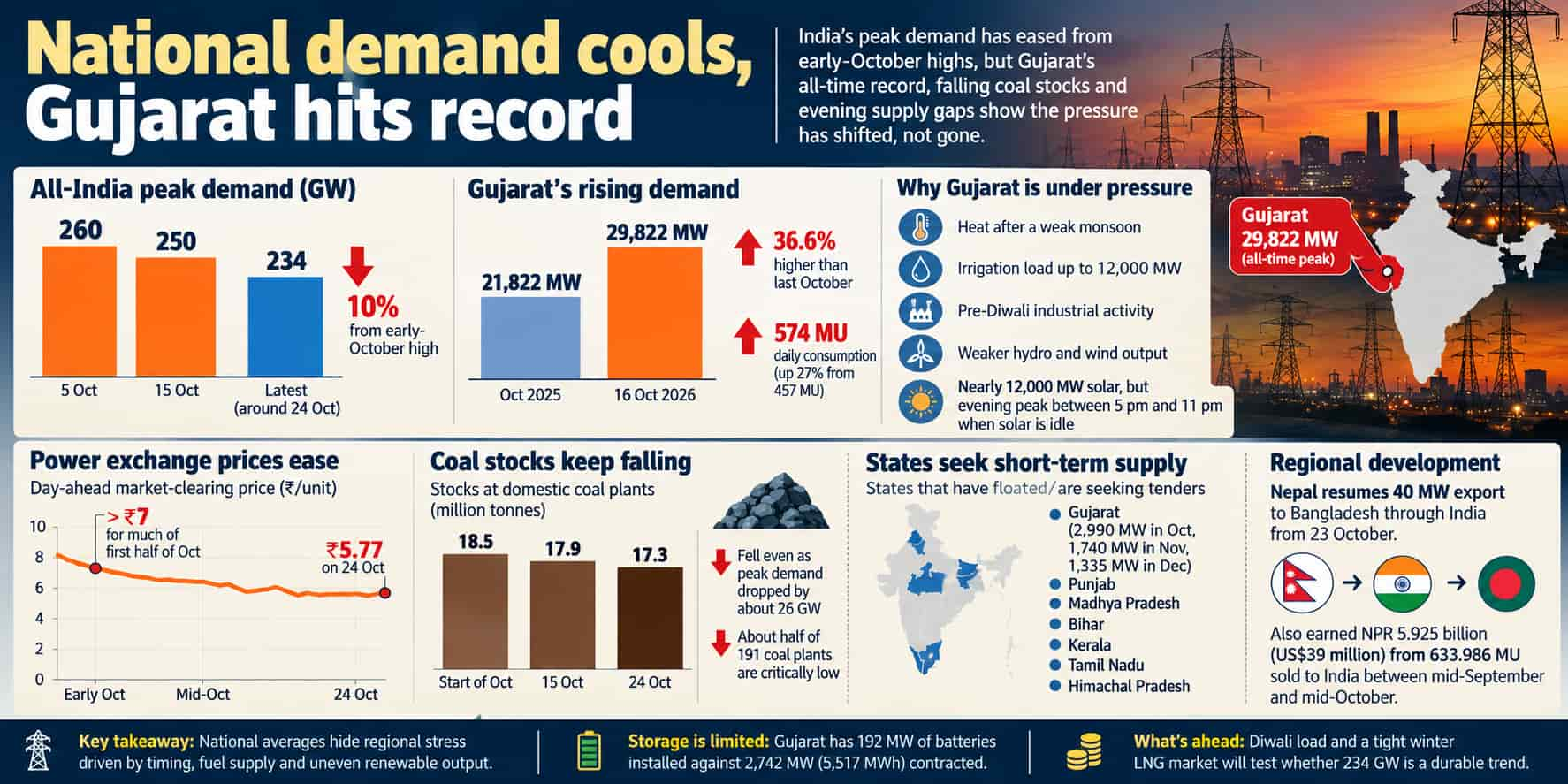
All-India peak demand has fallen to about 234 GW. That is down from roughly 260 GW on 5 October and about 250 GW on 15 October, as cooler weather and rain reduced cooling and irrigation load, according to a media report. The same report notes that Gujarat and Tamil Nadu remain high, with Gujarat at 28.3 GW on 24 October, close to June levels.
The average hides the west. Gujarat recorded an all-time peak of 29,822 MW on 16 October, 36.6 % above the 21,822 MW of last October. Daily consumption touched 574 million units, up 27 % from 457 million units, as per recent reporting. Officials cited heat after a weak monsoon, irrigation load of up to 12,000 MW, pre-Diwali industrial activity and weaker hydro and wind output.
The pattern is odd. Gujarat, with nearly 12,000 MW of solar, set its record in October and not June. Its sharpest pressure falls between 5 pm and 11 pm, when that fleet is idle.
Prices cool, but coal keeps the floor high
Exchange prices have softened with demand, though not returned to normal. Day-ahead prices stayed above ₹7 (US$0.074) a unit for much of the first half of October. The market-clearing price came down to about ₹5.77 (US$0.061) on 24 October, industry data shows.
Coal explains why the floor is high. Stocks at domestic-coal plants fell to 17.3 million tonnes on 24 October, from 17.9 million tonnes on 15 October and 18.5 million tonnes at the start of the month. Stocks fell even as peak demand dropped by about 26 GW. Indoen has tracked how record dispatch has failed to fill the gap.
About half of India's 191 coal plants are critically low, %ral Electricity Authority data. The supply gap reached 560 million units last month, the highest since August 2023, and daily peaks have run 45 GW to 50 GW above last year, a media report said.
 States queue for supply
Several states are seeking short-term coal-based power through tenders, among them Gujarat, Punjab, Madhya Pradesh, Bihar, Kerala, Tamil Nadu and Himachal Pradesh. Gujarat has lined up market purchases of 2,990 MW for October, 1,740 MW for November and 1,335 MW for December. It has also secured about 1,380 MW from central sources.
Storage is arriving late. Gujarat has 192 MW of batteries installed against 2,742 MW (5,517 MWh) contracted. Until the rest is built, purchases and appeals must bridge the evening. Uttar Gujarat Vij has sent messages asking industries and households to conserve between 5 pm and 11 pm.
"The state is not short of energy across the day. It is short of dispatchable megawatts between five and eleven in the evening, and those cannot be bought cheaply at short notice," said an executive at a leading Indian discom.
There is a counter-view. Gujarat's long-term plans include an 800 MW thermal unit and a 4,200 MW nuclear project, so this may be a one-season mismatch rather than a structural flaw. As Indoen reported last week, Tamil Nadu's purchases at up to ₹37 a unit showed what late buying costs.
Regulators write rules for flexibility
Gujarat's regulator notified a new Grid Code earlier this month. It requires thermal plants to run at minimum turndown of up to 55 % of rated capacity, with compensation for part-load operation, and moves scheduling to 15-minute blocks, as per recent trade data. Lower minimum loads let coal units make room for midday solar without shutting down, so they can ramp up again in the evening.
The commission has also drafted service standards. New connections would be energised within three days where the network exists, with ₹50 (US$0.53) a day compensation for delays, according to a media report. Faster connections add load and discom obligations just when supply is thin.
On the judicial side, the Appellate Tribunal for Electricity dismissed NTPC Renewable Energy's appeal over higher grid connectivity charges on a 1,070 MW Rajasthan solar project. Developers, it signalled, carry that cost risk unless they claim relief in time.
Regional: Nepal's power finds a way through India
Nepal resumed exporting 40 MW to Bangladesh through India's grid on 23 October. India's Central Electricity Authority approved the Solu Khola and Kabeli B-1 plants to replace flood-damaged units, according to a media report. Nepal also earned NPR 5.925 billion (US$39 million) from 633.986 million units sold to India between mid-September and mid-October, partly through the IEX day-ahead and real-time markets.
For India, this is useful but small. Those 634 million units are under 0.4 % of September's national consumption of 162 billion units. Regional trade helps at the margin and cannot close an evening gap. It does confirm India's role as the transit grid and marketplace for the sub-region.
The transition test
The week points to a shift in where India's grid is tested. Solar has solved much of the daytime problem. The binding constraint is now timing, with firm power needed after sunset and at the right price.
"Storage, flexible coal and time-based tariffs are three parts of one answer. None is enough alone, and all three are behind the demand curve," said a senior official at a central power sector agency.
With Diwali load and a tight winter LNG market ahead, November will show whether 234 GW is a trend or a pause.