

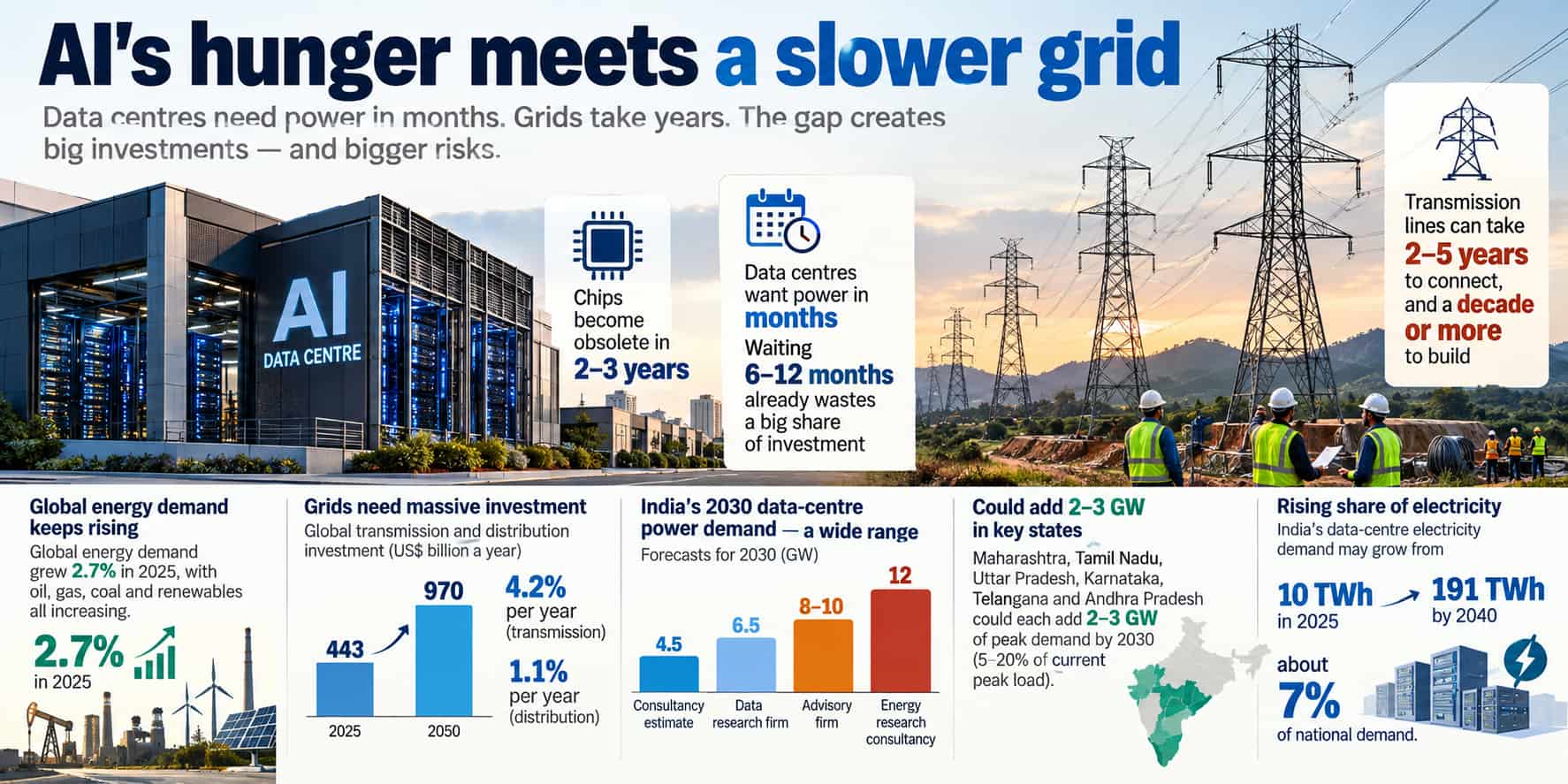
The world is not replacing fossil fuels so much as adding to them. Global energy demand rose 2.7% in 2025, and oil, gas, coal and renewables all grew together, according to a recent global energy outlook.
Grids are the pinch point. The same outlook expects global investment in power transmission and distribution to rise from US$443 billion in 2025 to US$970 billion a year by 2050. Transmission is set to grow at 4.2% a year, against 1.1% for local distribution.
Now place that beside the customer. In a recent podcast from a leading US business school, a climate policy head explained that the chips inside data centres become obsolete within two to three years. So waiting six to twelve months for power wastes a big share of the investment. That is why buyers chase “speed to power”.
Wires move at a different pace. Connection waits run two to five years in many US regions. Some long-distance transmission lines proposed more than a decade ago are still unbuilt, the discussion noted. A load can arrive, age and be replaced before the line meant to serve it is finished.
A queue that flatters the forecast
Long waits change behaviour. The same guest said developers join the queue “just in case,” which makes it longer still. A long queue therefore does not prove a large load. It may only show how afraid everyone is of missing out.
India’s forecasts show the same fog. An earlier consultancy estimate put 2030 data-centre demand at 4.5 GW, up from 1.2 GW in 2024, as per recent reporting. A data research firm sees 6.5 GW, from 1.5 GW in 2025, according to another media report. An advisory firm expects 8–10 GW. An energy research consultancy goes to 12 GW, from 2.2 GW in 2025, industry reports suggest.
The highest figure is more than two and a half times the lowest. Part of the gap comes from different starting points. Even so, a spread this wide is a real problem for anyone who must lay lines years in advance.
The doubt grows after 2030. The global outlook’s baseline has data-centre electricity demand rising 24% a year to 2030, then slowing to 5% a year. It also warns that the returns from AI are hard to judge and that efficiency gains could change future power needs.
 Where India will feel it first
The pressure will not spread evenly. An advisory firm’s report says Maharashtra, Tamil Nadu, Uttar Pradesh, Karnataka, Telangana and Andhra Pradesh could each add 2–3 GW of peak demand by 2030. That equals 5–20% of their present peak load, as per recent reporting.
The energy research consultancy adds that reliable, affordable power has now overtaken land and capital as the main constraint. It sees data-centre demand growing from 10 TWh in 2025 to 191 TWh by 2040, about 7% of national demand.
Money is ready. Indoen has reported that EQT plans to invest about US$50 billion in India by 2030, with US$30 billion aimed at data centres.
“Developers can build solar and storage in months,” said an executive at one of India’s leading renewable energy developers. “What we cannot control is when the grid connection arrives. Data-centre customers will pay for clean power, but they will not wait for it.”
Who carries the risk
Most Indian transmission and distribution is regulated. A ratings agency notes that state-run utilities such as NTPC and Power Grid can take on higher capital spending because of regulated tariffs and government backing, according to a media report. That helps funding. But if the load disappoints, the cost does not vanish. It moves to consumers through tariffs.
The US discussion carries the same worry. If households pay for AI’s power needs, the political reaction could be sharp. Yet this is not inevitable. More generation spread over a growing base can lower per-unit rates, the guest argued. One large technology company has also offered to bear the cost of new power through special tariffs.
“A chip bought today may be obsolete in three years, but the line built for it stays in the rate base for decades,” said a researcher at a New Delhi-based energy think tank. “The risk sits in that mismatch, and someone has to be named to carry it.”
The design question is simple. Should those who ask for power commit to paying for it before the wire is built? That choice, more than any forecast, will decide who pays if the load falls short.
Two things are worth watching. One is commissioned data-centre capacity by state, not announcements. The other is whether regulators ask large new loads for long-term commitments. Indoen has already described how India’s grid is becoming a queue. The next test is whether that queue is built on real demand.
Follow us on : X | LinkedIn | Facebook | Bluesky