
For most of its history, Indian wind power has been treated as a delicate guest at the grid’s table. Because turbines cannot be told to spin faster when the breeze dies down, regulators long excused wind and solar generators from the strict financial penalties that coal and gas plants face when their actual output strays from what they had scheduled to supply.
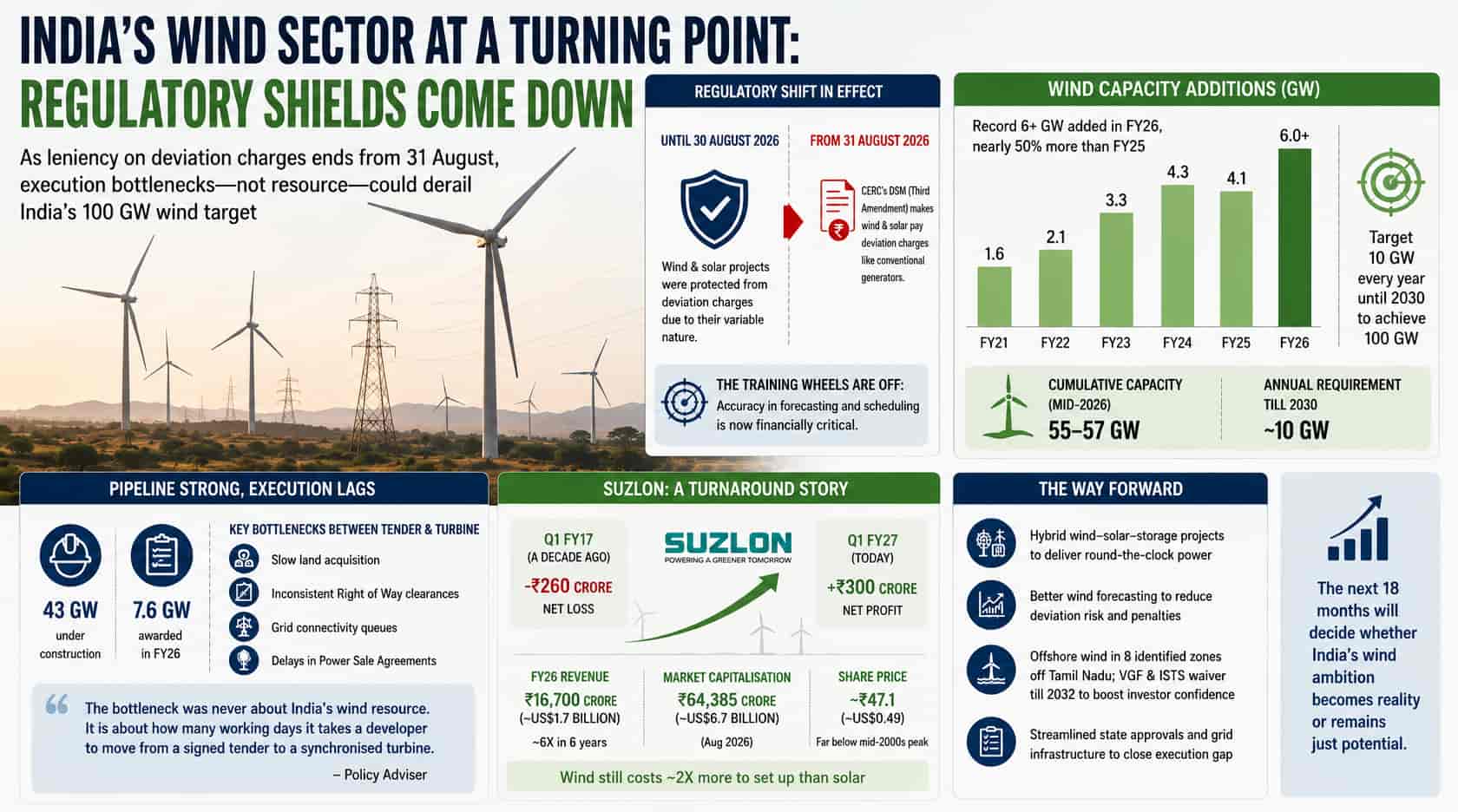
That excuse has just run out. The Central Electricity Regulatory Commission’s (CERC’s) Third Amendment to the Deviation Settlement Mechanism (DSM) Regulations takes effect on 31 August 2026, folding wind and solar into the same deviation-charge framework as ordinary sellers, according to a regulatory update. In plain terms, a wind farm that under-delivers or over-delivers against its forecast will now pay roughly what a coal plant would.
It is easy to miss why this matters. India’s grid operators have spent fifteen years coaxing renewables onto the system by going easy on their unpredictability. Removing that leniency is regulatory code for “the training wheels are off.” It tells developers that wind and solar are no longer treated as an experiment; they are now expected to behave like any other seller with money on the line for getting their forecasts wrong.
A sprint just when the legs are tired
The timing could hardly be tougher. India commissioned just over 6 gigawatts (GW) of new wind capacity in FY2025-26, its highest annual figure ever and nearly 50% more than the year before, taking cumulative wind capacity to about 55-57 GW by mid-2026, per industry estimates. Yet a report by the Indian Wind Turbine Manufacturers Association (IWTMA) finds that even this record pace falls short of the roughly 10 GW a year the country must add for the rest of the decade to reach its 100 GW wind target by 2030, as flagged in a recent industry report.
The pipeline itself is not the constraint. Some 43 GW of wind capacity is already under construction, with a further 7.6 GW awarded during FY2025-26 alone, according to the same assessment. What is holding India back is everything that happens between winning a tender and switching on a turbine: slow land acquisition, inconsistent Right of Way clearances, patchy grid-connectivity queues and delays in signing power sale agreements.
The report studied eight major wind states and found wide variation in how quickly each one moves a project from paper to power, with Gujarat leading on long-term planning and Maharashtra scoring best on execution and clearances.
“The bottleneck was never about India’s wind resource. It is about how many working days it takes a developer to move from a signed tender to a synchronised turbine,” said a policy adviser familiar with the sector’s regulatory landscape. “Every state that fixes its approval timelines effectively adds capacity without adding a single new site.”
 Suzlon as the sector’s mirror
If one company’s fortunes track India’s wind story most closely, it is Suzlon Energy. A decade ago, in the first quarter of FY17, the company posted a net loss of roughly ₹260 crore (US$27 million). In the same quarter of FY27, it reported a net profit of over ₹300 crore (US$31 million), according to a recent account of the company’s turnaround.
Full-year revenue for FY26 came in near ₹16,700 crore (US$1.7 billion), roughly six times what it was six years earlier, and the company’s market capitalisation stood above ₹64,385 crore (US$6.7 billion) in mid-August, even though its share price, at around ₹47.1 (roughly $0.49), remains a fraction of its mid-2000s peak.
This is, in effect, wind playing catch-up to solar’s cheaper economics through sheer financial discipline. “For the same power capacity, wind costs approximately twice as much as solar to set up,” a renewable energy research lead at a Gurugram-based research firm observed, a gap that helps explain why the sector spent years in the shadows of India’s solar boom even as its underlying resource base remained enormous.
That resource base is, in fact, the sector’s best-kept secret. According to the National Institute of Wind Energy, India’s estimated wind potential at 150-metre hub height is a staggering 1,163.86 GW, of which barely 5% has been tapped so far, per a recent sector overview. Three states, Gujarat, Tamil Nadu and Karnataka, account for the bulk of what has been built. The gap between potential and deployment is wider in wind than in almost any other Indian energy source, land and transmission constraints notwithstanding.
Hybrids, forecasting and a new industrial logic
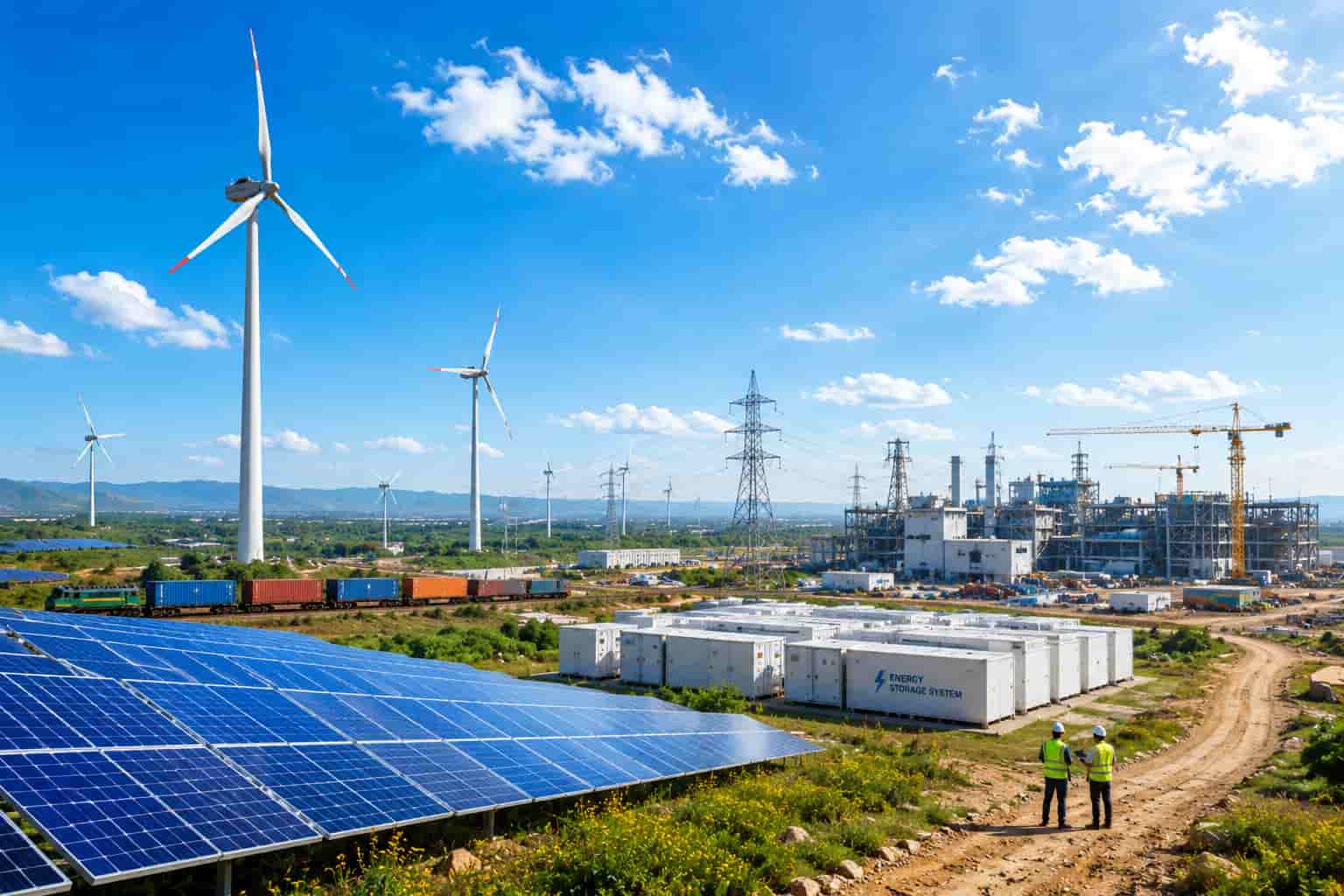
The CERC’s regulatory shift and the IWTMA’s execution warnings point towards the same practical answer: pairing wind with solar and batteries into single, more predictable “round-the-clock” plants. With deviation penalties now real, developers have a financial reason, not just a technical one, to invest in better wind-resource forecasting and co-located storage that smooths out a turbine’s naturally lumpy output.
Suzlon’s own leadership has been framing this shift for months. At a recent industry gathering, the company’s chief executive argued that combining solar and wind gives India a genuine opportunity to become a global green-energy powerhouse, as reported around the same forum. That framing is no longer just marketing language. It describes the only realistic way most Indian wind projects will survive the DSM amendment intact: by no longer standing alone.
“We are already redesigning our order book around hybrid and firm, dispatchable configurations rather than pure wind capacity,” said an executive at one of India’s leading wind turbine manufacturers. “Under the new deviation rules, a stand-alone wind asset without storage or a solar partner is simply carrying more financial risk than most balance sheets are built for.”
Offshore wind adds a further, longer-horizon layer to this story. India has identified eight potential offshore zones off the Tamil Nadu coast, backed by a viability-gap-funding scheme and a waiver on inter-state transmission charges for projects commissioned before the end of 2032, according to the same overview.
It remains a 2030s story rather than a 2020s one, but it signals that policymakers are trying to front-load investor confidence in offshore wind even as they tighten discipline onshore.
The bigger picture
None of this unfolds in isolation. India’s broader renewable build-out, tracked closely on this platform, has already run up against similar constraints of grid readiness and financing structure elsewhere in the system, a pattern this publication explored in the context of wind’s rising geopolitical weight earlier this year. What is distinct about this moment is the sequencing: a regulator withdrawing support at precisely the point an industry body is warning that support is still needed to hit a national target.
There is a case for reading the CERC’s move as a vote of confidence rather than a setback. Regulators do not usually strip protections from sectors they consider fragile; they do it when a technology has matured enough to be trusted with market discipline.
Wind’s cumulative capacity has nearly doubled in under a decade, and its complementary generation pattern, filling in when solar goes dark at night or during the monsoon, has become too important to the grid to be treated as a niche technology any longer.
But confidence and readiness are not quite the same thing. The next eighteen months will show whether India’s wind developers can absorb tighter financial discipline while simultaneously clearing the land, transmission and paperwork hurdles that the IWTMA has flagged. If they can, the sector graduates from subsidised adolescence into a genuinely mature pillar of the energy transition. If they cannot, the gap between India’s wind ambition and its wind reality, currently running at about 4 GW a year short of target, could widen rather than close.
Follow us on : X | LinkedIn | Facebook | Bluesky