


Does artificial intelligence help the fight against climate change, or does it quietly work against it? Most people would answer that AI helps, and not without reason. It sharpens solar forecasting, improves wind-pattern prediction, and makes power grids more efficient.
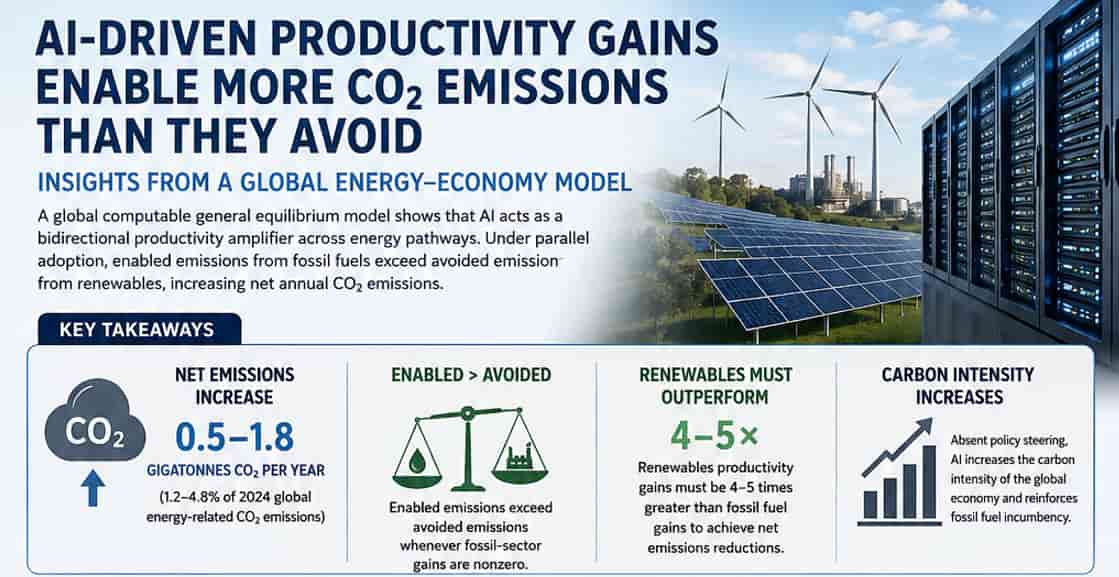
A new peer-reviewed study, however, has examined the fuller picture rather than the flattering half of it. Its conclusion is stated without much hedging. Net global carbon dioxide emissions rise by 0.5 to 1.8 gigatonnes annually as AI is adopted, equivalent to 1.2% to 4.8% of all energy-related CO₂ emitted worldwide in 2024.
Not a question of datacentre bills
Most conversations on AI and climate get stuck on the wrong question. The usual worry is that AI needs electricity, and if that electricity comes from coal or gas, AI itself becomes a modest climate villain. This concern is legitimate, but it is not what this study is chiefly about.
Its authors set that concern aside and examined something that receives far less attention: what AI does once it leaves the datacentre and is put to work inside the oil and gas industry. AI, in this framing, is a tool made available to two very different users at once, an oil company seeking cheaper crude and a solar developer seeking better forecasts. It assists both equally.
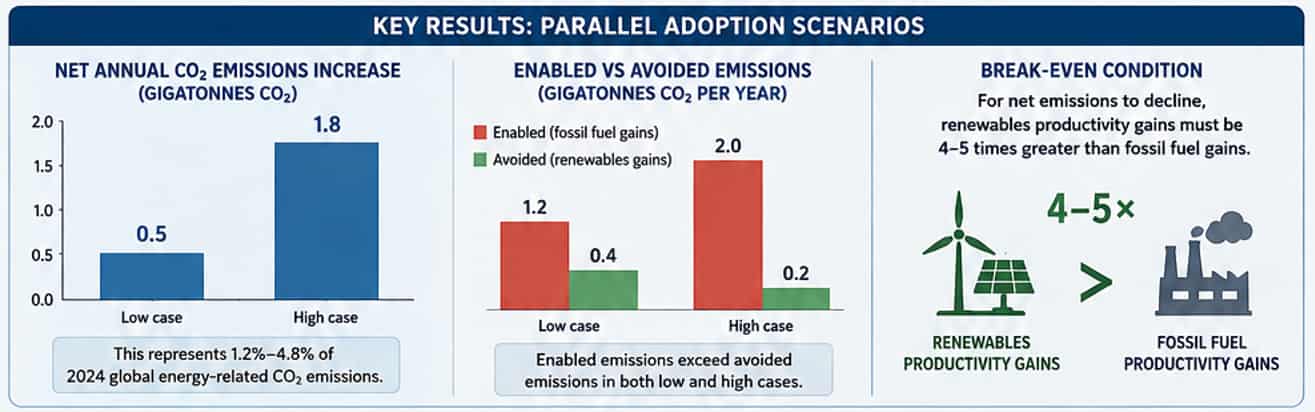
The comparison that follows is the study's most striking finding. Emissions enabled by AI's effect on fossil fuel productivity run to 0.6 to 2.4 gigatonnes of CO₂ annually, against the International Energy Agency's (IEA’s) own estimate of just 0.18 gigatonnes for global datacentre emissions in 2025. The indirect effect, in other words, is three to thirteen times larger than the one everybody worries about.
 Why fossil fuels prevail regardless
The study modelled what it calls parallel adoption, where AI improves fossil fuel and renewable productivity at broadly the same pace. Even here, fossil fuels come out ahead on emissions every time.
The reason lies upstream. It is exploration and extraction, not power generation, that drives the imbalance. AI-assisted analysis of producing oilfields, the study finds, could unlock between 470 billion and over a trillion additional barrels otherwise considered unrecoverable, enough to meaningfully delay projections of peak oil.
This is not hypothetical. Absent continuous reinvestment, global oil and gas output would naturally fall by roughly 8% a year as wells deplete. As the study notes, quoting the IEA, the industry must "run much faster just to stand still." AI, the authors argue, is precisely the sort of tool that helps producers keep pace with that decline.
 The breakeven ratio
For AI's net effect to turn negative, renewable productivity would need to improve four to five times faster than fossil fuel productivity. Tested across 64 scenario combinations, this ratio held in every case. Net emissions fell only when fossil fuel gains were held at zero.
Grid efficiency and other fuel-neutral improvements barely moved the needle, trimming just 0.1 gigatonnes annually in the best case. Carbon pricing helped more, though not enough. At US$308 a tonne, well above any price currently in force anywhere, enabled emissions still exceeded avoided emissions by one and a half times.
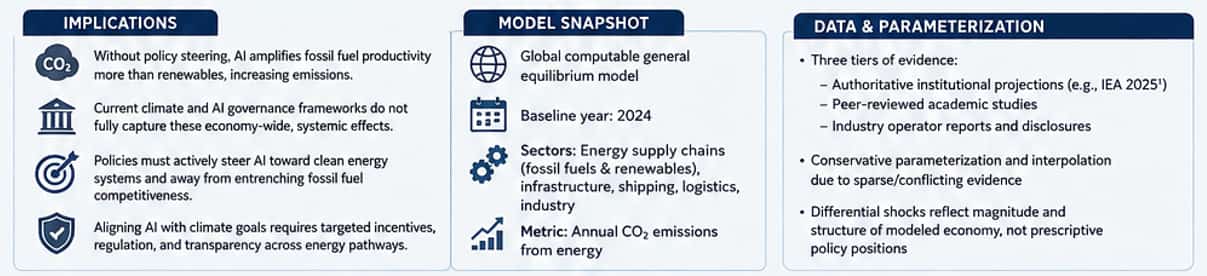
The explanation is simple. Roughly 80% of the world's primary energy remains fossil-based. An equal AI-driven boost to both sides, therefore, cannot be a neutral outcome, since one side starts out four times larger. As the authors put it plainly, AI "does not inherently decarbonize or intensify emissions." It reinforces whatever structure already surrounds it, and that structure still runs on fossil fuels.
 An honest caveat
The study does not present its figures as beyond question. Varying two key assumptions shifts the enabled-to-avoided ratio from roughly two to three times up to about seven times, a genuinely wide range. The authors also concede their static model cannot capture longer-term dynamics such as infrastructure lock-in.
Notably, two of their own choices likely understate the imbalance rather than overstate it: renewable gains were assumed at the optimistic end of documented potential, while fossil gains were calibrated more conservatively, using data closer to what has already been realised in the field. What does not change across any of this, the authors stress, is the direction of the result, even if its exact scale remains open to debate.
What the study recommends
The paper closes with five priorities, distilled here to a single thread. Efficiency is not the same thing as decarbonisation, and treating it as such is a persistent policy error. Enabled emissions need their own tracked category rather than sitting outside climate assessments altogether.
Renewable-focused AI pushes will not work unless paired with genuine limits on fossil-side gains, the authors caution, however aggressively renewables are pursued.
Efficiency improvements inside fossil fuel operations themselves should not be credited as environmental wins in isolation either, since they can enable greater overall throughput even while looking, on paper, like progress. And carbon pricing, however useful, is one tool among several, not a solution on its own, particularly at prices far below what this study shows would actually be required to close the gap.
The larger takeaway
AI is neither a climate saviour nor a villain by nature. What this study establishes is that it amplifies whatever economic structure it is placed within, and today that structure remains overwhelmingly fossil-fuel-based.
Left to market forces alone, AI's productivity gains will keep reinforcing that structure rather than displacing it, until governance catches up with what the modelling already shows.
The paper's own framing is worth holding onto here. AI has not chosen sides between oil and solar; it simply makes both more capable. Which side benefits more, in aggregate, was always going to depend on which side was larger to begin with, and for now, that answer remains fossil fuels.
Follow us on : X | LinkedIn | Facebook | Bluesky