
For a country that spends heavily on diesel subsidies, LPG cylinders and coal, that is a striking claim. It says the barrier to a large share of India’s energy transition is not cost. It is delivery.
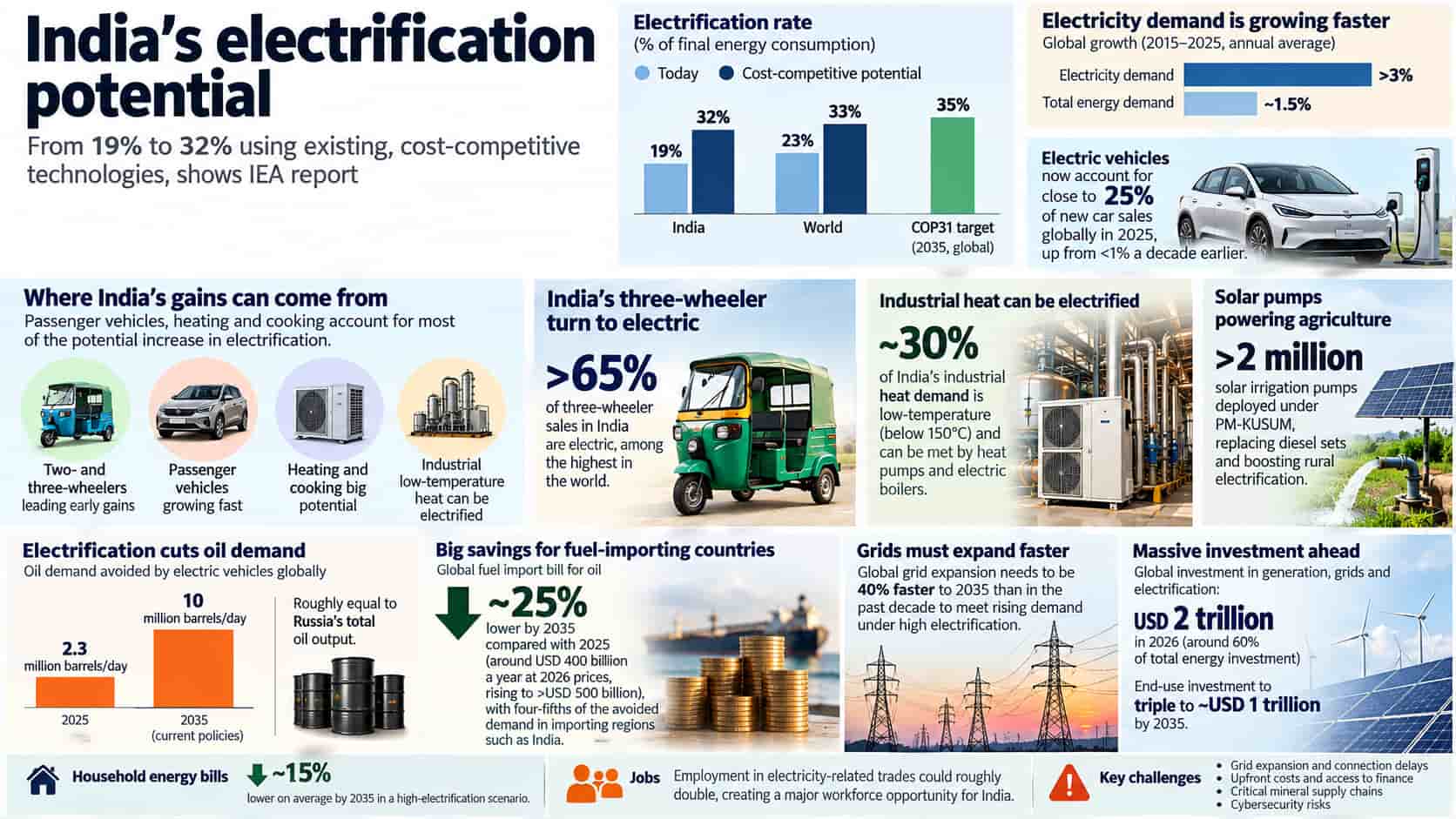
Global electricity demand grew by more than 3% a year between 2015 and 2025, nearly twice as fast as overall energy demand. Cooling, appliances, data centres and, increasingly, transport are driving that growth. Electric vehicles accounted for close to a quarter of new car sales worldwide in 2025, up from under 1% a decade earlier.
Electricity is still a minority fuel by volume, meeting just 23% of the world’s final energy consumption. But because electric technologies waste far less energy than combustion, electricity actually delivers close to 40% of the useful energy services people and businesses consume. It also happens to power the most productive parts of the economy: activities running on electricity generate more than 45% of global GDP.
India’s own electrification rate today stands at 19%, below the global average and well behind East Asia. According to the study, that gap closes fast once cost-competitive technology is deployed at scale. Passenger vehicles, heating and cooking account for most of the potential gain, with two- and three-wheelers doing much of the early work.
Three-wheelers point the way
Nowhere is India’s electrification story clearer than on the roads. Electric three-wheelers already account for over 65% of three-wheeler sales in the country, among the highest shares in the world for that segment. Battery costs for these smaller vehicles are lower and the payback period is short, sometimes under five years in similar markets, which is why commercial operators have moved first.
“Electric two- and three-wheelers are now cheaper to own than their combustion equivalents over their normal working life in many developing markets, India included,” the report notes. Passenger cars and heavier freight lag behind, held back by higher upfront costs and, in trucking, by charging infrastructure that has yet to catch up.
Heat that doesn’t need to be burned
Electrification is not only about vehicles. Low-temperature heat, below 150°C, accounts for almost 30% of industrial heat demand in India, and much of it currently comes from burning fuel to make steam or hot water.
The report cites a detailed case study of an Indian textile plant showing that heat pumps and electric boilers could technically meet most of this wet-processing heat demand, cutting emissions sharply when paired with renewable power.
Textile clusters in Gujarat, Rajasthan and Tamil Nadu have already begun installing electric water-heating and heat-recovery systems, encouraged by rising fuel costs and by energy-efficiency programmes run through India’s Bureau of Energy Efficiency.
On the innovation side, steam-generating heat pumps developed by the Indian Institute of Technology Madras and Aspiration Energy have been piloted at DCM Shriram’s sugar plant in Uttar Pradesh and later deployed at WABCO India, evidence that the underlying technology already works at industrial scale.
Agriculture tells a similar story. India’s PM-KUSUM scheme has deployed more than two million solar-powered irrigation pumps, many replacing diesel sets that farmers previously ran at high cost. In South Asia and sub-Saharan Africa, where agriculture makes up 17–19% of GDP against 1–2% in Europe and North America, electrifying irrigation and cold storage can move the needle on national electrification rates in a way it never could in richer, more service-based economies.
 The energy security dividend
Electrification’s appeal to Indian policymakers has as much to do with energy security as with emissions. Electric cars, two- and three-wheelers, trucks and buses already avoid around 2.3 million barrels of oil demand a day worldwide, more than the volume that bypassed the Strait of Hormuz through the UAE’s Habshan-Fujairah pipeline last summer, when regional shipping was disrupted.
By 2035, under current policy settings, that avoided demand could reach 10 million barrels a day, roughly equal to Russia’s entire oil output.
For a country that imports the bulk of its crude, the arithmetic is compelling. Globally, in the IEA’s high-electrification pathway, fuel-importing regions cut their import bills by around a quarter by 2035 compared with 2025, a saving of USD 400 billion a year. Measured against the higher prices prevailing in 2026, that figure rises past USD 500 billion annually, with four-fifths of the avoided oil demand landing in importing regions such as India.
The grid is the real bottleneck
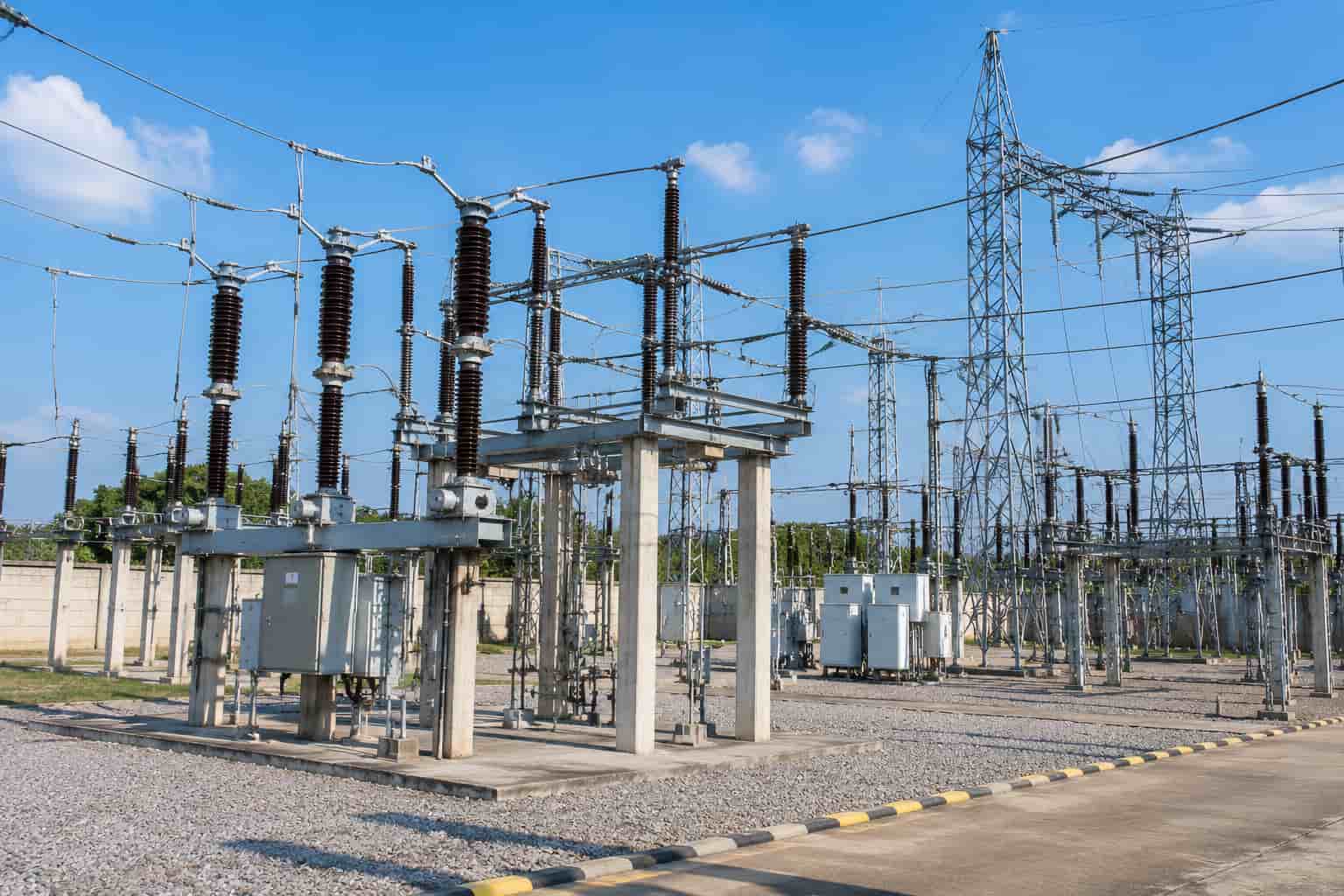
None of this happens without wires, transformers and substations keeping pace, and that is where the report turns cautious. Grids worldwide need to expand 40% faster to 2035 than they did over the past decade just to connect new supply and rising demand under the high-electrification pathway. Delays, the report warns, mean longer connection queues, more curtailment and greater risk to reliability.
That warning will sound familiar to readers who have followed Indoen Energy’s earlier report on India’s own transmission build-out and the connection queues now forming behind it. India’s solved-shortage-but-not-sharing problem is, in miniature, exactly what the IEA is describing at a global scale: generation and demand are growing faster than the infrastructure meant to move electricity between them.
On a full net-zero pathway, the numbers get bigger still.
Global battery storage capacity would need to rise nearly tenfold, to around 2,900 gigawatts by 2035, with annual solar PV additions doubling past 1,200 gigawatts and wind additions rising two-and-a-half times to roughly 400 gigawatts a year. Nuclear power, the report says, needs to make “a strong comeback” alongside them.
Where the money, and the risk, sit
Investment in generation, grids and end-use electrification is set to reach USD 2 trillion in 2026, around 60% of all global energy investment, with revenues of companies supporting electrification growing 15% a year since 2020. End-use investment alone, covering the vehicles, heat pumps and industrial equipment consumers and businesses actually buy, is projected to triple to roughly USD 1 trillion by 2035.
That investment does not fall evenly. Unlike power plants and grids, which are typically built by utilities and large developers, end-use electrification is paid for by millions of individual households and businesses, many with limited access to affordable finance.
The report finds that average household energy bills could fall by around 15% by 2035 in the high-electrification scenario, thanks to the greater efficiency of electric appliances and vehicles. But getting there requires an upfront outlay, on a heat pump or an electric vehicle, that can be a real burden for lower-income households unless it is cushioned by targeted subsidies or financing support.
There is a supply-chain counterweight too. Batteries and other electrification hardware depend on critical minerals that are geographically concentrated, raising the kind of dependency concerns India has spent years trying to reduce for oil and coal.
The report is careful to note that this is a different sort of risk: unlike combustion fuels, a disrupted battery or grid-equipment supply chain does not stop equipment already installed from running. The newer worry is cybersecurity, since digitally connected assets can, in principle, be remotely interfered with.
A cross-cutting problem, not a sector one
Perhaps the report’s most pointed observation for Indian policymakers is that very few countries, India included, currently have comprehensive, cross-sectoral electrification strategies. Most policy support is still sector-specific, aimed at electric-vehicle incentives or rooftop solar subsidies rather than a system-wide plan spanning grids, pricing, finance and skills together.
The skills gap is real too. Electricians, welders and grid line workers are already in short supply in several labour markets, even as the electricity sector has become the largest employer in the global energy industry. A faster electrification push could roughly double employment in these trades, the report suggests, a workforce opportunity India, with its young population, is arguably better placed to capture than most.
The report’s own conclusion is measured rather than triumphant: the technology and the economics are largely in place, but only co-ordinated planning of generation, grids, storage, pricing reform and consumer finance will convert cost-competitive potential into an actual electrification rate. For India, sitting at 19% today with a clearly costed path to 32%, that is less a target than a to-do list.
Follow us on : X | LinkedIn | Facebook | Bluesky