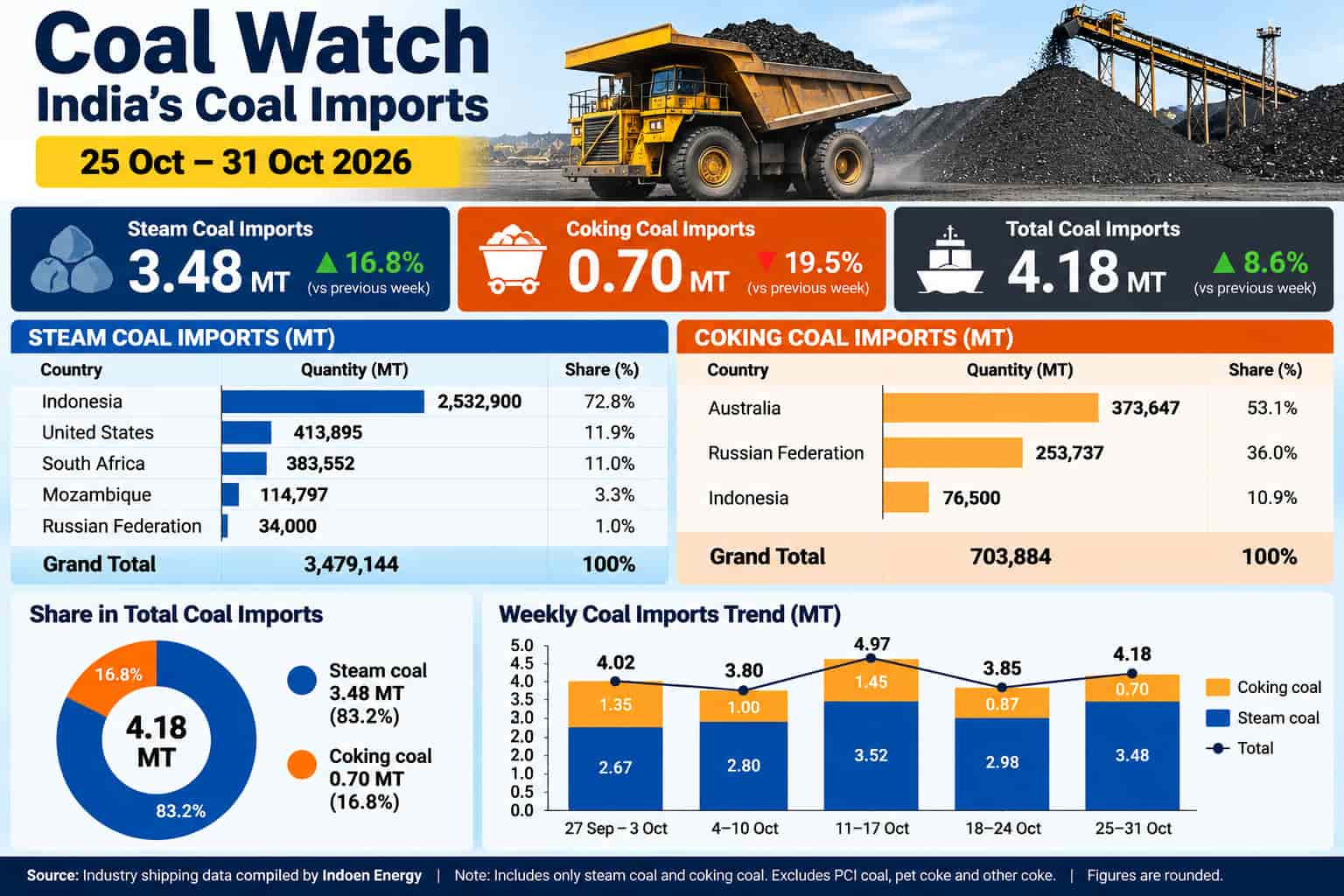
India’s coal imports rose 8.6% week-on-week to 4.18 MT during 25–31 October, driven entirely by a strong recovery in steam coal. Steam coal arrivals climbed 16.8% to 3.48 MT, while coking coal fell 19.5% to 0.70 MT.
The thermal rebound was heavily concentrated in Indonesia, which supplied 2.53 MT, or nearly 73% of weekly steam-coal imports. The United States and South Africa followed with 0.41 MT and 0.38 MT respectively. Coking coal moved in the opposite direction: Australian shipments remained the largest at 0.37 MT, while Russia supplied 0.25 MT.
The weekly numbers come against a much stronger October thermal-import backdrop. Ship-tracking estimates indicated that India’s thermal coal imports were heading towards 15.06 MT in October, potentially the highest monthly volume since May 2025, compared with 11.29 MT in September. Coal-fired generation reached 86.27 TWh during 1–22 October, up 27.6% year-on-year, as weaker hydropower and strong electricity demand increased dependence on thermal generation.
Inventory pressure nevertheless remained significant. Power-plant coal stocks stood at 19.93 MT on 25 October, down 2.5% from the previous week, while 95 plants were classified as having critically low inventories. By 28 October, stocks had reportedly recovered to around 18.1 MT from 17.4 MT five days earlier, suggesting that improved domestic supplies were beginning to slow the depletion.
This reflects a broader supply-side squeeze. Coal India’s H1 FY27 offtake rose 7.6% year-on-year to 384.2 MT, while its pithead stocks had fallen sharply as dispatches outpaced production. At the same time, the government has increased railway evacuation and power-sector supplies to rebuild inventories.
The underlying demand outlook remains firm. The IEA expects Indian coal demand to rise 4.2% in 2026 to 1,353 MT, with electricity generation, industrial activity and weaker hydropower supporting consumption. India is also expected to account for most of the growth in global metallurgical-coal demand.
The week therefore shows a renewed shift towards thermal imports, even as domestic supply improves. The sharp fall in coking coal highlights a contrasting steel-market procurement pattern, leaving total imports increasingly dependent on power-sector requirements.