In August this year, an ice-rock avalanche in Nepal’s Rasuwa district set off a flash flood that swept through homes, bridges and hydropower assets for nearly 100 km downstream. For anyone living in Himachal Pradesh, the images would have felt uncomfortably familiar.
A new study by the Council on Energy, Environment and Water (CEEW), based on fieldwork in 12 gram panchayats across Kullu, Mandi, Shimla and Sirmaur, asks a practical question: can mountain communities see risks coming and act before the water does?
A mountain range warming faster than the world
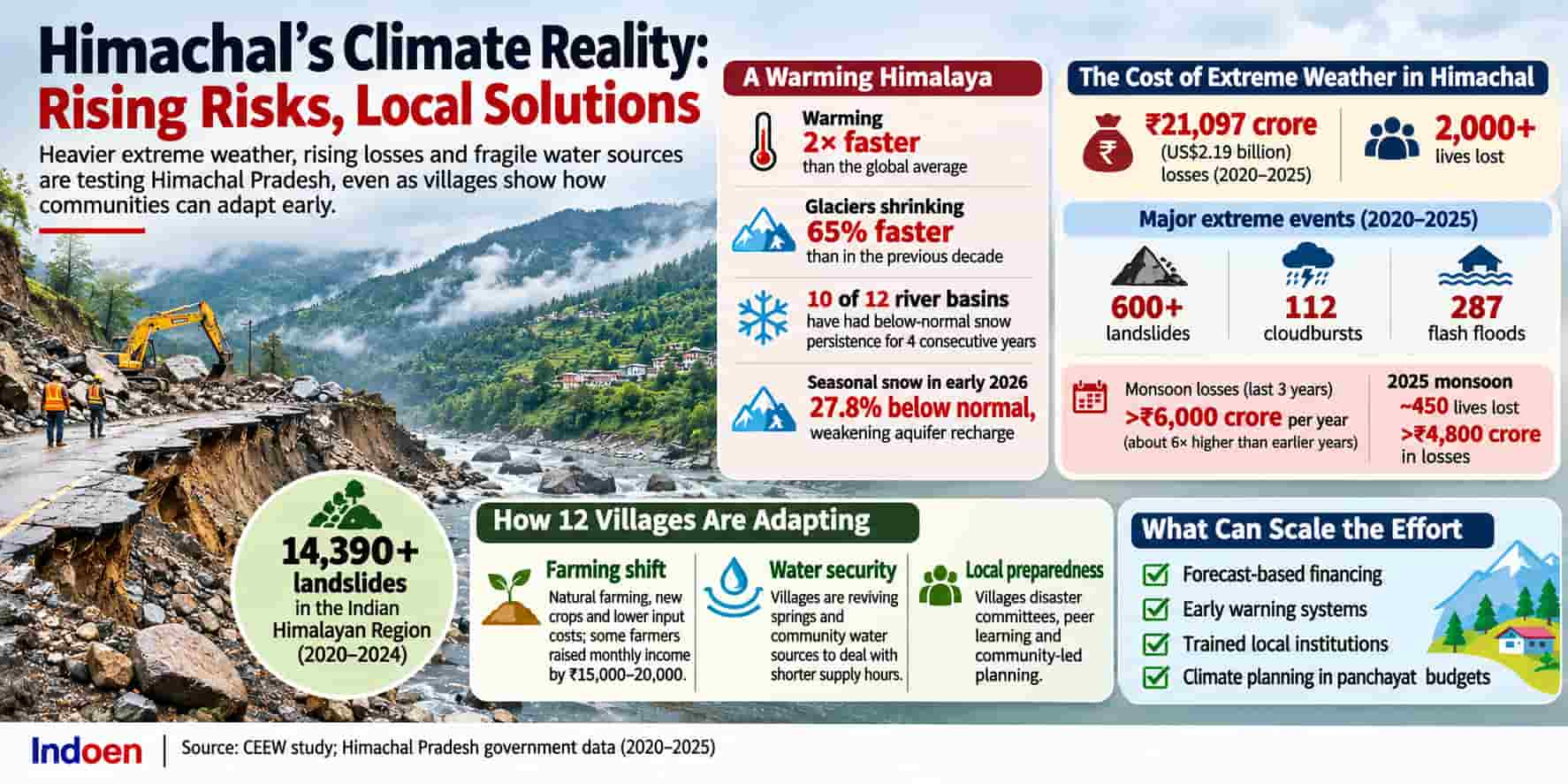
The Hindu Kush Himalayan region, often called the Third Pole, is warming twice as fast as the global average, according to the study. Glaciers are disappearing 65 per cent faster than in the previous decade, and 10 of the region’s 12 major river basins have recorded significantly below-normal snow persistence for four years in a row.
Early 2026 was no kinder, with seasonal snow persistence 27.8 per cent below normal, which weakens aquifer recharge.
The stakes extend well beyond the hills. About 1.9 billion people live downstream, and the Intergovernmental Panel on Climate Change now treats the region as the world’s most vulnerable mountain system.
The Indian Himalayan Region makes up 15 per cent of this landscape, and it is urbanising quickly, often without much planning. More than 14,390 landslides were recorded there between 2020 and 2024 alone.
The price of reacting late
Himachal Pradesh sits at the sharp end. Extreme weather events in the state have increased eightfold over five decades. Between 2020 and 2025, it recorded more than 600 landslides, 112 cloudbursts and 287 flash floods, with around 300 of these events in 2025 alone. Cumulative damage stood at ₹21,097 crore (US$2.19 billion), and more than 2,000 lives were lost. Roads, schools and health facilities took the worst of it, followed by livelihoods.
The monsoon bill is climbing fastest. Losses over the 2017–22 monsoon seasons totalled ₹6,013 crore (US$635 million), or about ₹1,000 crore (US$105 million) a year.
In the last three years, average annual monsoon losses have exceeded ₹6,000 crore (US$625 million), a roughly sixfold jump. The 2025 monsoon alone claimed nearly 450 lives and caused losses above ₹4,800 crore (US$505 million).
Such a leap within a handful of monsoons hints that where and how people build matters as much as how hard it rains. The report’s own data on tourism-led construction, discussed below, points the same way.
 Farmers who moved first
All 12 panchayats are feeling the impact, the report finds, yet all 12 are already doing something about it. Farming shows this best. In Parara, Sirmaur, a few households began natural farming seven or eight years ago, driven mainly by rising input costs, and neighbours followed once profits showed.
In Sandhu, apple grower Satya Devi says she cut input costs by over 90 per cent while raising yields, with monthly income up by ₹15,000–20,000 (US$160–210). Statewide, 3.06 lakh farmers have been trained under the Prakritik Kheti Khushhal Kisan Yojana (Natural Farming, Prosperous Farmer Scheme), and 2.22 lakh now practise natural farming on 38,437 hectares.
Bajaura, in Kullu, offers a more cautionary tale. Warming winters pushed farmers from apples to pomegranate, which then fell to new plant viruses, and the village has since turned to persimmon. Adaptation, it seems, can become a treadmill.
What keeps farmers moving is peer learning. As Mahesh Sharma, the Up-Gram Pradhan, puts it, “what started with a few orchards soon spread to the entire Panchayat”.
Springs, tanks and a quiet burden on women
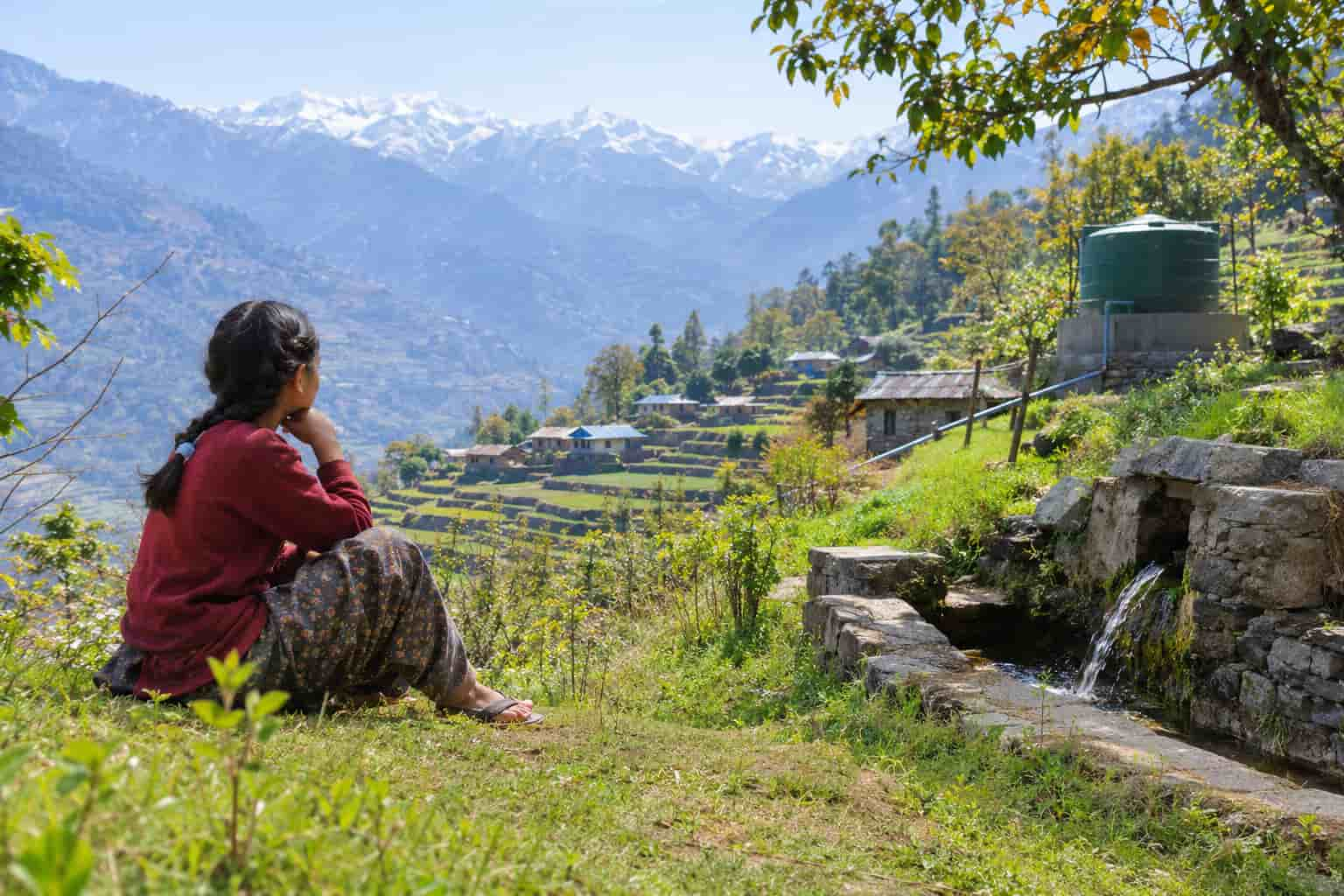
Water tells a more uneven story. Himachal has roughly 10,512 traditional water sources, including baoris, yet only about 30 per cent are reported to be in good working condition. Piped supply under the Jal Jeevan Mission often runs for about four hours a day, dropping to under an hour in dry summers. Women, who mostly fetch water, walk the extra distance.
Some villages have fought back. In Thana Kashoga, a community-run springshed programme using trenches, check dams and afforestation has revived five springs, with five or six more underway. Then came a twist. With water back, farmers moved to garlic and tomatoes and leaned on chemical fertilisers, which began to hurt soil quality. Solving one problem, in other words, can quietly create the next.
Rainwater harvesting is spreading too. Sunah Lamba Thach used MGNREGA funds to build community tanks costing ₹3–5 lakh (US$3,200–5,300) each, which also gave local women work at ₹300 (US$3) a day. A household tank is cheaper, at around ₹1 lakh (US$1,050).
When tourism outruns the terrain
Between 1990 and 2020, built-up areas in Himachal’s tourist zones grew by 427 per cent on average, against 55 per cent in non-tourist areas.
Meanwhile, agriculture’s share of state GDP has fallen from 35 per cent in FY 1990–91 to 14 per cent in FY 2023–24, though farming still supports nearly 60 per cent of the workforce. The economy is shifting faster than the safety net beneath it.
In Chalal, near Kasol, cloudbursts in 2022 and 2023 washed away homestays, cafes, camps and the Chojh bridge, the only motorable link to nearby settlements.
Four residents went missing, and children lost almost 15 days of school. Residents and in-migrants later pooled ₹3 lakh (US$3,200) to rebuild the bridge over a year, and they now press for a proper early-warning system.
Sharchi, in the Tirthan Valley, has taken the regulatory route. Its Sustainable Tourism Guidelines require a panchayat no-objection certificate, priced at ₹1,000 (US$11) for locals and ₹10,000 (US$105) for outsiders, and cap buildings at 3.5 floors or 12 rooms. Locals are promised 90 per cent of jobs in any government-introduced mass-tourism project.
The plan has been submitted to the chief secretary’s office.
Livelihood diversification has its own gaps. In Pandoh, women’s groups run jam, pickle and tailoring enterprises, yet the village officer for women’s self-help groups, Poonam, notes the need for “more contextual training that fits our different education levels”.
Warnings that stop short of the village
Disaster response is where the cracks show. Road blockages often keep officials out, and early warnings usually reach only panchayat officials as WhatsApp messages, which they must relay onward. In Banogi, two hydropower projects within 5 km released water simultaneously in 2023 and 2024, and floods destroyed markets, homes and roads. In Pandoh, sirens sound but do not say when, or how much, water is coming.
The state is responding. It operates 22 automatic weather stations and is adding 48 more under a ₹890 crore (US$94 million) project. Its Panchayat Emergency Response Centre scheme, launched in 2025, aims to give panchayats an organised first-response framework. Yet only a few villages have formal village disaster management committees so far. Shoghi, working with ADRA India, built one of the first.
Relief remains a sore point. After the 2023 cloudbursts, households reporting major damage received ₹3.5 lakh (US$3,700), with another ₹3.5 lakh on proof of rebuilding.
In Banogi, 50 affected households approached the High Court and saw compensation raised from ₹1 lakh to ₹3 lakh (US$1,050 to US$3,200) per person, after complaining that uniform payments ignored the scale of loss.
Making foresight pay
To turn stories into a plan, the researchers convened more than 60 participants in Shimla for a two-day consultation. It produced 25 anticipatory adaptation solutions across agriculture, water, critical infrastructure, disaster management and development planning.
The policy asks are institutional. The study wants village disaster committees strengthened, gram panchayat development plans treated as anchors for resilience spending, and a dedicated foresight cell at the National Disaster Management Authority. It also seeks AI-driven, localised impact forecasts and forecast-based financing, which releases money when pre-agreed risk thresholds are crossed.
Neighbours offer proof of concept. Nepal set up an anticipatory action clinic in October 2024. Bangladesh mobilised US$10.4 million (₹99.84 crore) in 2024, reaching over 430,000 people across 20 districts ahead of floods and cyclones, which works out to roughly US$24 a head. Pakistan released its own national guide the same year.
The money question is not unique to the hills. Indoen has previously examined how India’s climate finance tends to flow towards emissions rather than vulnerability, and Himachal’s villages show what sits on the other side of that gap.
The limits of looking ahead
The report is candid about caveats. Uncertain forecasts, limited finance and weak coordination often hold back local anticipation. Benefit-cost ratios in an FAO assessment of anticipatory action topped 7:1 in the strongest cases, but fell considerably for rapid-onset hazards, where impacts are harder to prevent. Cloudbursts and flash floods, Himachal’s signature threats, belong to that category.
Warning alone, then, will not be enough. Stakeholders in Shimla also pressed for relocating critical infrastructure, stabilising slopes and building all-weather roads with U-ducts to survive flash floods. Set against the ₹3,345.81 crore (US$350 million) sanctioned under PMGSY-III for 3,123 km of rural roads and 43 bridges, such design choices may be where the biggest resilience gains lie.
What could come next
Early signs of institutional uptake are encouraging. The researchers’ Gram Panchayat Climate Resilience Calendar, which links seasonal risks to monthly preparedness tasks, is being taken up by the state disaster management authority, with statewide dissemination planned. Over 60 officials have been trained, and 40 more stakeholders consulted. Planned model gram panchayats, working with national agencies, would test forecast-based financing on the ground.
If that works, Himachal could offer the Indian Himalaya a template where communities, not just distant control rooms, decide when to act. If it stalls on funding, community-funded repairs, like Chojh’s ₹3 lakh (US$3,200) bridge, may be left carrying a burden they were never meant to bear.
Follow us on : X | LinkedIn | Facebook | Bluesky