

Canada's $50bn Churchill Falls deal launches North America's largest-ever clean energy programme
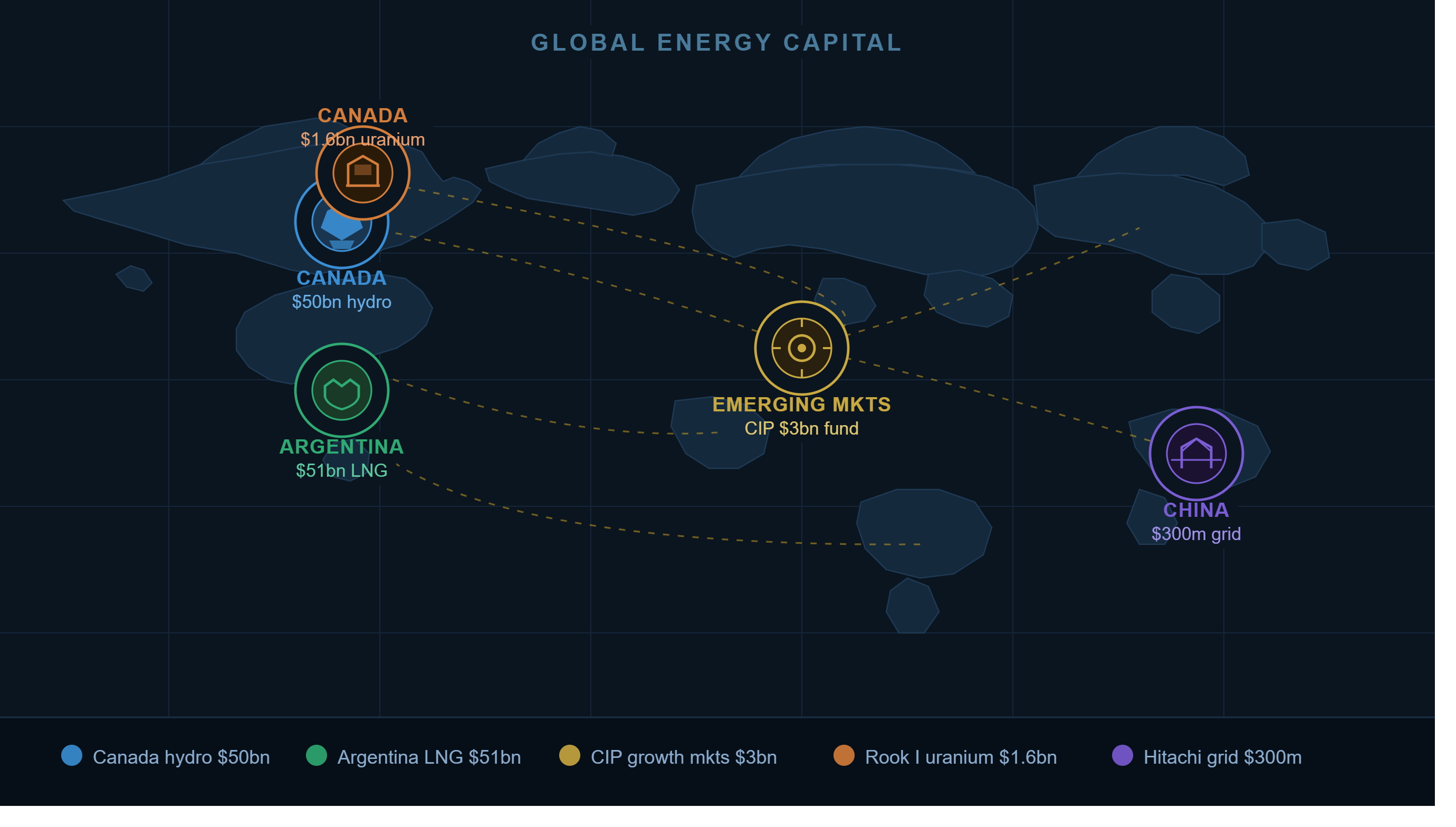
Canadian Prime Minister Mark Carney, alongside the Premiers of Québec and Newfoundland and Labrador, has announced a package of hydroelectric and wind projects valued at nearly C$70 billion (US$50.5bn) — what Ottawa is calling the largest clean energy investment in North American history.
The centrepiece is a Definitive Cooperation and Implementation Agreement between Hydro-Québec and Newfoundland and Labrador Hydro that terminates and replaces the deeply contested 1969 Churchill Falls contract — a 57-year dispute that had locked Newfoundland into selling its hydropower to Quebec at a fraction of market price.
The federal government is committing up to $10bn in direct financing to upgrade Churchill Falls, develop the long-discussed Gull Island hydroelectric project in Labrador, enable a major Innu-led onshore wind project, and build associated transmission lines. Together, the projects would generate 14,000 MW of renewable power — nearly tripling Churchill Falls' current output — enough to serve the combined residential loads of Toronto, Montreal and Vancouver.
Construction activity is expected to support 23,000 jobs and contribute $31bn to Canada's GDP through the early 2040s, with Hydro-Québec also positioned to sell a significant volume of the generated power into the northeastern United States.
The deal resolves what was one of Canada's most acrimonious inter-provincial energy disputes and unlocks infrastructure that federal and provincial governments have been unable to advance for decades.
The Gull Island project, in particular, had been planned since the 1970s and repeatedly deferred due to the absence of a commercial agreement between the two provinces.
The Churchill Falls resolution demonstrates how a combination of federal financial guarantee, a structured bilateral utility agreement and political will can unblock long-stalled large-scale hydro infrastructure — a structural lesson with direct relevance to India, where inter-state hydropower allocation disputes (the Cauvery river sharing, the long-delayed Tipaimukh project, ongoing tensions over upper-riparian development in the Northeast) continue to impede the deployment of domestic hydro capacity that is already technically feasible.
Canada's $10bn federal financing guarantee model — underwriting provincial utility borrowing rather than directly funding construction — also offers a financing architecture worth examining for India's own large hydro revival under the National Hydroelectric Policy.
The geopolitical framing of the deal is significant. Carney explicitly positioned the investment as Canada mastering its energy destiny and building economic independence in contrast to the United States under the Trump administration — positioning clean energy as both a sovereignty asset and an export commodity.
The Hydro-Québec plan to sell into Massachusetts and New York reinforces that clean power can generate hard-currency export revenue, a model India's own policymakers have been articulating through the green ammonia and hydrogen export strategy, though at very different technology and timeline scales.
One material risk to watch: Québec's separatist Parti Québécois, currently leading in polls ahead of October provincial elections, has indicated it could revoke the agreement if it takes office — a reminder that even historically large clean energy commitments remain vulnerable to electoral discontinuity.
YPF-Eni-XRG submit $51bn Argentina LNG project for RIGI approval
YPF, Eni and XRG have submitted their joint Argentina LNG project for approval under Argentina's Large Investment Incentive Regime (RIGI), advancing plans to develop the country's vast Vaca Muerta shale gas reserves for large-scale LNG export at a total project cost of US$51 billion — the largest private investment ever proposed in Argentina and the largest single RIGI submission to date.
The integrated project spans upstream gas production in Neuquén, dedicated pipelines from the Neuquén Basin to the coast, gas processing and liquids fractionation facilities, and two floating LNG units anchored offshore Río Negro in the Gulf of San Matías, with combined liquefaction capacity of 12 million tonnes per annum (MMtpa).
Of the US$51bn total, approximately US$29bn is expected to be deployed by 2031 when the two FLNG units are targeted to begin operations, with roughly US$24bn allocated to infrastructure — pipelines, industrial facilities, port works and the FLNG units themselves — and $5bn to upstream drilling.
Once operational, the project is expected to generate approximately $10bn annually in export revenue over two decades, with construction-phase employment peaking at 40,000 workers and approximately US$15bn in procurement from Argentine suppliers over the project's life.
The RIGI framework provides long-term legal, fiscal, customs and foreign-exchange stability intended to underpin the international project finance and offtake agreements the consortium will need to reach financial close.
The strategic logic of Vaca Muerta LNG is well established: the shale formation contains some of the world's largest technically recoverable gas reserves outside the Middle East and Russia, but landlocked geography has prevented Argentina from converting that resource endowment into meaningful export revenue.
The FLNG model — floating liquefaction on vessels moored offshore — addresses the absence of a deep-water Atlantic coast terminal by bringing the liquefaction infrastructure to the sea rather than building a fixed onshore facility, which would require substantially more land, permitting and coastal infrastructure.
The consortium's structure is itself geopolitically significant: YPF is the Argentine national oil company, Eni is a major European integrated oil and gas player with a large and growing LNG portfolio, and XRG is Abu Dhabi's state energy investment vehicle — combining state capital, European expertise and Gulf sovereign capital in a single project, a configuration that signals serious long-term commitment beyond a speculative development bet.
For India, this project matters directly as a future LNG supply option. India is the world's third-largest LNG importer, bringing in roughly 25–27 million tonnes per year, with supply heavily concentrated on Qatar (around 40% of imports), Australia and the United States.
The 12 MMtpa Argentina LNG capacity, if operational by 2031, would represent a significant new Atlantic Basin supply source — and one with a structurally different cost curve from Middle Eastern or Australian LNG, given Vaca Muerta's low wellhead costs and the project's economies of scale. India's state LNG importers — Petronet, GAIL and IOCL — have historically sought long-term offtake diversification; a project of this scale, with Atlantic shipping routes comparable in length to US Gulf Coast LNG, merits active engagement from Indian buyers at the offtake structuring stage rather than as a late entrant once pricing terms are set.
CIP closes $3bn Growth Markets Fund II with India among 15 target markets
Copenhagen Infrastructure Partners (CIP) has reached final close on its Growth Markets Fund II (GMF II) at approximately US$3 billion in commitments to the fund and associated vehicles — nearly triple the size of its US$1bn predecessor that closed in 2019.
GMF II targets large-scale greenfield energy infrastructure across 15 selected high-growth, middle-income markets in Eastern Europe, Asia and Latin America, explicitly naming India, Vietnam, the Philippines, Mexico and South Africa as core investment destinations.
The fund has already committed US$1.6bn across nine investments at final close, generating total value above paid-in capital, including the largest standalone battery storage project in Chile (commissioned below construction budget), Mexico's first large-scale combined solar-and-storage projects (now under construction after securing the largest capacity allocation under Mexico's recent binding planning framework), and Pestera II, described as one of Romania's largest renewable energy investments. LPs include sovereign wealth funds, pension funds, impact-focused family offices and Development Finance Institutions. CIP expects GMF II to be fully committed within one to two years.
The near-tripling of fund size from GMF I to GMF II is not merely a fundraising milestone — it signals a structural shift in how institutional capital perceives risk and return in renewable infrastructure across emerging and middle-income markets.
CIP's predecessor fund is now expected to deliver approximately 8.7 GW of energy infrastructure across more than 50 projects in India and South Africa — a track record that includes CIP's 1.7 GW Unicus solar-hybrid joint venture with Greenko in India and a 300MW onshore wind project in Karnataka that reached a final investment decision in January 2024.
The growth in LP appetite from US$1bn to US$3bn over a single fund vintage, despite what CIP's partner Niels Holst described as "geopolitical headwinds," suggests that the combination of contracted revenue structures, DFI co-investment and a track record of on-budget project delivery in difficult markets is proving sufficient to attract mainstream institutional capital at scale.
For India, the India relevance here is not indirect — India is a named and demonstrated target market for both vintage funds, with CIP's local development pipeline representing over $5bn in potential project commitments according to the fund's own disclosure.
With US$1.4bn remaining to deploy from GMF II's final close beyond its existing nine investments, and a stated timeline of full deployment within two years, India's renewable energy sector should expect several hundred million dollars of CIP greenfield capital over that period.
The DFI participation in the LP base also matters: DFI co-investment structures typically include concessional debt tranches alongside equity, lowering overall project financing costs and enabling projects that might not meet commercial return hurdles on a purely private-market basis. That blended capital architecture is precisely what India's grid-scale storage and complex hybrid projects increasingly require.
NexGen starts $1.6bn Rook I uranium mine as global nuclear fund demand strengthens
NexGen Energy has commenced construction of its C$2.2bn (US$1.6bn) Rook I uranium project in Saskatchewan, following the Canadian Nuclear Safety Commission's March 2026 licensing decision, which cleared the project's final regulatory hurdle.
The underground mine and processing mill are designed to produce approximately 30 million pounds of uranium annually across an 11-year mine life, generating 233.6 million pounds of yellowcake in total — a scale that would make Rook I one of the world's largest uranium sources, exceeding Cameco's McArthur River-Key Lake operations, which are licensed at 25 million pounds per year.
Major earthworks and surface infrastructure are already advancing; an initial airstrip has been commissioned, expanded site accommodation is occupied, and shaft development is planned for 2027.
The 2021 feasibility study projected an after-tax net present value of C$3.5bn at an 8% discount rate, a 52.4% internal rate of return, and a payback period of under one year at the assumed uranium price, underscoring the project's economics at current uranium market prices, which have risen sharply as nuclear energy reasserts itself in global electricity planning.
The Rook I project sits in the Western Athabasca Basin — the geological formation that hosts the world's highest-grade uranium deposits — and comes to construction at a moment when nuclear power is accelerating across multiple jurisdictions simultaneously.
The combination of AI data-centre power demand, industrial electrification, manufacturing reshoring and the structural limitations of intermittent renewables in meeting firm power requirements has renewed governmental and corporate interest in nuclear energy across the US, Europe, Japan, South Korea and Southeast Asia. Canada is simultaneously positioning itself as the primary Western-aligned alternative to Kazakh and Russian uranium supply, with its uranium export potential described by some analysts as capable of doubling by 2035.
The Rook I project would be a central pillar of that export growth — and its four-year construction timeline means first production is expected around 2030.
India's interest in this project is direct and structural. India has 23 operational nuclear reactors and one of the world's most ambitious nuclear expansion programmes, with 21 more reactors under construction or in advanced planning and a stated 100 GW nuclear target by 2047.
Domestic uranium production through the Uranium Corporation of India falls well short of expanding reactor requirements, making import diversification a strategic priority. India and Canada signed a nuclear cooperation agreement in 2010, enabling direct uranium trade, and Indian buyers have received Canadian uranium through joint supply arrangements.
The commissioning of a 30-million-pound-per-year mine in Saskatchewan would substantially expand the Canadian supply pool available to India under existing bilateral frameworks — and at a geologically superior grade that reduces per-unit production cost.
In a supply environment where Russian and Central Asian uranium sources face growing geopolitical risk, a large Western Athabasca Basin project of this scale is precisely the kind of long-term supply anchor that India's Department of Atomic Energy and NPCIL should be engaging with proactively at the offtake and diplomatic level.
Hitachi Energy's $300m China transformer bet illuminates the global grid equipment crunch
Hitachi Energy has announced a $300 million investment in China to expand its power transformer and component manufacturing capacity at its Hefei facility in Anhui Province, targeting a global transformer market the company describes as experiencing sustained demand that existing supply chains cannot meet.
The investment will establish a new state-of-the-art power transformer factory, a new ultra-high-voltage bushing facility, and a digital production line for tap changers at a site where Hitachi Energy already operates one of its 11 manufacturing locations in China, with more than four decades of on-the-ground presence.
The China investment forms part of Hitachi Energy's US$9 billion global capital expenditure programme — described as the largest investment plan in the power equipment industry — aimed at expanding manufacturing capacity, engineering, R&D and partnerships across multiple geographies.
The rationale is straightforward: global transformer demand is surging, driven by AI, data centres, electrification, industrialisation and the need for grid modernisation, with lead times for large power transformers in some markets extending to two years or more as utilities attempt to rapidly scale transmission and distribution infrastructure.
The transformer supply crunch is one of the least discussed but most consequential bottlenecks in the global energy transition. Utility-scale solar and wind projects can be built in 12–18 months; the high-voltage transformers and substations needed to connect them to the grid may take as long or longer to procure.
The crunch is particularly acute for large power transformers — units above 100 MVA — which require specialised manufacturing capabilities, high-grade electrical steels and long production cycles.
Hitachi Energy's decision to concentrate a significant portion of its expansion capital in China reflects a pragmatic assessment of where manufacturing cost efficiency, component supply chains and engineering talent remain most concentrated, even as geopolitical pressures in other segments of the clean energy supply chain push capacity toward other geographies.
For India, the Hitachi Energy China investment has specific supply-chain implications. Hitachi Energy has operated in India for over 75 years, with transformer manufacturing at Vadodara and other sites, and is listed on Indian exchanges, making it a direct participant in India's T&D buildout.
India's Power Ministry has flagged transformer procurement delays as a constraint on substation expansion, particularly as the government accelerates grid connectivity for renewable energy projects under the Green Energy Corridors and associated transmission programmes.
Understanding whether Hitachi's US$9 billion global capex plan includes material India manufacturing expansion — or concentrates incremental capacity in China and Europe — matters for India's long-term grid equipment supply security.
At a broader level, the Hitachi Energy announcement confirms that the global transformer crunch is real and expected to persist, with direct implications for India's ambitious transmission buildout timelines: the equipment bottleneck will not resolve itself simply by allocating capital to new projects.