
India’s 2070 net-zero goal is now being sold as a market. A report by Australian economist Nicki Hutley, released just ahead of the COP31 summit, calls it a US$22.7 trillion opportunity for global investors. It adds that India faces a US$6.5 trillion funding gap, which foreign capital must help to fill.
Hutley’s case rests on development. India is the world’s third-largest emitter in absolute terms. Yet its per-capita emissions are about 3.1 tonnes of carbon dioxide equivalent, against a global average of 6.6 tonnes. GDP per head is about US$2,810. Urbanisation, air conditioning and data centres will push power demand up. The task, the report argues, is to meet that demand with clean power, not to slow growth.
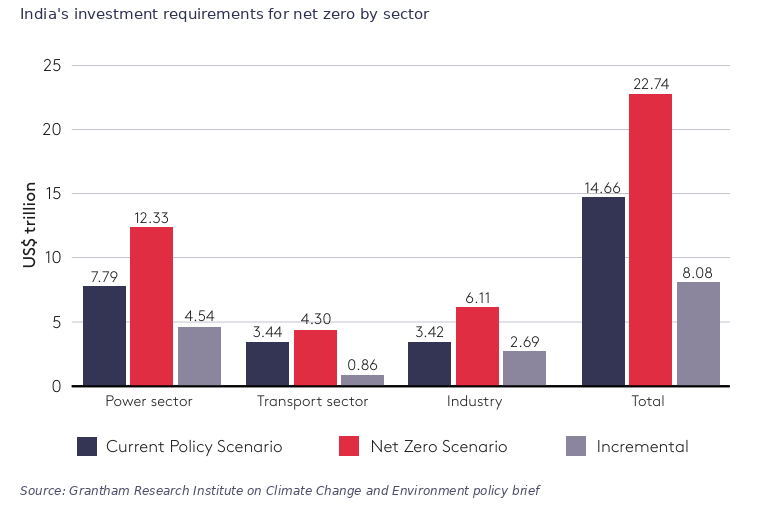
The headline number is not new. It comes from a NITI Aayog study published in February. That study priced the net-zero pathway at US$22.7 trillion by 2070, against US$14.7 trillion if India stayed on current policies. The Hutley report takes government arithmetic and presents it to investors. That is a fair exercise. But some detail is lost on the way, and that detail is where the real story sits.
Start with the annual sums. Spread over the decades, US$22.7 trillion means about US$500 billion a year. India invested around US$135 billion in 2024, and only US$70 billion to US$80 billion of it went to clean energy. A separate IVCA and BCG report, released on 26 November, puts the cumulative need at US$22 trillion to US$24 trillion. Baselines differ between studies. Yet all of them point to a multiple of today’s spending, not a top-up.
Scale matters here. India’s gross fixed capital formation was about US$1.2 trillion in FY2024-25. On a higher International Energy Agency baseline, current clean energy investment of US$113 billion is roughly 9% of that. Averaging US$500 billion a year would take a far bigger share. But the economy will be much larger by then.
NITI projects GDP of US$30 trillion by 2047 even on the net-zero path, as per industry coverage. The burden is heavy, but not impossible.
 Seventy per cent of what?
The report says India could mobilise just over 70% of the bill through available financing, including foreign capital already expected to flow into the economy. The arithmetic is simple. NITI Aayog thinks reforms could mobilise US$16.2 trillion by 2070, which is 71% of US$22.7 trillion. The remaining US$6.5 trillion is the gap.
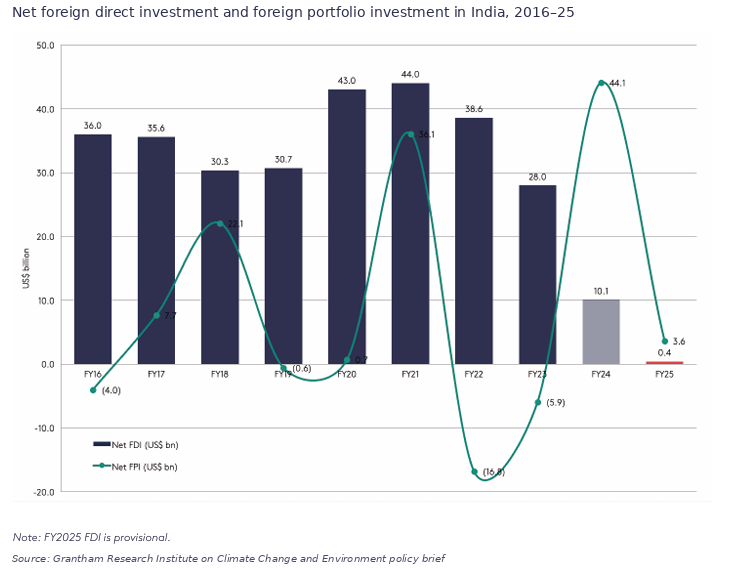
But the US$16.2 trillion is not all Indian money. A September policy brief, co-written by a NITI Aayog climate-finance modelling lead, notes that 19% of it is international. Do the sums. Nineteen per cent of US$16.2 trillion is about US$3.1 trillion. Add the US$6.5 trillion gap, and foreign sources would need to supply roughly US$9.5 trillion, based on the rounded figures. That is 42% of the total. In FY2022-23, the share was only about 17%, the brief says.
So the purely domestic share is closer to 58% than 70%. The difference is worth about US$3.1 trillion.
“The 70% figure is a mobilisation target, not a measure of what Indian savings can carry,” said a researcher at a New Delhi-based energy think tank. “Read it as domestic money plus the foreign money we already attract, and the picture changes.”
NITI’s logic is sound. Leaning only on domestic savings could crowd out other investment and push up interest rates. But the headline hides how much weight foreign capital must carry.
If foreign money falls short, domestic banks carry more. NITI expects banks and NBFCs to supply about 83% of the debt, with banks alone lending roughly US$4.5 trillion. Banks fund long projects with shorter-term deposits, which creates a mismatch. Indoen has reported that most Indian lenders remain poorly prepared for deeper climate financial risks.
 A gap that opens late
The gap is not constant. It stands at about US$2.5 trillion by 2050, then widens to US$6.5 trillion by 2070, the brief shows. After 2050, spending shifts towards capital-intensive and less mature technologies. These include green hydrogen, carbon capture, direct air capture and offshore wind. Power takes over half of all investment and transport about 20%. Industry takes a quarter, mostly after 2045.
This means today’s investor pitch and tomorrow’s gap point at different assets. Money now flows to what India already builds well. Between 2021 and October 2026, India drew about US$31 billion in climate equity. Of that, US$19 billion went to power and low-carbon fuels and US$9.5 billion to transport. That is roughly US$5 billion a year. Equity is only one slice of funding, so the comparison with US$500 billion a year is not like for like. Still, it shows how thin risk capital is where the gap will be widest.
Hydrogen already shows the strain. Indoen has reported how a cost gap and EU carbon rules temper India’s US$180 billion to US$200 billion hydrogen outlook to 2030.
Capacity also runs ahead of delivery. Non-fossil sources made up 54.2% of installed capacity by June 2026, but only about a quarter of actual generation, the Hutley report notes. Indoen has tracked how wires, storage and discoms struggle to keep pace.
 The test is currency, not capital
Hutley herself argues that there is no shortage of capital and that financing is the biggest barrier. She also says 2070 is too distant to meet Paris goals, even if emissions peak by 2040, as currently expected.
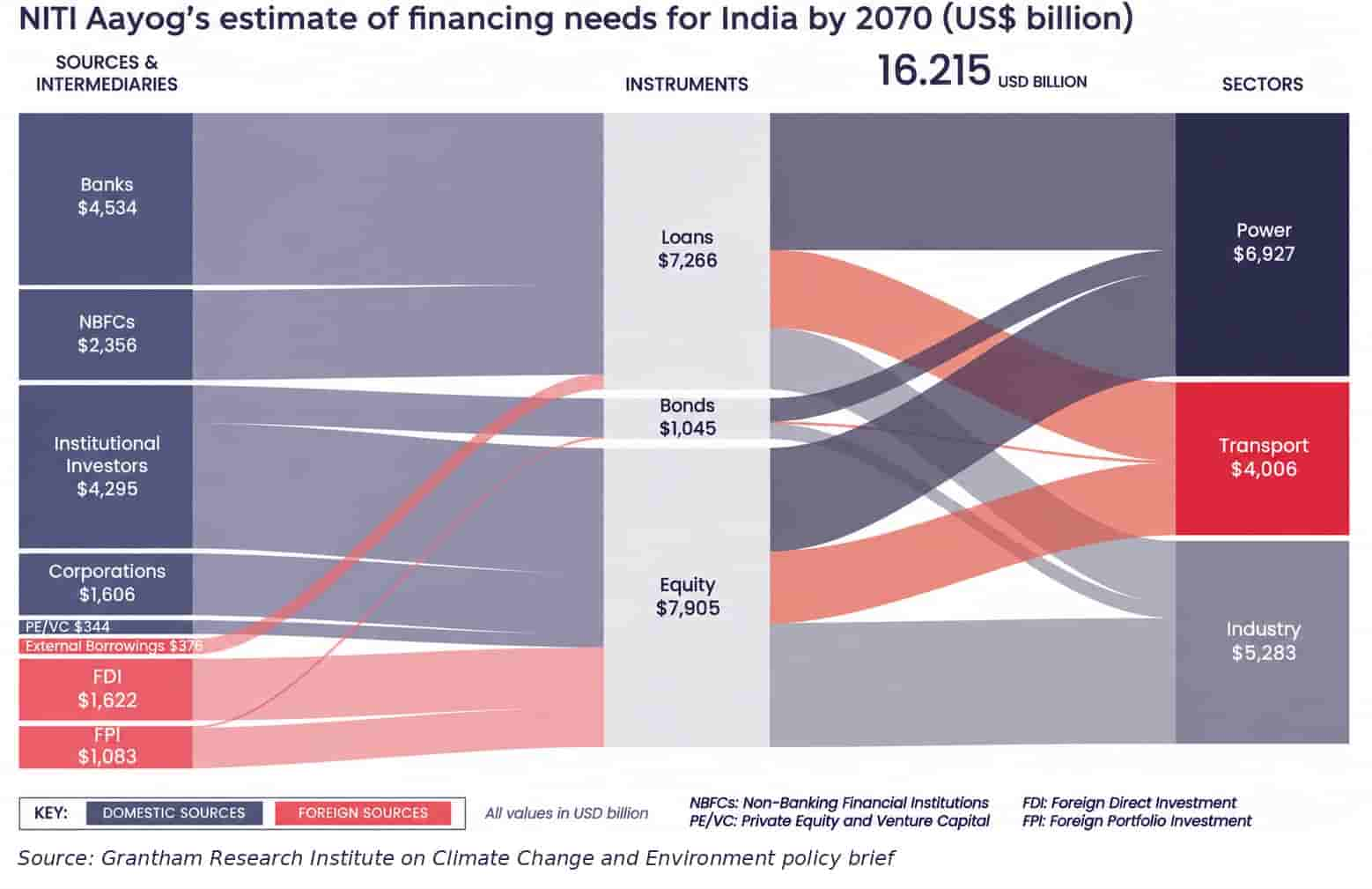
The policy brief explains where the barrier lies. NITI expects foreign money mainly as equity. It sees FDI averaging nearly US$38 billion a year and portfolio flows about US$22 billion a year, for power, transport and industry alone. That is US$60 billion a year.
In FY2025-26, net FDI was US$7.65 billion, while net portfolio investment saw an outflow of US$16.67 billion, as per RBI data. Gross FDI inflows were far higher at US$94.53 billion. But repatriation of US$53.58 billion and Indian firms investing abroad cut the net figure. The comparison is not perfectly like for like. The direction is still clear.
Currency is the choke point. On a foreign-heavy path, the current account deficit could peak at about 3.2% of GDP in 2045, against 2.3% to 2.5% on a domestically financed one. Unhedged rupee exposure also puts off many foreign institutions.
The brief notes that India lacks the hedging arrangement Brazil has built through a development bank and its central bank.
“For a solar park, capital is rarely the problem,” said an executive at one of India’s leading renewable energy developers. “Hedging costs and offtaker risk are. Fix those two, and the money turns up.”
The savings the pitch skips
The investor pitch talks of spending. It says less about savings. In NITI’s net-zero scenario, India’s fuel import bill falls from 4% of GDP to 0.2% by 2070, industry reports suggest. Electricity use rises from 1,541 TWh in 2024 to 13,000 TWh. A bigger grid replaces a bigger import bill.
The same scenario cuts fossil fuel revenues from 2.3% of GDP to 0.2%. That revenue is not spread evenly. Indoen has reported how India’s coal states hold a US$3.3 billion fiscal fault line. A transition that saves the nation money may still squeeze particular districts and state budgets.
What to watch
Several levers are on the table. NITI proposes a dedicated institution to structure blended finance. The brief points to the UK’s National Wealth Fund and Australia’s Clean Energy Finance Corporation as models. It also suggests easing the Statutory Liquidity Ratio towards 18% and deepening the corporate bond market from about 16% of GDP to 30%.
Near term, the Ministry of New and Renewable Energy has flagged about US$220 billion of opportunity by FY2030, much of it dependent on private capital. The global backdrop is less helpful. The amount of public climate funding being pledged fell by about 70%, and COP31 ended without an overarching cover decision.
Yet the failure at the summit may matter less than the economics. A recent analysis of the Global Carbon Budget notes that global fossil CO₂ emissions are expected to dip by 0.4% in 2026. Such falls have been seen before only in crises. The Iran war oil shock helped. But cheap solar, wind and electric vehicles offset more emissions than the price spike did. Solar now supplies ten times the energy than it did in 2015, and battery storage is growing faster than renewable generation. India sits outside this trend for now.
Indoen has reported that its fossil emissions are projected to rise 4.4% in 2026. The same analysis names grid expansion as the main bottleneck, and notes that governments still provide over US$900 billion a year in fossil fuel support. Cheap technology lowers the cost of the build. It does not lower the cost of capital.
The US$22.7 trillion is best read as a financing puzzle with a large foreign-shaped piece. India can build solar and wind. The harder tasks are making rupee risk affordable to overseas investors and moving more domestic savings into long-term assets. That, more than the headline, will decide whether 2070 is met.
Follow us on : X | LinkedIn | Facebook | Bluesky