
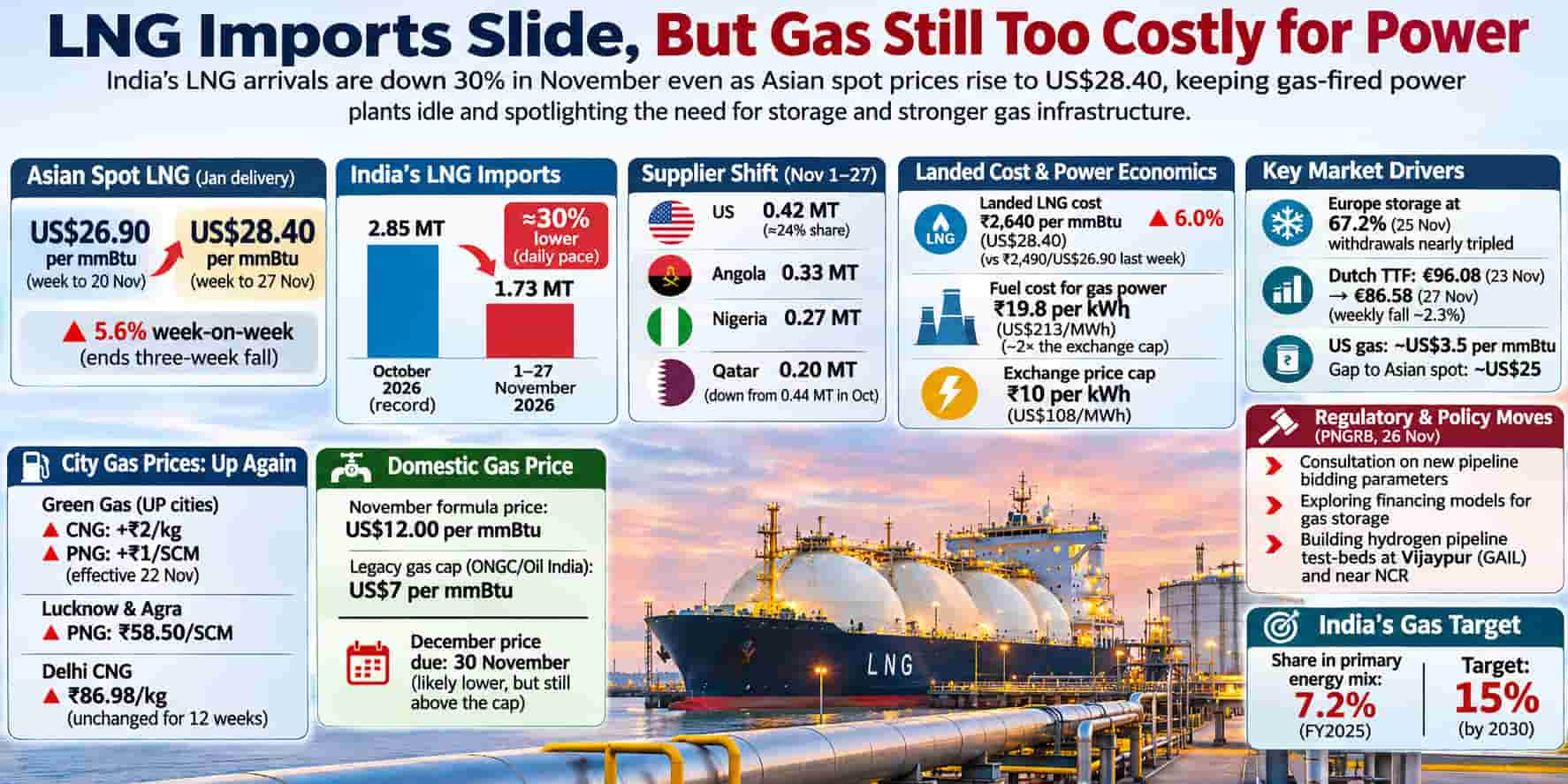
Asian spot LNG for January delivery averaged US$28.40 per mmBtu in the week to 27 November. A week earlier it was US$26.90. That is a rise of 5.6% and ends a three-week fall, as per recent trade data. A cold November lifted gas use in Europe. Asian demand stayed tepid, and Hormuz flows continued, so the rise was modest. Qatar’s exports are still below pre-war levels but above those of the second and third quarters, which limits Asia’s call on Atlantic cargoes.
Europe’s market swung more sharply. Dutch TTF jumped to €96.08 per MWh on 23 November. By 27 November it had eased to about €86.58, on course for a weekly fall of 2.3%. EU storage was 67.2% full on 25 November, as per EU storage data, and withdrawals had nearly tripled in a few days.
US gas trades near US$3.5 per mmBtu. The gap to Asian spot is about US$25. For India, this means more US supply exists, but Europe’s bids decide where those ships go.
An analyst tracking global LNG markets said: “The arbitrage to Asia is shut. Europe is cold, and its storage is thin. US cargoes will stay in the Atlantic until Asia pays a clear premium.”
India imports less, even at lower prices
India’s LNG imports in 1–27 November were 1.73 million tonnes, about 64,000 tonnes a day, as per ship-tracking data. October’s arrivals were a record 2.85 million tonnes, so the daily pace is about 30% lower. A Kpler analyst linked this to carry-over stock from October and fewer cargoes from Angola and Nigeria.
This is the first surprise. India bought less even as spot prices fell from their October peak. Buyers appear to be drawing down stock rather than chasing cargoes.
The Qatar picture has also slipped. Qatar, once about 45% of India’s supply, ranked fourth in November with 0.20 million tonnes. It sent 0.44 million tonnes in all of October. The US led with 0.42 million tonnes. The supplier map has shifted for good, at least for this winter.
 Landed cost and gas power
The rupee closed at ₹92.98 (US$1) on 27 November, a fall of 60 paise on the day, as a Houthi attack on a Saudi Aramco facility lifted crude, as per a PTI report. It had touched its strongest close of this financial year, near ₹92.2, on 25 November.
So spot LNG now equals about ₹2,640 per mmBtu (US$28.4), against ₹2,490 (US$26.9) a week earlier. That is a rise of 6.0%. The dollar price added 5.6%, and the weaker rupee added the rest. Regasification and pipeline charges come on top.
Gas-fired power is the second surprise. By our estimate, fuel alone for a plant with a heat rate near 7,500 Btu per kWh costs about ₹19.8 per kWh (US$213 per MWh). The day-ahead exchange cap is ₹10 per kWh (US$108 per MWh). Fuel cost is nearly twice that. LNG would need to fall to about US$14.3 per mmBtu for such a plant to clear at the cap. Only oil-linked term cargoes, near US$13–15 by our estimate, come close. Spot gas, at twice that, will not.
City gas and domestic prices
Retail prices kept moving up. Green Gas Limited raised CNG by ₹2 (US$0.02) per kg and domestic PNG by ₹1 (US$0.01) per SCM in Lucknow, Agra, Unnao, Ayodhya and Sultanpur from 22 November. PNG is now ₹58.50 (US$0.63) per SCM in Lucknow and Agra.
Delhi CNG stayed at ₹86.98 (US$0.94), unchanged since IGL’s ₹3.89 hike on 29 August. That price has held for twelve weeks while costs moved sharply. It cannot hold for ever if spot stays near US$28.
The domestic price is a different story. The November formula price is US$12.00 per mmBtu, but the cap on legacy ONGC and Oil India gas stays at US$7. The December price is due by 30 November. With Brent lower this month, it should ease, but by our reading it will still sit above the cap.
Regulation: Pipelines, storage and hydrogen test-beds
The Petroleum and Natural Gas Regulatory Board (PNGRB) set out three moves on 26 November, as per a media report. Its Secretary, Anjan Kumar Mishra, said a consultation document on new pipeline bidding parameters is out. Years of little bidding prompted it. The Board is also exploring financing models for gas storage, though funding remains the hurdle. And it is building hydrogen pipeline test-beds at GAIL’s Vijaypur site and near the National Capital Region.
He added that LNG’s share of India’s gas supply rose by about three percentage points to 54% by September, despite high prices. The same report says India bought some cargoes at US$33 per mmBtu, against US$10–12 last year.
India has no gas storage. EU sites hold about two-thirds of their capacity. That gap explains why a Hormuz scare reaches Indian consumers at once. An analyst tracking Indian gas markets said: “Crude has strategic reserves. Gas has none. Every cold spell or Hormuz scare becomes a spot-market event for India, and the bill lands on the economy.”
The energy-security question
India wants gas at 15% of its primary energy mix by 2030. The share was 7.2% in FY2025. This week shows the strain. Dependence on LNG is rising, but storage is absent, and power plants cannot afford the fuel.
There are limits to the gloom. Falling November imports show that Indian buyers can cut back when prices bite. A mild December would ease Europe and Asia. Watch the December gas price, Qatar’s force majeure status after December, Europe’s January cold and Houthi attacks on Gulf infrastructure.