

On 11 November, two announcements came out of the China Pavilion at COP31 in Antalya. Both were easy to miss in a week dominated by a failing climate pact. China joined Türkiye and Ethiopia to launch an initiative on high-quality carbon crediting. The same day, the China Beijing Green Exchange signed an MoU with the International Emissions Trading Association (IETA). Its aim is to help internationalise China’s voluntary credits.
Neither deal moves a single tonne across a border. The initiative is not a trading agreement, and the MoU does not make Chinese credits eligible under Article 6 of the Paris Agreement. So why should India care? Because of the price, the partners and the timing behind them.
A price that has quietly moved
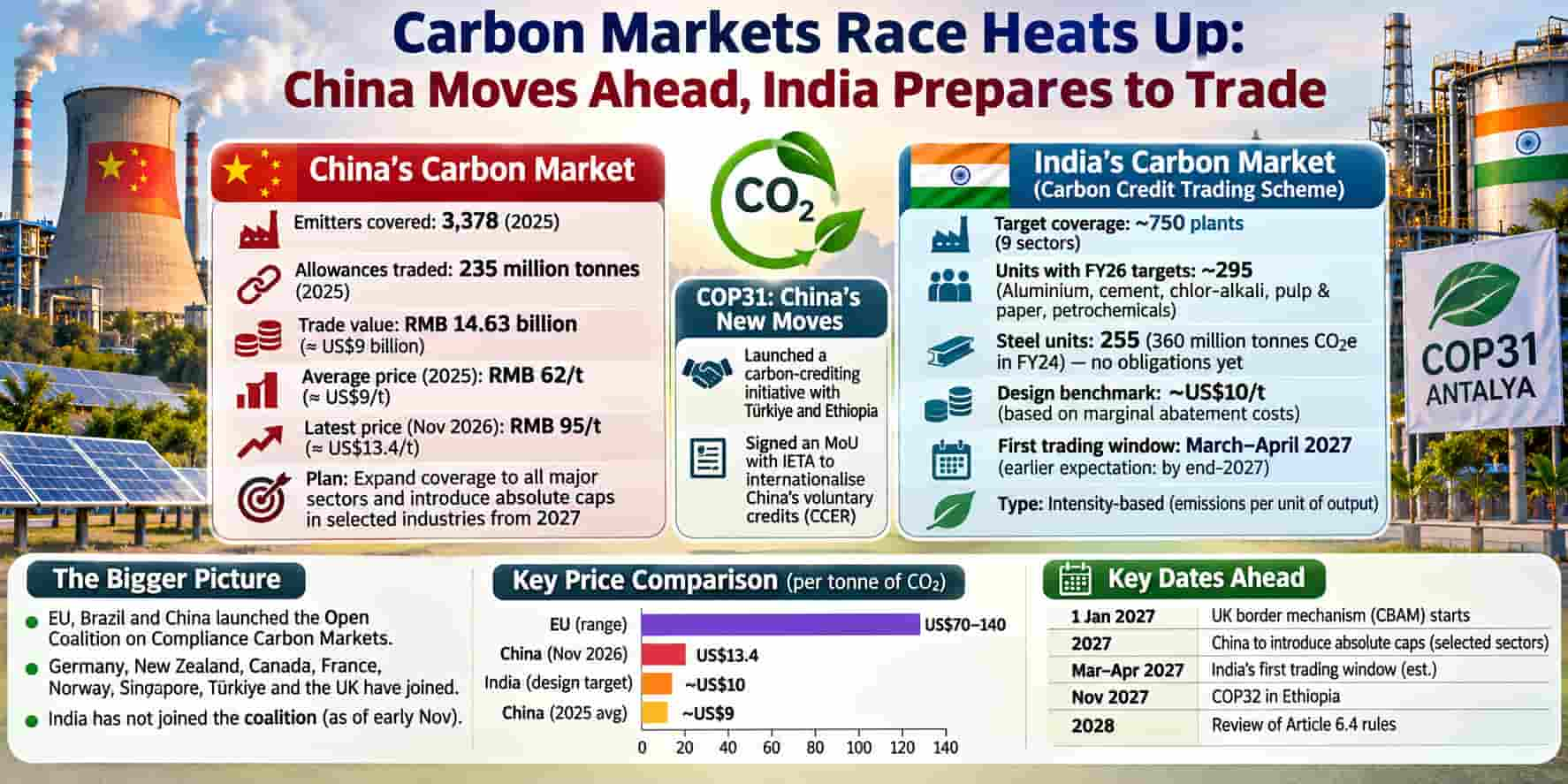
China’s national emissions trading system covered 3,378 emitters in 2025 and traded 235 million tonnes of allowances worth 14.63 billion yuan. That works out to about RMB 62 a tonne, or roughly US$9. By early November, allowance prices were reported to be consolidating near RMB 95. At the exchange rate then, that was about US$13.4 per tonne, roughly 53% above the 2025 average of RMB 62.36. Cumulative trading had reached 961 million tonnes and RMB 65.7 billion by the end of August, around US$9.8 billion.
The voluntary side is smaller. Its credit scheme, CCER, restarted in 2024. The first batch, in March 2025, covered 9.48 million tonnes from nine offshore wind and solar thermal projects. In 2025, 8.84 million tonnes changed hands for 626 million yuan, about US$89 million. The average price was RMB 70.76 a tonne, near US$10.
The bigger shift is design. Beijing plans to bring all major industrial sectors into the system by 2027. It has also said it will introduce absolute emissions caps in selected industries from that year.
A target, not yet a price
India’s Carbon Credit Trading Scheme has no traded price yet, so any comparison needs care. What exists is a design intention. The scheme’s architect has said marginal abatement costs were considered when setting targets to keep carbon costs near US$10 a tonne.
This is a design benchmark, not an official fixed carbon-credit price. As per recent reporting, that is comparable to China’s level, against US$70 to US$140 in the EU. One modelling exercise put a market-clearing price near US$11.48 a credit.
The comparison still matters. China’s traded price has moved above the figure India considered when designing its targets, while India’s market has yet to establish a traded price.
Coverage is also thinner than the headline suggests. The scheme targets about 750 plants across nine sectors. Yet only about 295 units carry FY26 targets, in aluminium, cement, chlor-alkali, pulp and paper, and petrochemicals. The 255 steel units, which released 360 million tonnes of CO₂ equivalent in FY24, have no notified obligations yet.
Draft targets for these units were issued in June 2026 but have not yet been finalised. A 7 September amendment also pushed 21 refineries and 173 textile units to FY27. Those steel units alone emitted more than the 235 million tonnes of allowances China traded last year, though emissions and trading volume are different measures.
Trading is still ahead. Before the West Asia war, the scheme’s director expected most sectors to trade by the end of 2027. A more recent industry estimate puts the first trading window in March–April 2027. India’s scheme is also intensity-based, measuring emissions per unit of output. China is moving towards absolute caps in selected industries.
 The table India has not joined
In May, the EU, Brazil and China launched the Open Coalition on Compliance Carbon Markets in Florence. Brazil presides. China and the EU co-chair. The group works on monitoring, carbon accounting and offset rules. Germany, New Zealand, Canada, France, Norway, Singapore, Türkiye and the UK have since joined. As of early November, India had not.
Now add the COP31 move. China’s crediting initiative pairs it with the COP31 host and with Ethiopia, which hosts COP32 in Addis Ababa in November 2027. So Beijing co-chairs one coalition and co-launches another initiative with the current and next COP hosts. A review of the Article 6.4 rules, due from 2028, follows soon after.
Whether this amounts to rule-setting is open to debate. These are voluntary groupings with no binding targets. But the people drafting verification and offset norms will have shaped them before others arrive.
“China has not sold a single credit abroad under these deals,” said a policy adviser familiar with the carbon-market negotiations. “What it is offering is a rulebook others can read, and a table to discuss it at. Whoever is absent from that table inherits the rules.”
Recognition is the real currency
Rules matter because recognition now carries money. The UK has listed India’s scheme as a qualifying carbon price under its border mechanism, which starts on 1 January 2027. The relief will equal the price actually paid at home.
At about US$10, that relief is small beside a UK or EU price several times higher. As Indoen has noted, EU talks had produced no recognition, while compliance costs for Indian exporters could reach US$2 billion to US$4 billion a year.
There is a fair counterargument. A low price is a choice. It shields steel, cement and aluminium makers who compete with China and face high energy costs. Joining a coalition also carries political cost, because India has called border carbon taxes unilateral. India may reasonably prefer to finish its own market first.
What China has not done yet
Caution is due on the Chinese side too. The IETA MoU does not make CCERs eligible for Article 6 use. Any transfer would still need national authorisation and accounting adjustments. The new initiative must still show projects, investments or deals. Prices are jumpy as well. Trade reports point to short-term corrections alongside high volumes.
One detail deserves attention. China’s first credits came from offshore wind and solar thermal, technologies close to India’s own renewables pipeline. If buyers begin to ask whether such projects need credit income to be built, Indian developers could face the same test. Credit integrity, not volume, may decide who earns a premium.
The test for Delhi
India’s own carbon-market debates, from price signals to border tests, have mostly been framed around the EU. The China story adds a second reference point. It is a market that is bigger, already trading and now looking outward.
“India’s challenge is sequencing,” said a researcher at a New Delhi-based energy think tank. “A price few plants pay will not impress a buyer. And a coalition India has not joined will not wait for the first trade.”
The dates are close. The UK border mechanism starts on 1 January 2027. China’s absolute caps in selected industries are due in 2027. India’s first trading window is now expected in March–April 2027, while broader trading across most sectors was earlier pencilled in for the end of 2027. COP32 follows in November. The Article 6.4 review starts in 2028. Steel targets, still unnotified, may be the clearest early signal of India’s intent.
China has not won anything yet. But it is building the room while India builds the market. The question for Delhi is whether both can be finished in the right order.
Follow us on : X | LinkedIn | Facebook | Bluesky