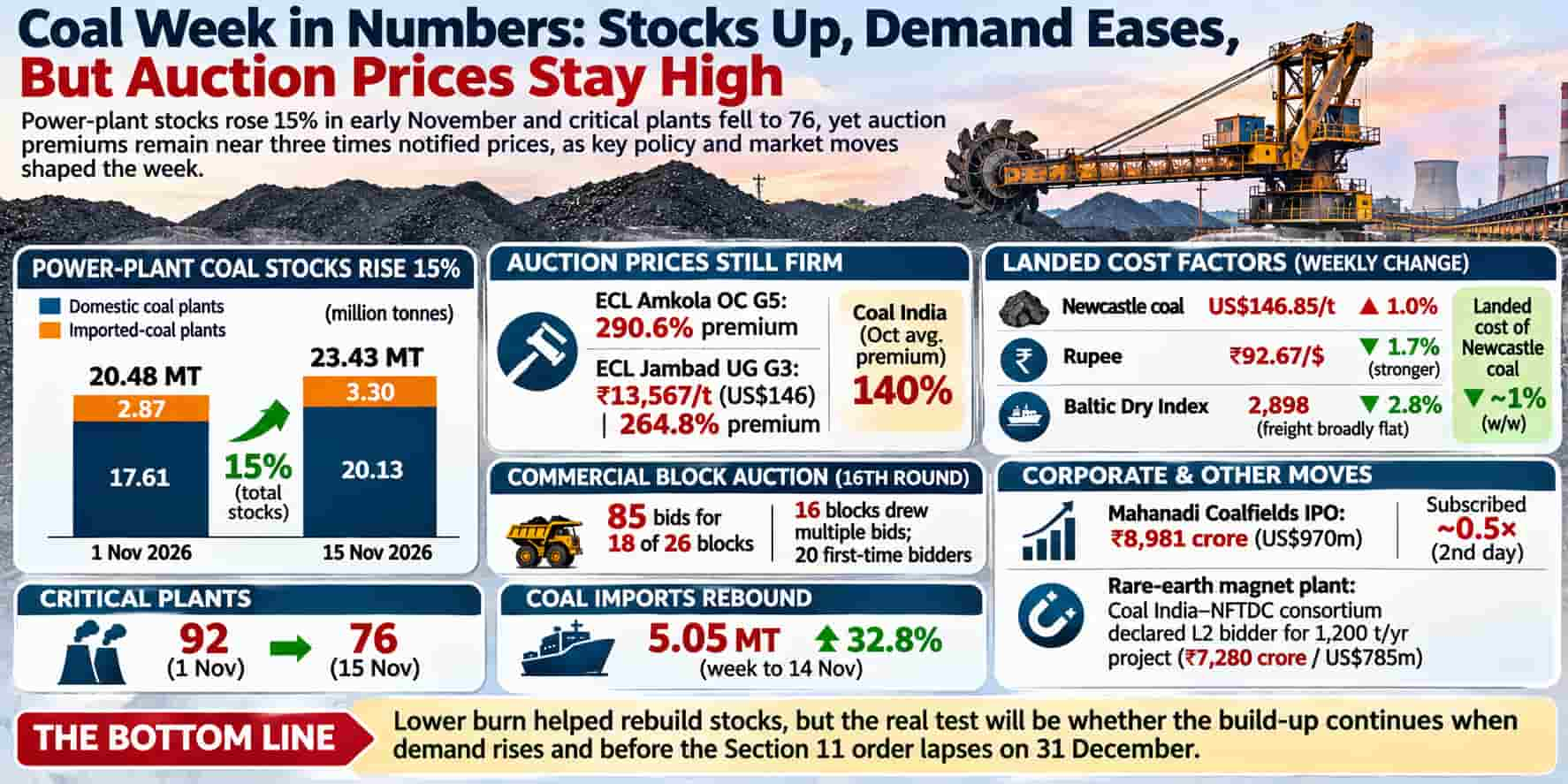
Stocks at plants running on domestic coal rose from 17.61 million tonnes on 1 November to 20.13 million tonnes on 15 November, a gain of 15%. Imported-coal plants added 0.43 million tonnes, taking stocks to 3.30 million tonnes. Critical plants fell from 92 to 76, as per CEA-based data. Receipts beat consumption by more than 3 million tonnes.
The pace is still short. Reaching 55 million tonnes by March, the target set in our earlier analysis, needs about 0.26 million tonnes a day over 136 days. The first fortnight of November added about 0.17 million tonnes a day, roughly two-thirds of that, and it came in a low-demand month.
“Stocks are rising because plants are burning less, not because deliveries have jumped. Winter demand will show how much of this is real,” an executive at a leading thermal utility said.
Auction prices still run far ahead of notified rates
Auction data shows scarcity has not eased. In ECL’s 13 November auction, reported this week, Amkola OC G5 coal fetched a 290.6% premium over its notified price. Jambad UG G3 cleared at ₹13,567 a tonne (USUS$146), a premium of 264.8%, as per auction data. That is about the same figure as Newcastle’s US$146.85, though calorific values and delivery terms differ.
Coal India’s October average premium was 140%. Buyers outside the linkage system, squeezed by the priority given to power plants, are paying near-import prices for domestic coal.
“Industrial buyers outside the linkage system now price domestic coal against imports. That was not true a year ago,” an analyst tracking Indian thermal coal markets said.
New blocks draw bids, but this winter needs rails
On 20 November, the Ministry of Coal opened bids for the 16th round of commercial coal mine auctions and the second attempt of the 15th round. It received 85 bids for 18 of the 26 blocks on offer. Sixteen blocks drew multiple bids and 20 bidders were first-timers, the ministry said. Eight blocks drew none. Qualified bidders move to an e-auction on the MSTC portal.
The response shows appetite for captive and commercial coal. It does not help this winter. New mines take years to open, and rail capacity still limits stock-building, as our analysis last week noted.
 Corporate: A slow IPO and a rare-earth step
Mahanadi Coalfields’ ₹8,981 crore (USUS$970m) IPO, a sale of 10% of the company by Coal India, opened on 19 November at ₹129–136 a share (USUS$1.39–1.47). It was subscribed about 0.5 times by the end of the second day, with a grey-market premium near 0.5%, reports show.
The slow start is notable. Mahanadi’s own filings show its e-auction premium fell 66% in two years, to ₹274.90 a tonne (USUS$3.0). October’s 140% across Coal India looks like a cyclical high, and investors appear unwilling to pay for it.
Separately, on 19 November a Coal India-led consortium with NFTDC was declared L2 bidder for a 1,200-tonne-a-year sintered rare-earth magnet plant under the ₹7,280 crore (USUS$785m) scheme. It is another sign that the PSU is moving beyond coal.
Landed cost: The rupee does the work again
Newcastle closed at US$146.85 a tonne on 20 November, about 1% above a week earlier, market data shows. Australian coking coal was US$250.50, down 5.8% on the month and about 8% below its September peak of US$271, though still 26% above last year. That eases some pressure on steelmakers.
The rupee closed at 92.67, up 1.7% on the week and below 93 for the first time since April. Foreign inflows, exporter dollar selling and a softer dollar drove it, currency reports show.
Freight was flat for coal ships. The Baltic Dry Index fell 2.8% to 2,898, but panamax rose 1% to 2,140 and supramax slipped 1.4%, shipping data shows.
Together, these cut the rupee cost of a Newcastle tonne by about 1% on the week and about 5% from end-October. Imports had already jumped 32.8% to 5.05 million tonnes in the week to 14 November, as Coal Watch recorded. The rupee gain rests on inflows and could reverse.
What it means
This was a week helped by weather and policy, not by a fix to the underlying squeeze. Lower demand rebuilt stocks, more blocks drew bids, and PSUs diversified. Yet auction prices stayed near import levels, and winter demand is yet to arrive. Energy security depends on whether stocks keep rising once the burn returns, before the Section 11 order lapses on 31 December.
Follow us on : X | LinkedIn | Facebook | Bluesky