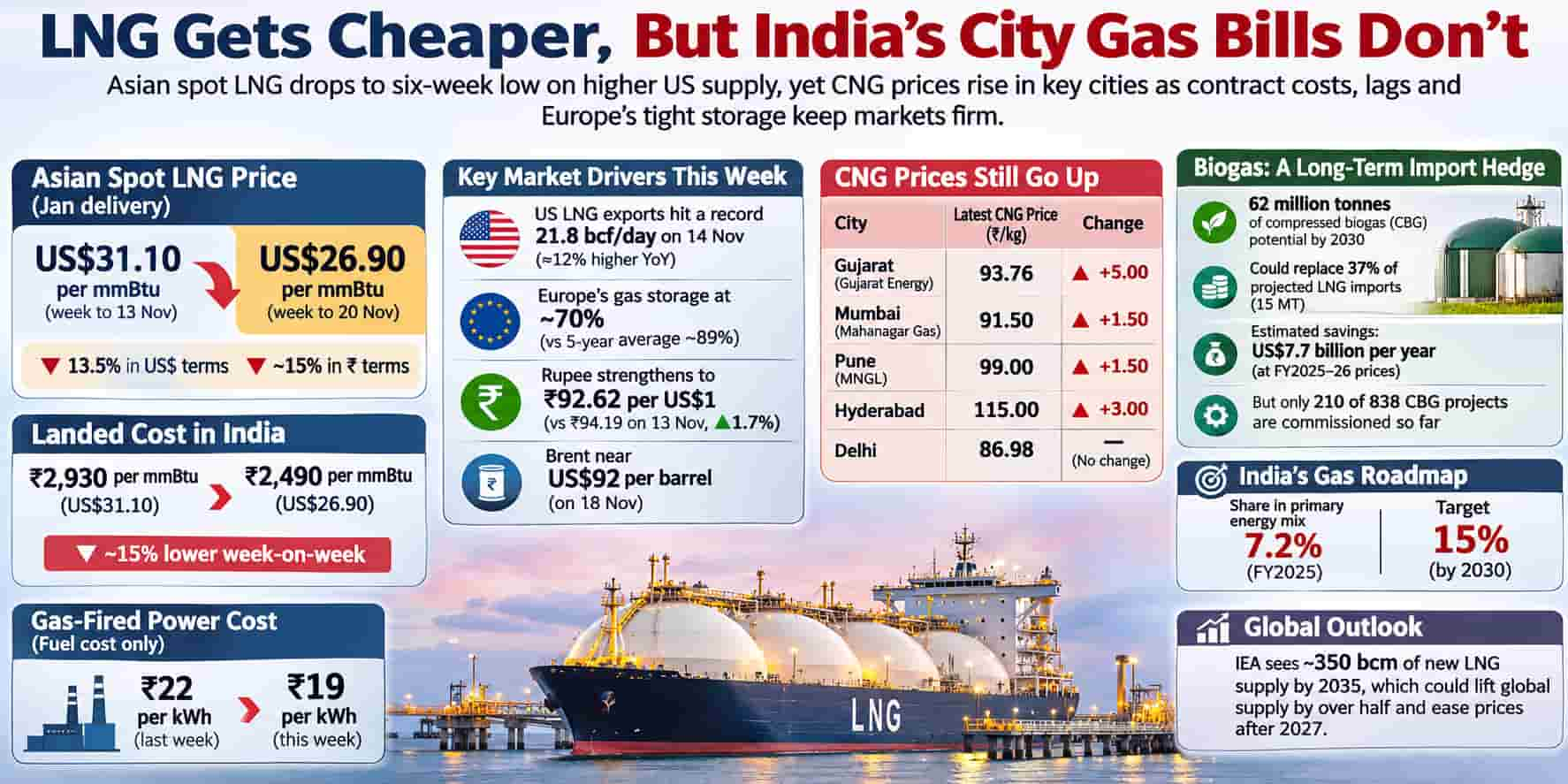
Asian spot LNG for January delivery averaged US$26.90 per mmBtu in the week to 20 November. A week earlier, the same January delivery was US$31.10. That is a fall of 13.5% and the third weekly decline. It is the lowest level since 9 October, as per recent trade data.
Buyers in China, South Korea and Japan were largely covered. LNG kept moving through the Strait of Hormuz. Thailand, Pakistan and Vietnam still bought some cargoes. At least four cargoes were diverted away from Egypt, where gas cuts to fertiliser and industrial users reduced demand.
US supply is the other force. Gas flows to US LNG plants hit a record 21.8 bcf a day on 14 November, about 12% above a year earlier, as per industry data. Golden Pass, a joint venture of ExxonMobil and QatarEnergy, set its own record. So Qatar’s American molecules flow freely, while its Gulf cargoes remain under force majeure, which QatarEnergy has extended to the end of December.
US gas trades near US$3.2 per mmBtu. The gap to Asian spot is about US$24. That spread explains why every spare US cargo is chased. For India, it means more supply in the Atlantic, but Europe’s bids still decide where those ships go.
An analyst tracking global LNG markets said: “Asia is covered for now. That is why prices are falling even as Europe’s storage runs below 70%. January is when both regions need cargoes at the same time.”
Europe’s thin buffer still sets the floor
Dutch TTF traded at €85.78 per MWh on 20 November, on course for a weekly fall of more than 6%. It touched a six-week low near €81 on 18 November. The fall came despite Houthi missile strikes on Riyadh and fresh mine explosions in Hormuz on 20 November.
Storage remains the weak point. EU sites were about 70% full on 19 November, against a five-year average near 89%. A cold spell is forecast from around 20 November. For India, this keeps Atlantic cargoes costly in January and February. Indian and European buyers will then bid for the same ships.
 Landed cost: A double fall
The rupee closed at ₹92.62 on 20 November, against ₹94.19 on 13 November. That is a gain of 1.7%. It was the first close stronger than ₹93 in over seven months. Foreign investors bought equities worth ₹10,308 crore (US$1.1 billion) on the day, and lower crude prices helped. Indoen’s weekly review shows Brent near US$92 on 18 November.
So spot LNG now equals about ₹2,490 per mmBtu (US$26.90), against ₹2,930 (US$31.10) a week earlier. In dollars, the fall was 13.5%. In rupees, it was about 15%. Regasification and pipeline charges come on top.
Contract prices tell another story. With Brent near US$90 and a typical 12–13% slope, a fresh oil-linked cargo would price near US$11–12. Cargoes arriving now follow earlier, higher crude, so nearer US$13–15, on Indoen’s estimate. Spot is still about twice that. Indoen’s earlier analysis showed how India’s supplier map has changed.
Gas-fired power is cheaper, but not cheap. At US$26.90, fuel alone for a plant with a heat rate near 7,500 Btu per kWh costs about ₹19 per kWh (US$0.20), on Indoen’s estimate. Last week it was about ₹22. Such plants earn only in the evening peak, as Indoen’s grid coverage shows.
City gas: Costs fall slowly, prices keep rising
Retail prices did not follow spot lower. Gujarat Gas, now Gujarat Energy, raised CNG by ₹5 (US$0.05) to ₹93.76 per kg (US$1.01) from 16 November. The same day, Mahanagar Gas raised Mumbai CNG by ₹1.50 (US$0.02) to ₹91.50 (US$0.99), its eighth hike in 11 months, as per city price listings. MNGL raised Pune CNG to ₹99 (US$1.07). Hyderabad is at ₹115 (US$1.24) after a ₹3 rise.
PNG was broadly unchanged. Pune was the exception, with a ₹1.50 rise to ₹53 per SCM (US$0.57).
Delhi CNG stayed at ₹86.98 (US$0.94), unchanged since 29 August. The gap to Hyderabad is ₹28 (US$0.30), or about 32%. It shows how unevenly gas costs have reached consumers.
An executive at a leading Indian gas utility said: “Our gas cost is still catching up with the October peak. Spot has eased, but we buy on contracts with a lag. Until that clears, we cannot hold prices everywhere.”
The network keeps growing. India had about 17.8 million domestic PNG connections and 9,266 CNG stations on 30 September, as per PPAC data. Mahanagar Gas and GAIL also stepped up coordination on PNG Drive 3.0 on 17 November.
Policy: Biogas as an import hedge
A CII–EY report, released on 17 November, says India’s feedstock could support 62 million tonnes of compressed biogas a year by 2030. That is above the roughly 40 million tonnes of LNG India may import that year. Replacing all of it would save US$20.6 billion a year at FY2025–26 import prices. A more realistic 15-million-tonne target would replace 37% and save US$7.7 billion.
This is the second surprise. Those savings assume US$9.8 per mmBtu. At this week’s US$26.90, the same 40 million tonnes would cost about US$56 billion, and the 37% about US$21 billion, on Indoen’s arithmetic. Price risk is bigger than volume risk.
The gap to delivery is wide. Only 210 of 838 registered CBG projects are commissioned. Another 255 are under construction, and 373 have not started. The report seeks relief from state VAT on the CBG part of blended gas. It also backs cluster pipelines under the GOBARdhan scheme. The savings are a scenario, not a forecast. They assume all output displaces imports.
The December domestic gas price is due by 30 November. It will show how far the crude slide narrows the gap between November’s US$12.00 formula price and the US$7 cap.
The energy-security question
India wants gas at 15% of its primary energy mix by 2030. The share was 7.2% in FY2025. This week’s fall is welcome, but it rests on US supply and Asian restocking, not a Hormuz settlement.
There is a longer view. The IEA’s World Energy Outlook 2026, released on 19 November, sees about 350 bcm of new LNG supply by 2035, which could lift global supply by over half if projects proceed. That points to softer prices after 2027, and a stronger hand for Indian buyers in term talks.
Winter comes first. Watch Qatar’s next force majeure notice, mine incidents in Hormuz, the cold spell in Europe and CNG price decisions in Delhi.
Follow us on : X | LinkedIn | Facebook | Bluesky