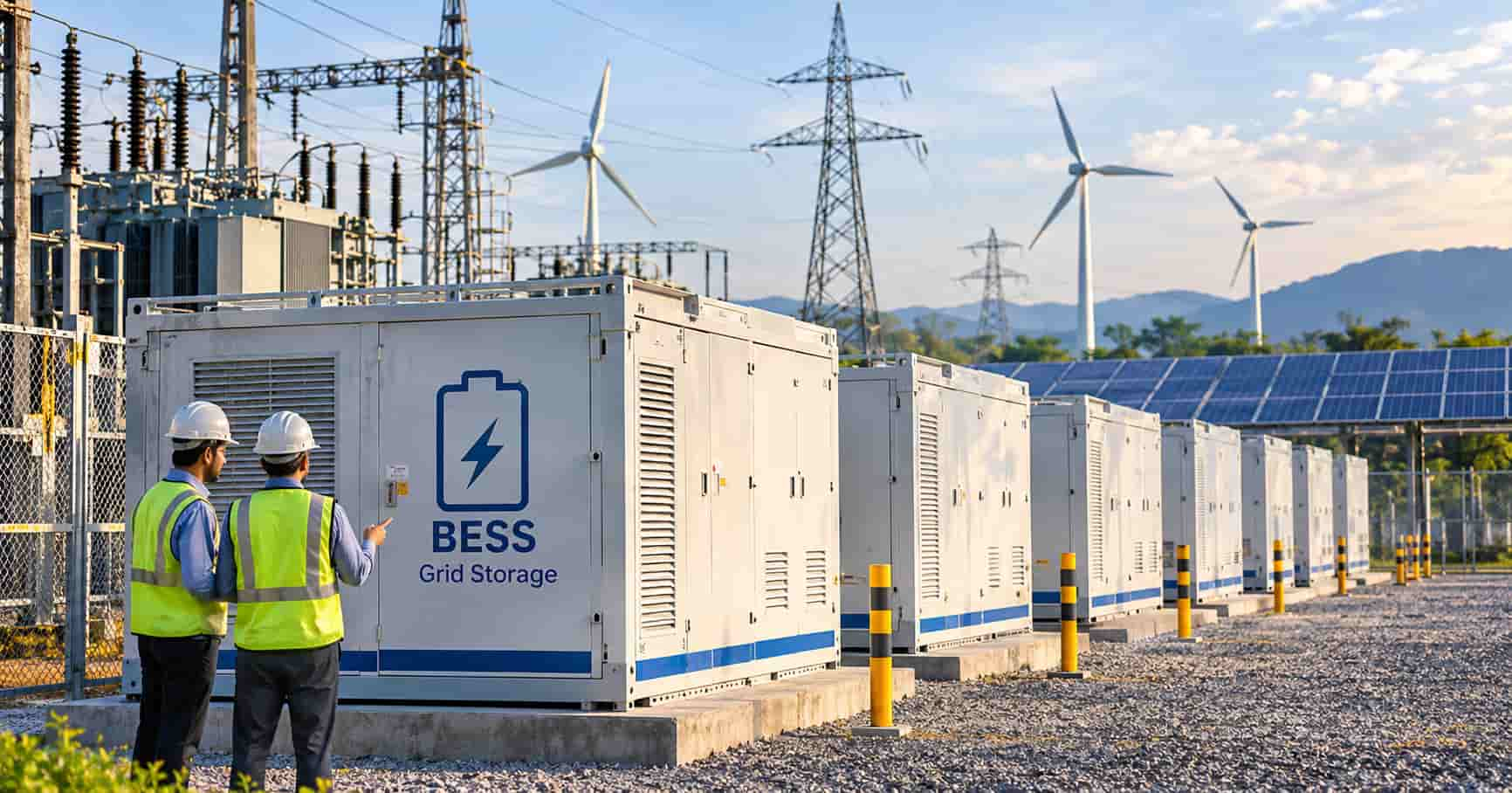
India’s Ministry of Power issued draft amendments on 10 November. They would make domestic content mandatory for energy storage in four bidding guidelines. Comments close on 25 November.
Three days later, China’s planners published their storage plan for 2026 to 2030. The two documents look unrelated. Read together, they ask different questions. India asks where batteries come from. China asks what they earn.
China moves from building to earning
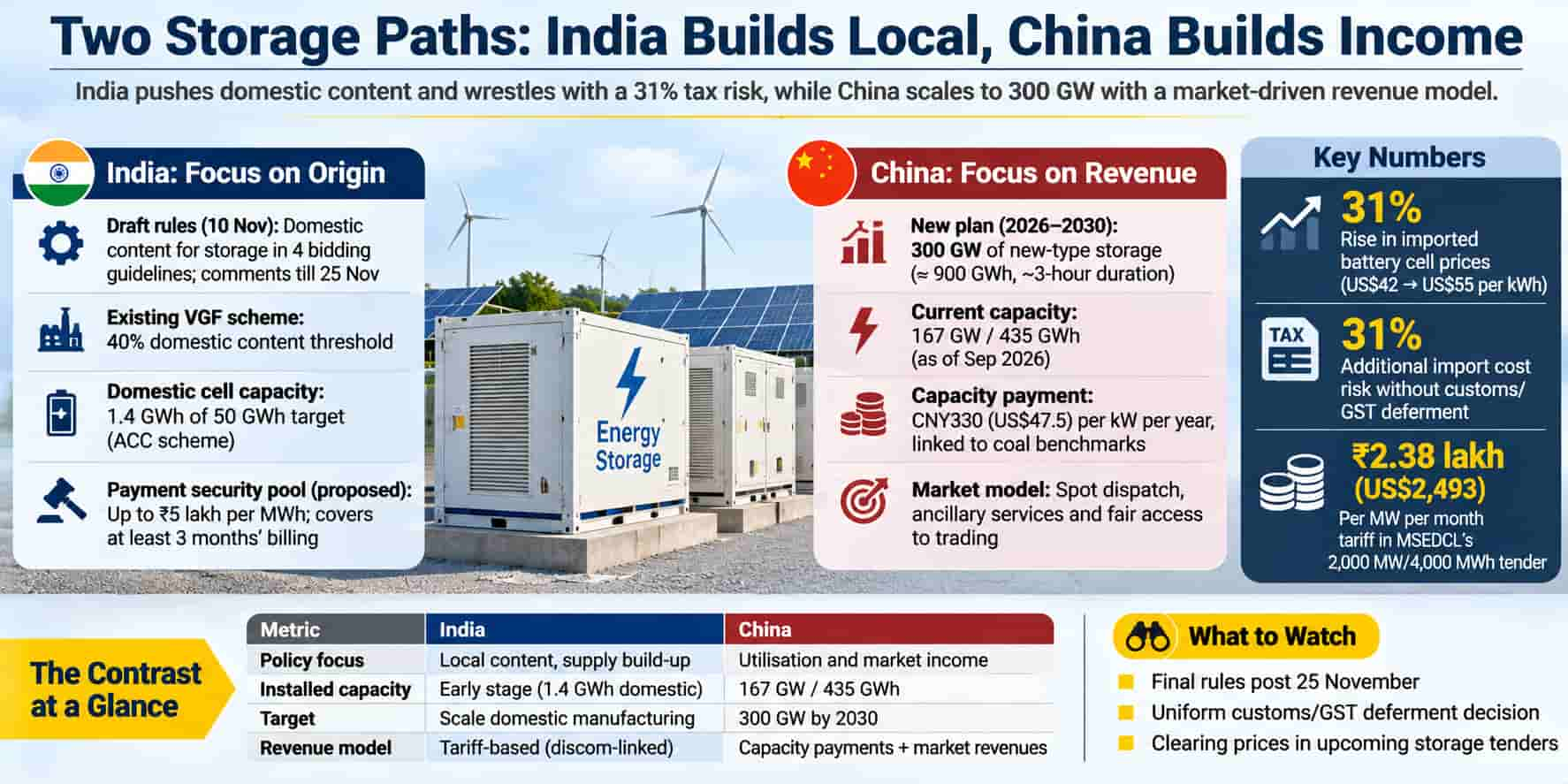
The Chinese plan targets 300 GW of new-type storage by 2030, at an average duration of about three hours. That implies roughly 900 GWh. China had 136 GW at the end of 2025. As per recent reporting, it reached 167 GW and 435 GWh by September 2026.
The bigger change is in revenue. A January notice gave standalone storage a capacity payment, pegged to local coal capacity benchmarks. It builds on a national fixed-cost reference of CNY330 (US$47.5) per kW a year. The new plan adds spot-market dispatch, ancillary services and fair access to trading.
One analysis of the formula notes that two- and three-hour systems earn less than longer ones. Utilisation is rising. Equivalent hours reached 1,195 in 2025, about 300 more than a year earlier. Yet planners also warn against disorderly battery manufacturing expansion.
India polices origin
The Indian draft does not fix a percentage. It points to existing central orders. The viability gap scheme for batteries already uses a 40% domestic content threshold. The supply side is thin. Under the advanced chemistry cell scheme, only 1.4 GWh of a targeted 50 GWh had materialised by January, according to an IEEFA report.
Meanwhile, landed cell prices reportedly rose from US$42 to US$55 per kWh in 2026. That is a rise of about 31%. Higher lithium, copper and aluminium prices and changes to China’s export incentives drove it. Indoen has already tracked this price turn. Its look at the four-hour grid rule shows how selective access to the grid has become.
 A second 31%
Here the story turns. The same report says the Finance Ministry is weighing a uniform rule on customs duty and GST deferment for imported storage equipment. Some customs offices have allowed deferment under the warehousing route. Others have rejected applications or kept them pending for months.
Without deferment, developers face an extra burden of nearly 31% of import value. Electricity supply is exempt from GST, so they cannot claim the tax back. The figure matches the 31% cell price rise by coincidence, but the effect is the same. Two shocks of similar size can hit a project bid in 2025.
There is a policy contradiction here too. Separate reporting says the ministry is also examining whether warehousing benefits should continue for imported, fully assembled systems. One ministry pushes local content. Another is unsure how to tax imports. Developers are caught between them.
A policy adviser familiar with industry representations to the ministry put it plainly: “Developers priced these projects on the legal position they saw in 2025. A change in duty treatment hits them first. It then returns to the distribution company through change-in-law claims.”
The payment question
Tariffs already show the strain. The latest IEEFA-JMK data shows SJVN’s 265 MW tender in September cleared at ₹2.35 lakh (US$2,462) per MW a month. That is 19.3% above ₹1.97 lakh (US$2,064) in a similar tender in February that was later cancelled.
Total storage tendering fell about 66% from the previous month to 0.98 GW. Re-tenders made up 57% of issuance.
Maharashtra’s MSEDCL awarded 2,000 MW/4,000 MWh at ₹2.38 lakh (US$2,493) per MW a month. If the 15-year agreements reported for that tender run their full term, Indoen’s arithmetic puts payments at about ₹8,600 crore (US$920 million). A distribution company carries all of it.
The Power Ministry’s draft addresses this. Intermediary procurers could collect a non-refundable contribution of up to ₹5 lakh (US$5,350) per MWh from developers to fund a payment security pool. It would cover at least three months of billing. Participation is optional.
Two points stand out. First, developers would be funding their own insurance against their customers’ late payment. Second, the cover looks adequate on paper. At the maximum rate, the MSEDCL tender would build a fund of about ₹200 crore (US$21 million). One quarter of its billing is about ₹143 crore (US$15 million). The real questions are whether developers opt in and whether lenders accept the arrangement.
China treats the same problem differently. Its capacity charges flow into system operating costs. The whole system pays for availability. In India, each distribution company’s balance sheet carries its own storage bill.
A shared worry about oversupply
China’s plan warns against disorderly battery manufacturing expansion. India’s domestic content push is meant to build exactly that capacity. The timing is awkward. Today, cells are getting dearer for Indian importers. If China trims its own manufacturing surplus, prices could rise further while Indian supply is still being built.
A researcher at a New Delhi-based energy think tank framed it this way: “China is asking what a battery earns after it is built. India is still settling who builds it and who pays the first bill. Both questions meet at the bidding stage.”
What to watch
Three things will tell. The first is what the Power Ministry finalises after the 25 November deadline, especially the payment pool. The second is whether the Central Board of Indirect Taxes and Customs issues one uniform rule. The third is where the next tenders clear.
Indoen’s look at global storage targets showed how much China and India now drive the world’s storage plans. China is trying to build a market on top of its fleet. India is still building the rules beneath its own.