
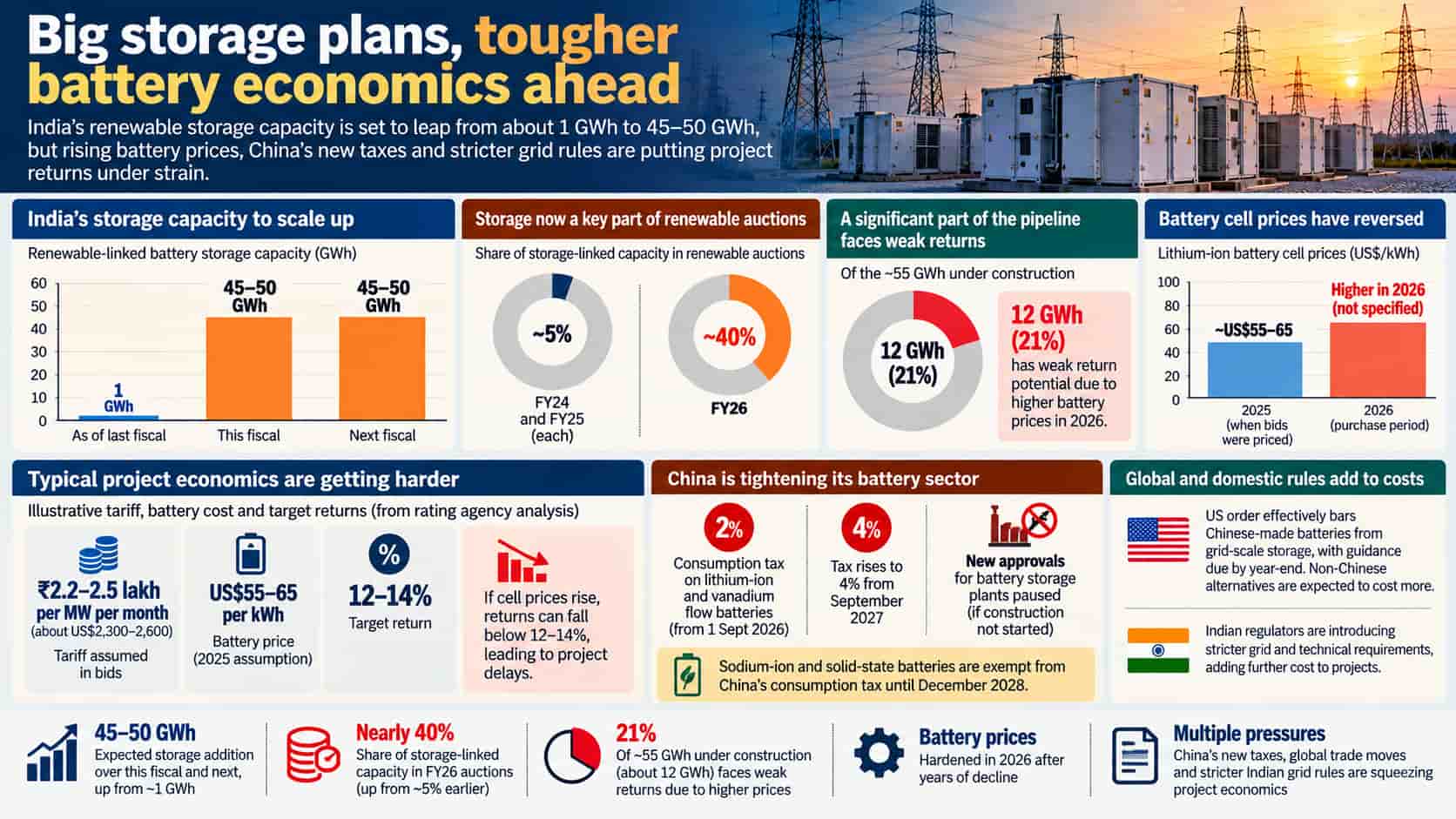
India’s battery storage story rests on one striking number. About 1 GWh of renewable-linked storage was commissioned as of last fiscal. A domestic rating agency now expects 45–50 GWh over this fiscal and the next, based on bids won between FY24 and FY26 across nearly 100 developers. Industry analysis suggests demand is not the worry.
Storage-linked projects made up nearly 40% of auctioned capacity in FY26, up from about 5% in each of the two years before. The worry is price. The same analysis finds that about 12 GWh, or 21% of the pipeline under construction, has weak return potential because battery prices have hardened in 2026.
A bid priced on a falling market
The mechanism is simple. Developers usually buy batteries about a year after winning a bid. Through 2025, cell prices kept falling, so many bid aggressively and assumed the fall would continue. It did not. Projects awarded in 2025 are now buying at 2026 prices against tariffs set on 2025 hopes.
The margin for error is thin. The agency’s own illustration pairs a tariff of ₹2.2–2.5 lakh per MW per month (about US$2,300–2,600) with battery prices of US$55–65 per kWh. That gives the usual target return of 12–14%. If cell prices rise, the return slips below that line, and developers may defer purchases and wait for cheaper cells.
Inexperience adds to the risk. About 8–9 GWh of the weak-return capacity belongs to sponsors with limited execution records, who may struggle to buy equipment on good terms. Early signs of stranded projects are already visible, the agency notes.
Here lies the first hidden point. A fixed-price tender quietly makes each winner a seller of price insurance. For the year between award and purchase, the developer is short on battery prices, usually with no hedge.
“We bid on the cell price we could see in 2025, and the purchase order goes out a year later,” said an executive at one of India’s leading renewable energy developers. “That gap has no hedge, and nobody priced it.”
 Beijing is ending the price war
The cheap cells behind India’s low bids came from Chinese overcapacity, and that is now being disciplined. China began levying consumption taxes on batteries from 1 September 2026. Lithium-ion and vanadium flow batteries face 2%, rising to 4% from September 2027. Beijing has also reportedly paused approvals for new battery storage factories that have not begun construction, as per recent reporting citing industry sources. Chinese solar makers moving into storage to escape their own oversupply had added to the glut.
The reports do not say how far the tax will reach export prices. The direction, however, is clear. Beijing wants fewer price wars and healthier margins. India’s 2025 bids assumed the opposite.
The tax design holds a second surprise. Sodium-ion and solid-state batteries are exempt until December 2028. So the chemistry that dominates Indian tenders today is taxed, while the one Beijing hopes to lead tomorrow is not. A new roadmap from China’s Ministry of Industry and Information Technology targets initial volume production of solid-state batteries by 2030. It also admits weak original innovation and supply-demand imbalances in lithium-ion.
Timing sharpens the point. The tax doubles in September 2027, when a large part of the 50–55 GWh scheduled for FY27 and FY28 is still to be commissioned.
The US adds another pull. As per recent reporting, a late-August executive order effectively bars Chinese-made batteries from grid-scale storage there, with Department of Energy guidance due by year-end. Analysts quoted in the report expect non-Chinese alternatives to cost more. India is not the target, but it draws on the same supply chain.
The rulebook is moving too
Costs are rising even as Indian regulators add duties. On 3 September, the Central Electricity Authority (CEA) issued draft technical rules. From 1 July 2027, at least 15% of inverters at new renewable plants would need grid-forming control, as would every battery power conversion system.
Ground-mounted solar and onshore wind plants would need co-located storage of at least 10% of capacity for two hours. A 100 MW solar plant would need 10 MW and 20 MWh. The duration rises to four hours from July 2029, according to a media report.
On 21 September, the Central Electricity Regulatory Commission (CERC) added a draft grid code amendment. Standalone storage would need a trial run of at least 50 MW in aggregate, with staged trials allowed for larger projects. Systems of 10 MW and above, connected at 33 kV or higher, would join the primary frequency response framework.
Those of 25 MW and above must support automatic operation from the load despatch centre. Delays in starting commissioning could be extended by three months at most, with monthly updates, industry reports suggest. Comments close on 4 October for the CEA draft and 21 October for the CERC draft.
Each rule makes technical sense. The trouble is timing.
“None of the tariffs fixed in 2025 priced grid-forming controls, frequency response or automated dispatch,” said a researcher at a New Delhi-based energy think tank. “Someone has to decide who pays for them, and it is better done before commissioning than after.”
The drafts do not answer that. Whether existing contracts allow any cost pass-through is not clear from the reporting. It is the first question developers and distribution companies will ask.
A market that is already sorting itself
The tender data show a market that is real but selective. India added 8.2 GWh of battery storage in H1 2026, about 84 times the 98.4 MWh of a year earlier, according to a market research tracker. Yet Q2 additions of 3.6 GWh were 22% below Q1. Storage tenders of 28 GW were issued in H1, but only about 9 GW was auctioned, down 18% year on year. The tracker’s H1 report puts the shift in numbers.
An industry body’s H1 review points the same way. Of 281 GWh tendered so far, 105 GWh is under execution and 110 GWh is still at tender stage. About 53 GWh of tenders were cancelled. Of the 8.5 GWh operating, 6.9 GWh runs in merchant mode, outside government-backed contracts, as per recent reporting. Trackers count differently, so their totals are best read as trends, not one ledger.
Read together, thin auctions, cancelled tenders and delayed projects suggest buyers and sellers are still searching for a price both can live with. Indoen Energy noted in May that aggressive bidding was raising questions about storage profitability. In August, it reported that falling global prices were financing a boom built on imported cells. The new evidence shows what follows when that tailwind reverses.
What to watch next
The long-term need is not in doubt. A domestic rating agency estimates India’s storage requirement will rise nearly eightfold to 411 GWh by FY32, from about 54 GWh operational in June 2026. That needs investment of over ₹4 lakh crore (US$41.7 billion). Curtailment already shows the stress. Nearly 8.1 TWh of solar was curtailed in the first quarter of FY27 because of transmission and grid-stability concerns, the report notes.
So the real question is not whether storage will be built. It is who carries the price risk on the way. Three markers will show the answer. The first is the next auction round, where higher bids would confirm that the market has repriced. The second is the final CEA and CERC text, including any relief for existing contracts. The third is China’s tax step-up in September 2027.
For India, the lesson is familiar from the early solar boom. Cheap tenders look like policy success until the cost cycle turns. Storage now faces its own version of that test. This time, the cycle is being set in Beijing and Washington, not New Delhi.