
Governments are setting bigger storage goals, but the numbers still fall short of what the world promised. A new, recently released report from Ember finds that global 2030 storage targets now add up to 822 GW. That is almost three times the 284 GW counted before COP29, a rise of 190%.
The pledge itself is far larger. The Global Energy Storage and Grids Pledge, signed by 74 countries at COP29, aims for 1,500 GW by 2030. That is a sixfold jump in global capacity. Even after the rise, targets cover only a little more than half of it.
Storage matters because it smooths supply and helps grids absorb variable wind and solar power. It also keeps a renewables-heavy grid stable. Along with grid infrastructure, it helps turn the COP28 goal of tripling renewable capacity into actual generation.
The analysis covers 98 countries and the EU as a bloc, which together hold 97% of global renewable capacity. Of these, 33 have a 2030 storage target.
Two economies explain most of the jump
Look closely, and the headline loses some of its shine. Since COP29, eight countries and the EU have raised their storage targets or declared new ones. Two moves matter most.
China lifted its target by 330 GW, from 130 GW to 460 GW, in its 15th Five-Year Plan. The plan sets 300 GW of new-type storage, mostly lithium-ion batteries, and 160 GW of pumped hydro. China also reached its 2025 goal of 30 GW two years ahead of schedule.
The EU declared its first bloc-wide target of 200 GW under a Tripartite Agreement on Energy Storage, signed in June 2026. The agreement aims to cut gas demand and make better use of renewable capacity.
Together, China and the EU hold over 80% of all national storage targets. “The headline tripling is really two markets moving, not a wholesale change in how governments plan for storage,” said one analyst.
The rest of the picture is patchy. Among the eight largest targets, five have gone up since COP29. India, Spain and Italy have not changed theirs. Spain and Italy will anyway have to fall in line with the EU-wide figure.
Some smaller markets show what is possible.
Viet Nam sharply raised its 2030 ambition to 16.3 GW of batteries and 6.0 GW of pumped hydro. Its 2023 plan had only 0.3 GW and 2.4 GW.
Italy targets 15 GW of batteries and 7.5 GW of pumped hydro, and buys storage through central auctions. Its first auction in 2025 far exceeded expectations. A larger one is due in November 2026.
The UK plans 23–27 GW of batteries, plus 4–6 GW of long-duration storage. Australia’s grid operator projects 33 GW by 2030, though that is a planning projection and not a binding government target.
 nstallations are racing ahead of policy
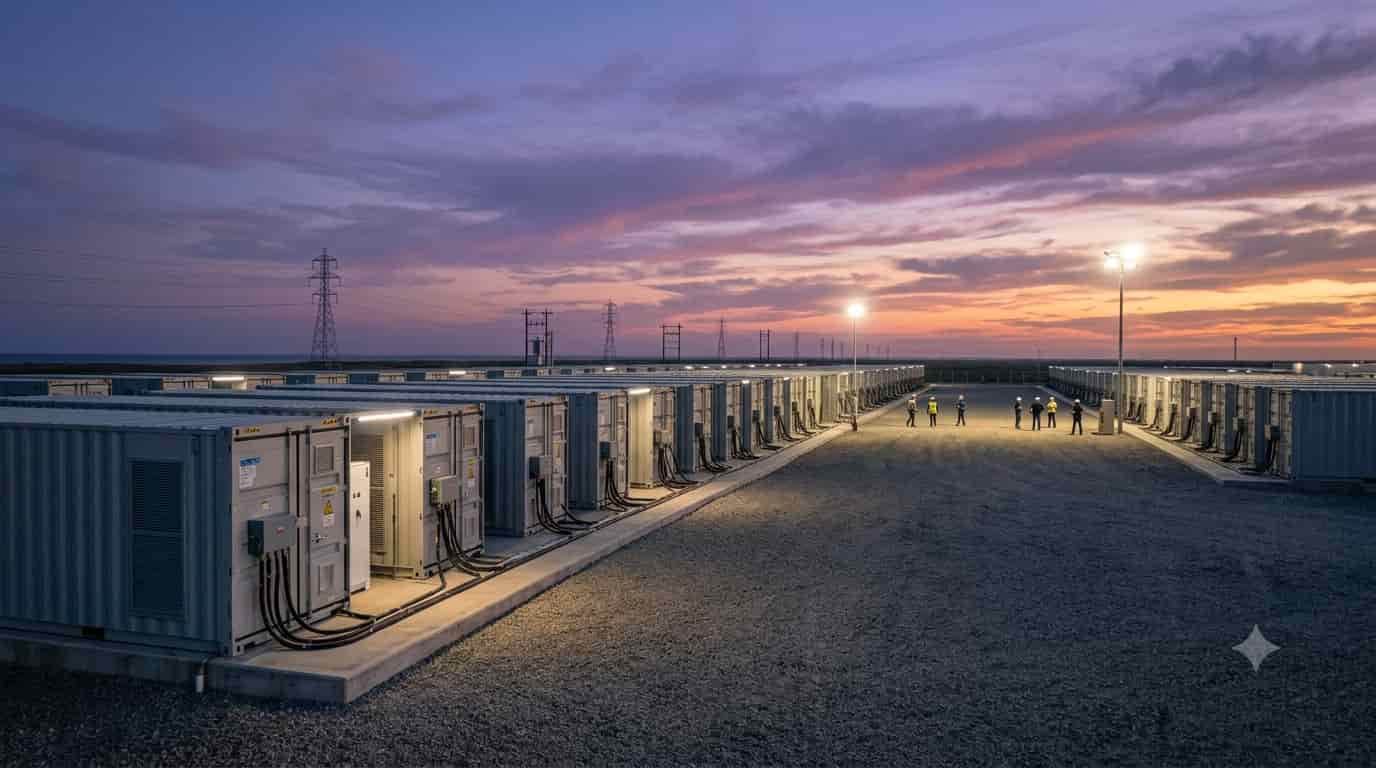
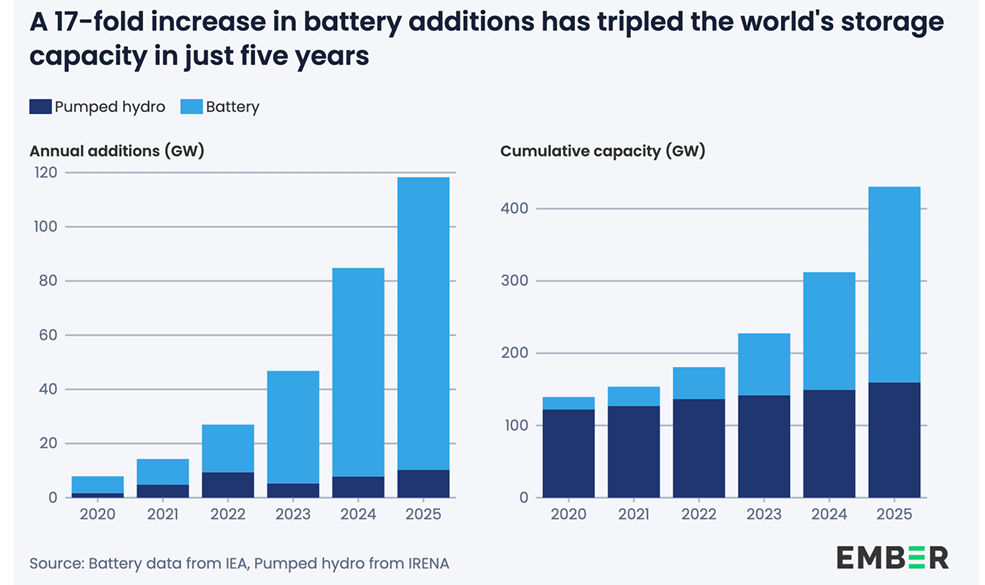
Here is the surprise. The market is moving much faster than governments. Global storage additions hit a record 118 GW in 2025, of which 108 GW were batteries. That is 40% more than in 2024. China accounted for 54% of additions and the US for another 16%. Cumulative installed capacity stands at 430 GW.
Over five years, battery additions have grown seventeen-fold. The world’s storage capacity has tripled in the same period.
The speed is striking even by clean energy standards. Batteries went from about 10 GW of annual additions to 100 GW in four years. Solar took nine years to make the same climb. Wind took 15.
Do the sums, and policy looks timid. Reaching 822 GW from 430 GW needs just 78 GW of additions a year between 2026 and 2030. That is well below what was installed in both 2024 and 2025.
If the 2025 pace simply continued, capacity would touch 1,020 GW by 2030. That is 24% above the sum of national targets. Falling costs are a big reason. Battery storage costs have dropped by roughly 20% a year on average over the past decade.
The pledge looks within reach
The gap between today’s 430 GW and the 1,500 GW pledge is 1,070 GW. Yet the study argues that the growth needed is modest.
In the International Energy Agency’s (IEA’s) net zero scenario, batteries alone reach 1,200 GW by 2030, which is 80% of the pledge. BNEF forecasts 158 GW of battery additions in 2026, a 46% rise over 2025. After that, annual storage additions need to rise only from 171 GW to 216 GW between 2027 and 2030.
Put differently, annual additions have grown by 72% to almost 80% a year since 2020, depending on the measure. They need to grow at only about a fifth of that rate. Even 20% yearly growth between 2026 and 2030 would deliver the pledge.
There is a caution, though. Growth has cooled. Battery additions roughly doubled every year in the early part of the decade, but the rise slowed to 1.4 times between 2024 and 2025. Reaching 1,200 GW of batteries needs another 1.4 times increase over the next four years. That is achievable, but it is not automatic.
Do targets still matter?
A fair question follows. If markets are already building, why bother with targets?
The study offers evidence for this view. The US and Germany have no 2030 storage target, yet the US has installed roughly 52 GW of utility-scale batteries and Germany about 30 GWh. Saudi Arabia has just connected the world’s largest single battery project at 7.8 GWh, on its way to a 48 GWh target by 2030. Chile added enough batteries in 2026 to shift more than three-quarters of its new daily solar generation into non-sunny hours.
Still, the study holds that targets add value. “Markets are already building storage, but a target tells investors where and what kind of storage the grid will need,” said another analyst. Without such signals, the wrong mix can end up in the wrong places.
Other large solar markets show the risk. Poland’s 1.5 GW of storage is 85% legacy pumped hydro, not new batteries. Austria has a 3.2 GWh battery fleet, Switzerland 1.6 GWh and Brazil 0.7 GWh. Of the world’s top 20 solar countries in 2025, eight still have no 2030 storage target.
Solar and storage rise together
Batteries turn cheap midday solar into power available round the clock. They store the noon surplus and release it in the evening and overnight, which reduces curtailment and grid stress. Ember research estimates that 34% of new solar could be shifted to the evening because of batteries added in 2026.
The IEA’s tripling-aligned scenario pairs about 6,100 GW of solar with 1,500 GW of storage, a ratio of 4:1. In 2025, the world added more than 6 MW of solar for every 1 MW of batteries.
Of the 33 targets, 17 have a 2030 solar-to-storage ratio of at least 4:1. Read carefully, a higher ratio means less storage per unit of solar. On this yardstick, many countries are planning lean.
What it means for India
India has the third-largest storage target in the study, after China and the EU. Its National Electricity Plan 2022–32 yields 31.8 GW of battery storage and 19 GW of pumped storage by 2030. That is about 51 GW in all. It has not been raised since COP29.
The target looks modest next to India’s 319 GW solar target. The study explains this by pointing to the role of batteries in short-duration peaking rather than bulk generation. The ratio works out to 6.3:1.
At the scenario’s 4:1 mix, the same solar capacity would come with roughly 80 GW of storage. This is simple arithmetic on the study’s figures, not a number the study proposes.
Indian readers will recognise the debate. Indoen has earlier examined how India’s battery storage pipeline must turn tenders into working capacity. It has also looked at why coal’s limited flexibility makes batteries urgent in a solar-heavy grid.
If India follows the global pattern, installations could overtake its target well before 2030.
The road to 1,500 GW
The storage story connects to a wider agenda. Türkiye’s COP31 presidency is pushing a 35-by-35 Global Electrification Pledge. It would lift electricity’s share of final energy demand from around 20% to 35% by 2035.
According to the study, that pledge delivers its climate and energy-security benefits only if new demand is met by renewables, backed by grids and storage.
The conclusion is simple. Storage ambition has risen sharply, but almost entirely because of China and the EU. The 2030 goal looks achievable at a fraction of the growth rates already delivered this decade. What is missing is a clearer signal from more governments.
If more countries publish targets, the next count could close much of the gap to 1,500 GW. If they do not, the market will likely keep building anyway, but unevenly and mostly in a few places.
Follow us on : X | LinkedIn | Facebook | Bluesky