
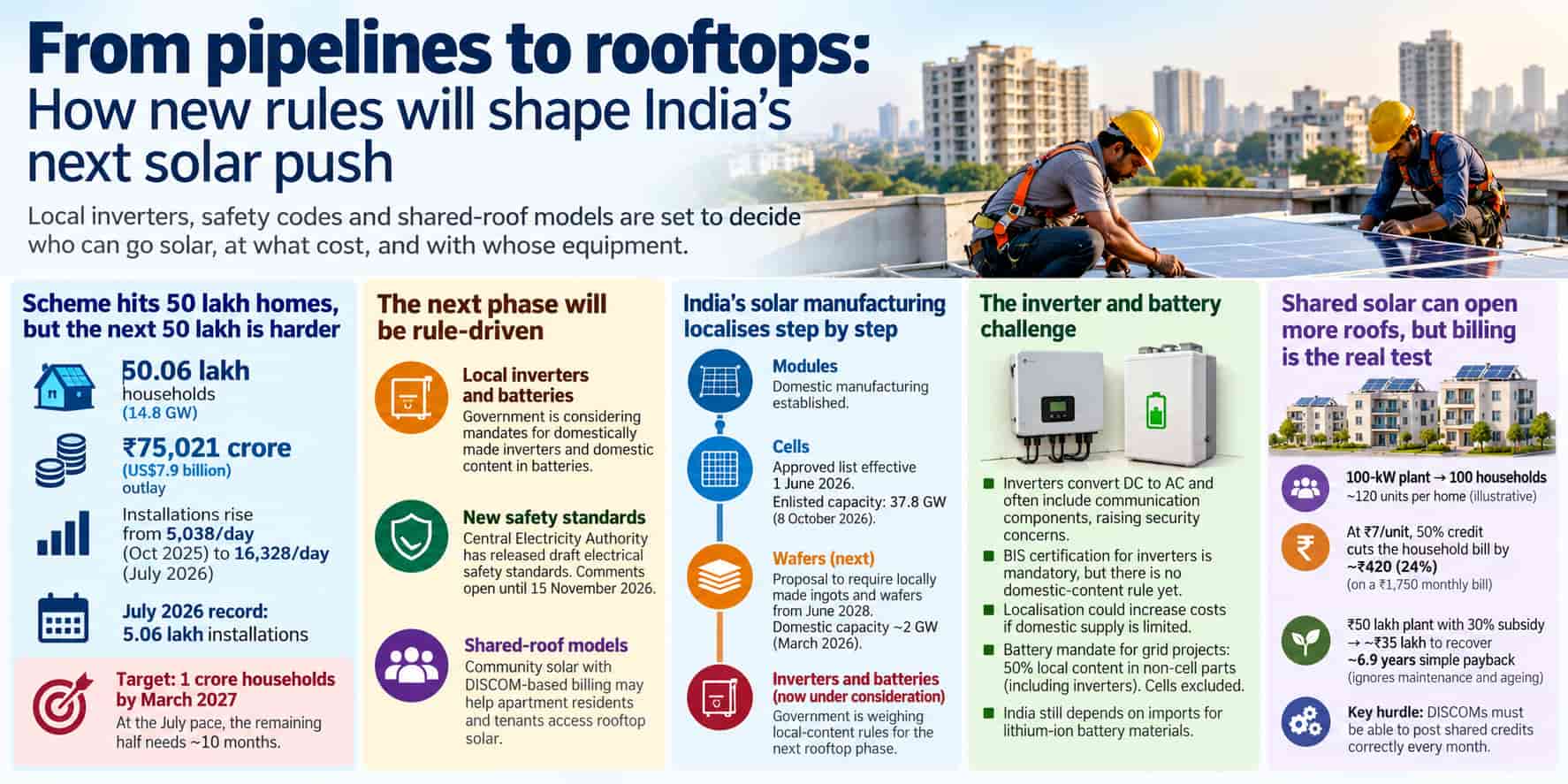
India’s biggest rooftop solar programme has reached 50.06 lakh households. That adds up to 14.8 GW of capacity, as per recent reporting, under a scheme with an outlay of ₹75,021 crore (US$7.9 billion).
The pace has picked up sharply. Daily installations rose from 5,038 in October 2025 to about 16,328 in July 2026. July alone set a record of 5.06 lakh.
Yet the target is one crore households by March 2027. At the July pace, the remaining half needs roughly ten months. That is Indoen’s own arithmetic, and it points past the deadline.
This matters because the next phase is already taking shape. A follow-on scheme is expected after 31 March 2027, with a target of 30 GW of rooftop capacity, according to a media report. The rules for it are being written while the first target is still unfinished.
The ladder of local-content mandates
India has localised solar one link at a time. Domestic modules came first, then cells. The approved list for cells took effect on 1 June 2026. Enlisted capacity reached 37.8 GW after a revision on 8 October, up from about 36.9 GW in late September, industry reports suggest.
Wafers are next. A March proposal would require locally made ingots and wafers from June 2028. Domestic capacity then stood near 2 GW, according to a wire report.
Indoen has already traced how India’s solar makers are trying to fill the cell and wafer gaps. The new point is where the ladder goes next. It is leaving the factory and entering the household. The government is now considering locally made inverters and domestic content in batteries under the next rooftop phase.
 The inverter is more than a box
An inverter looks like a minor item. It is not. It turns the panel’s direct current into grid-ready alternating current. Increasingly, it also talks to the outside world through software.
That is why the mandate may be as much about security as industry. A June 2026 report quoted an industry adviser warning that imported units could carry embedded communication components. The EU, it noted, is weighing limits on funding for projects that use inverters from high-risk vendors. India already makes BIS certification compulsory for inverters under a 2025 order. But it has no domestic-content rule like the one for cells, the report added.
Local content is not the same as local capability, though. “Assembling an inverter in India is not the same as making one,” said an executive at one of India’s leading inverter manufacturers. “The power chips and key components still come from outside. A mandate that ignores this will raise prices before it builds capability.”
That worry has some basis. Industry reports suggest that localisation could push up procurement costs if domestic supply cannot match demand. India also still depends on imports for lithium-ion battery materials.
Batteries show the limits clearly. A separate proposal for grid-connected projects would require 50% local content in non-cell parts. These include energy management systems, containers and inverters. Such parts make up roughly 35% of the cost of large systems. Cells are left out. The same report says the country’s target of 47 GW of storage by 2032 needs about ₹3.5 lakh crore (US$36.8 billion), as per recent reporting.
So, the rule localises what India can make today, not what costs the most. Indoen has noted that the country is 10–15 years away from making its own battery cells. The mandate will not close that gap soon.
Safety codes arrive at the same door
The compliance burden is growing from another side too. The Central Electricity Authority has released draft electrical safety standards covering solar, wind, battery storage, EV charging and grid assets. Comments are open until 15 November 2026, according to a media report.
The draft is wider than rooftop solar. But its effects will reach homes. Developers and installers may need to update procurement specifications, grounding systems and protection relays. The extra effort at the start is expected to cut long-term hazards and insurance liabilities.
Here is the underexplored link. One ministry is weighing where equipment must be made. A separate authority is drafting how that equipment must be wired and protected. Both sets of rules will meet at the same inverter and the same battery. If they are not aligned, installers will carry the confusion, and households will pay for it.
Roofs that nobody owns
The next question is who gets access at all. Many urban households do not own a roof. Apartment residents, tenants and families in shaded plots are left out of the scheme.
A recent guest column proposes community solar run through the electricity bill. One plant on a shared roof would serve many households, and the DISCOM would credit each home every month. In the author’s example, a 100-kW plant gives 100 households about 120 units each. At ₹7 (US$0.07) per unit, half of that credit cuts the household bill and half repays the investor. The column calls these figures illustrative.
The numbers are modest. A household with a ₹1,750 (US$18) bill saves ₹420 (US$4), about 24%. For the investor, a ₹50 lakh (US$52,500) plant with a 30% subsidy leaves ₹35 lakh (US$36,800) to recover. At ₹5.04 lakh (US$5,300) a year, simple payback is about 6.9 years. That ignores maintenance and panel ageing.
The model works on paper, but it is no windfall for anyone.
Its real test is administrative. “The roof is the easy part,” said a researcher at a New Delhi-based energy think tank. “The hard part is the bill. If a utility cannot post a shared credit correctly every month, no housing society will trust the scheme for long.”
Building-integrated solar faces a similar gap. A peer-reviewed review by researchers from three Indian institutions finds the technology suited to many climates and building types. It also lists the barriers: no dedicated national standards, weak policy support, high upfront costs and limited local production, as per recent reporting. The study also notes that the technology is not clearly defined apart from ordinary building-attached panels. Both formats need definitions before they need money.
What to watch
Three things will show whether rules or subsidies lead the next phase. The first is the 15 November deadline for comments on the safety draft. The second is whether local-content rules for inverters and batteries come with a supply roadmap, or only a date. The third is whether DISCOM billing systems can handle shared credits at scale.
Indoen has earlier examined how rooftop solar is winning the numbers game but losing the share game. The next chapter may be less about how many roofs get panels and more about who sets the terms. The first phase was built on cash. The second may be built on paperwork, and households will feel the difference in what they pay and what they can install.