
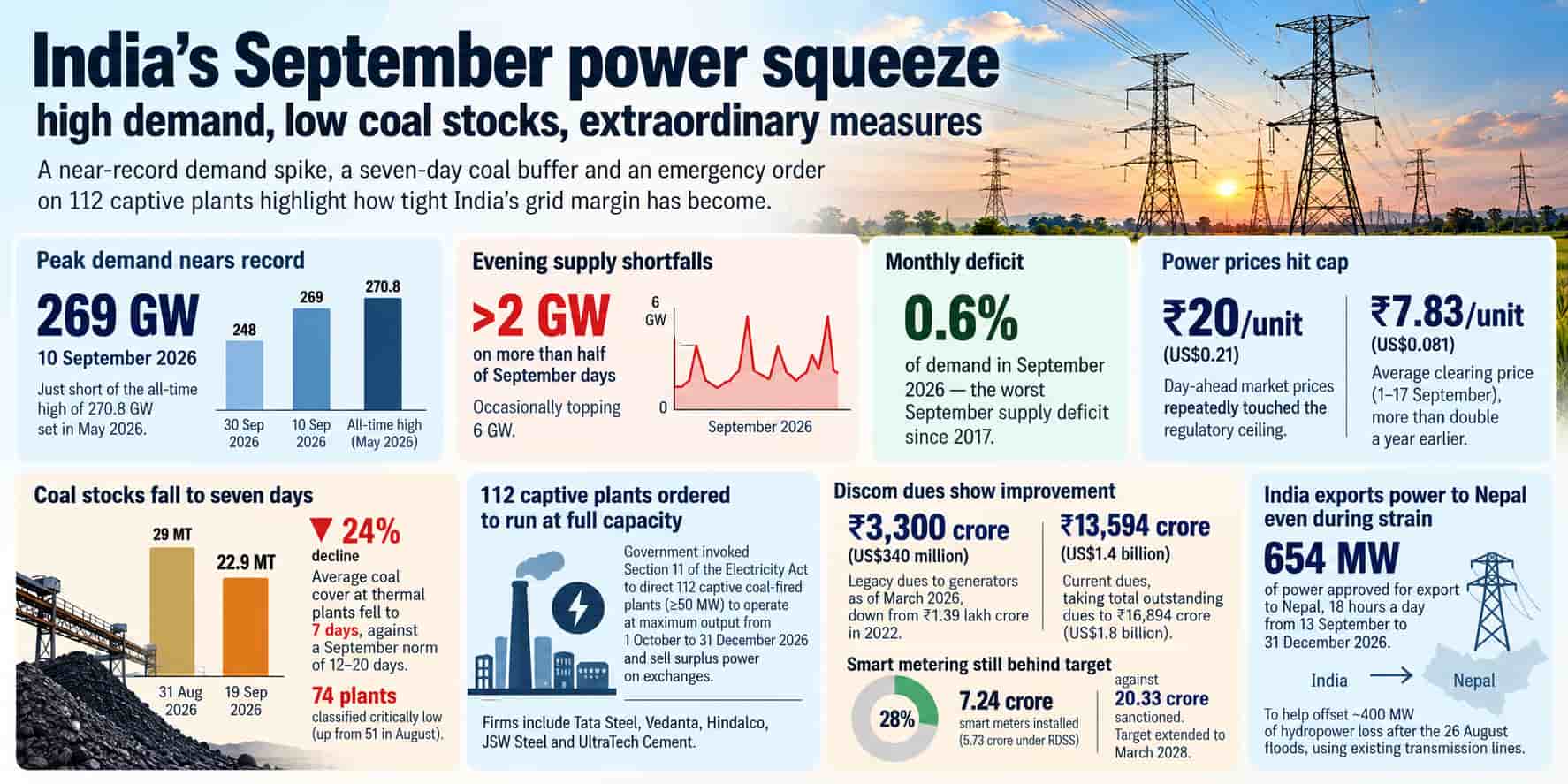
India’s all-India peak demand touched 269 GW on 10 September 2026, just short of the all-time high of 270.8 GW set in May. What stood out, though, was not the peak itself but the supply gap around it. Grid-India data showed evening shortfalls exceeding 2 GW on more than half of September’s days, occasionally topping 6 GW, even though the overall deficit for the month worked out to only about 0.6 % of demand, industry data shows.
That made it the worst September supply deficit since 2017. Maximum demand met on 30 September settled at 248 GW, a reminder that the constraint through the month was timing — getting enough dispatchable power onto the grid in non-solar evening hours — rather than a shortage of installed capacity.
A 15% monsoon rainfall deficit cut hydro generation through the month, pushing more of the evening load onto thermal plants already running down their coal buffers. On the exchange, this showed up directly: day-ahead market prices repeatedly struck the ₹20 (US$0.21) per unit regulatory ceiling, and the average clearing price for the first 17 days of September came in at ₹7.83 (US$0.081) a unit, more than double the same period a year earlier, as per recent trade data.
A price cap meant to protect consumers also means the exchange stops signalling scarcity exactly when scarcity is at its worst — a limitation regulators have flagged before but not yet revisited.
Coal buffers thin to a week, and government steps in
Behind the price pressure sat a coal inventory squeeze. Central Electricity Authority data showed thermal plant stocks falling 24% to 22.9 million tonnes by 19 September, from 29 million tonnes on 31 August, cutting average fuel cover to just seven days against a September norm of 12 days for pithead plants and 20 days for the rest.
Of the 190 plants the CEA tracks, 74 were classified critically low, up from 51 in August, according to a media report.
The government’s response arrived on 25 September. Invoking Section 11 of the Electricity Act, the power ministry ordered 112 captive coal-fired plants of at least 50 MW capacity — belonging to firms such as Tata Steel, Vedanta, Hindalco, JSW Steel and UltraTech Cement — to run at maximum output from 1 October to 31 December 2026 and sell surplus electricity through the power exchanges, with weekly reporting to the CEA, industry data shows.
It was an unusual reach into privately owned industrial generation. A day later, Tata Power disclosed a second extension of a separate Section 11 directive on its 4,000 MW Mundra plant, pushing that deadline to the same 31 December date, a pattern that suggests emergency powers are becoming a standing tool of grid management rather than a last resort.
“Coal is reaching the pitheads; the strain is in moving it to the plants fast enough to match an unusually sustained evening peak,” said a senior official at a central power sector agency. For industrial users whose captive capacity has effectively been nationalised for a quarter, the order raises a fair question about compensation and the opportunity cost of diverted power — a tension the directive does not resolve.
 Discom dues hold steady, smart metering still short of target
Away from the supply emergency, the discom balance sheet showed little new movement this week. Legacy dues to generators stood at ₹3,300 crore (US$340 million) as of March 2026, down sharply from ₹1.39 lakh crore (US$14.4 billion) when the Late Payment Surcharge Rules began in 2022, while current dues of ₹13,594 crore (US$1.4 billion) took total outstanding dues to ₹16,894 crore (US$1.8 billion), according to a media report.
That improvement in payment discipline has not been matched by the metering rollout: 7.24 crore smart meters were installed nationally as of 30 June 2026, with 5.73 crore of those under the Revamped Distribution Sector Scheme against 20.33 crore sanctioned — under 30% of target, and the sunset date already pushed to March 2028, per a parliamentary reply.
This links to Indoen Energy’s earlier coverage of how India’s power grid has stopped being a pipe and is becoming a queue, where congestion rather than headline capacity is the real constraint.
Even under strain, India kept the lights on next door
Perhaps the most telling detail of the week came from across the border. Even while managing its own evening shortfalls, India approved the export of up to 654 MW of power to Nepal, 18 hours a day from 13 September to 31 December, after a 26 August glacier-collapse flood near the Nepal–Tibet border knocked out roughly 400 MW, or a tenth, of Nepal’s hydropower capacity, as per recent trade data.
The power flows through the existing Muzaffarpur–Dhalkebar and Tanakpur–Mahendranagar lines, and the arrangement will be reviewed again in December.
That India could extend regional support during its own tightest fortnight in years says something about surplus capacity elsewhere on the grid, even if that capacity isn’t always in the right place at the right hour.
A flexibility problem, not a capacity one
Taken together, September’s events read less as a shortage story and more as a flexibility story: enough installed capacity, not enough fuel logistics or dispatchable firm power exactly when evening demand peaks.
That is the same structural question running through India’s wider energy transition debate, where rapid solar additions have made the non-solar evening hours the system’s true pinch point, a theme Indoen Energy has examined in its analysis of why India’s coal fleet must learn to flex or its solar boom will keep hitting a wall.
An emergency order on captive plants can buy a quarter of headroom; it does not by itself fix the underlying coal-logistics bottleneck or add the storage and firm renewable capacity that would make such orders unnecessary.