


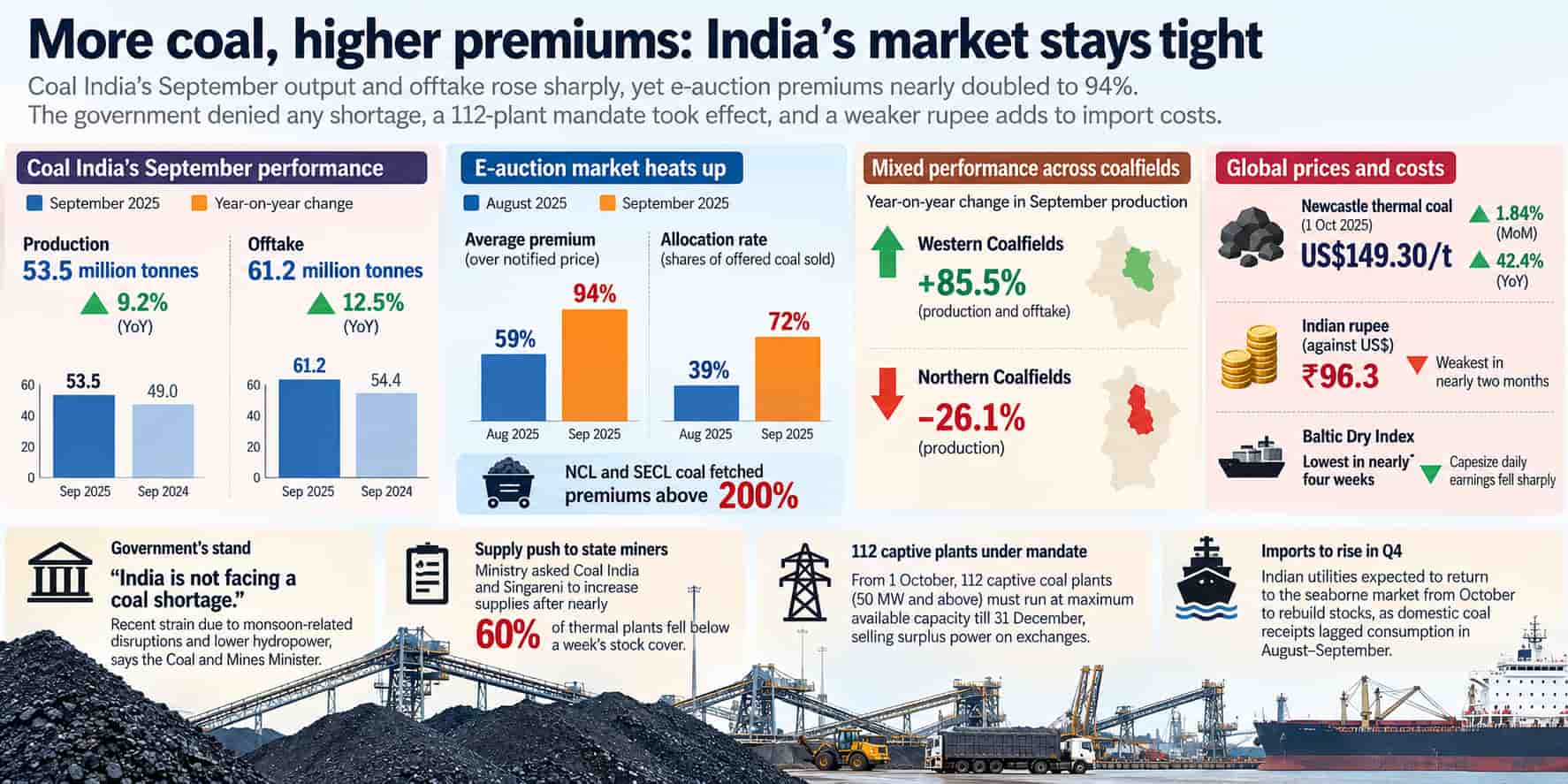
Coal India produced 53.5 million tonnes in September, up 9.2% year-on-year and above its own monthly target of 51.55 million tonnes. Offtake rose even faster, up 12.5% to 61.2 million tonnes, company data shows. By most readings, that is a company meeting the moment.
The e-auction market read it differently. The average premium over notified prices jumped to 94% in September, from 59% in August. The allocation rate, which measures how much offered coal actually found a buyer, rose to 72% from 39%, industry data shows. NCL and SECL coal fetched premiums above 200%.
“Buyers are not waiting for linkage coal to arrive on schedule. They are paying almost double the notified price for the certainty of getting material now,” an analyst tracking Indian thermal coal markets said. That a production rebound and a record premium happened in the same month is the sharpest signal yet that assured supply, not raw tonnage, is what the market is short of.
A tale of two coalfields
The national output number also hides a split underneath it. Western Coalfields posted an 85.5% jump in both production and offtake. Northern Coalfields, by contrast, saw production fall 26.1% for the month, the same company data indicates. A single aggregate figure would have missed both ends of that range entirely, and it is worth remembering, much as Punjab’s comfortable stocks did a few weeks ago, that the coal story in India rarely moves as one block.
 The government says there is no shortage
Against this backdrop, the Union Coal and Mines Minister said publicly on 1 October that India was not facing a coal shortage, attributing the recent strain to monsoon-related mining disruptions and lower hydropower rather than any structural gap, a trade publication reports.
“Rakes and road transport are moving coal to stations; what we are seeing are temporary interruptions, not a broader shortage,” a senior official at the Ministry of Coal said.
The data gives a mixed answer. The CEA’s 27 September report classified 82 of 190 monitored plants as critical, and peak demand was projected to ease to between 230 and 235 GW by 4 October, which should relieve some pressure.
Separately, the Ministry of Coal had already asked Coal India and Singareni Collieries to increase supplies after nearly 60% of plants fell below a week’s stock cover, a business publication reports. A minister’s reassurance and an instruction to two state miners to supply more, issued in the same fortnight, are not strictly contradictory, but they do sit in some tension.
The captive mandate goes live
The Section 11 order flagged in last week’s analysis took effect this week. From 1 October, 112 captive coal plants of 50 MW and above must run at maximum available capacity through 31 December, selling surplus power on the exchanges, as Indoen Energy reported. The order is now a live operational fact rather than a forthcoming one, and its first weekly CEA reports are due before this month is out.
Global prices hold near highs, the rupee does the damage
Newcastle thermal coal closed at US$149.30 a tonne on 1 October, up just 1.84% over the month but still 42.4% higher than a year ago, commodity data shows. The price has essentially plateaued near its highest levels of the year rather than extending the rally.
What moved instead was the rupee, which slid to around ₹96.3 against the dollar this week, its weakest level in close to two months. That depreciation alone adds to the rupee cost of every dollar-denominated cargo, even with Newcastle barely moving.
Freight offered some offset: the Baltic Dry Index fell to its lowest level in nearly four weeks, with capesize daily earnings dropping sharply as Chinese iron-ore demand cooled, shipping data shows. For Indian importers, a weaker rupee and cheaper freight are now pulling landed cost in opposite directions.
Imports are coming back regardless
None of this changes the structural picture for the next quarter. Analysis from shipping-data firm Kpler expects Indian utilities to return to the seaborne market from October to rebuild stock buffers, after domestic coal received at power plants ran well behind consumption through August and September, the firm’s analysis shows. That import rebound would arrive just as Newcastle sits near its yearly highs and the rupee is at a two-month low, a combination that raises the cost of rebuilding the very buffer the crisis has eroded.
Where this leaves the transition debate
The wider question Indoen Energy has tracked since August remains unresolved. A coal company can beat its production target, premiums can hit record highs, and the government can deny a shortage, all in the same fortnight. That is not a sign the system is broken so much as a sign it has very little slack left in it, just as it heads into a festive season with higher demand still to come.
Follow us on : X | LinkedIn | Facebook | Bluesky