
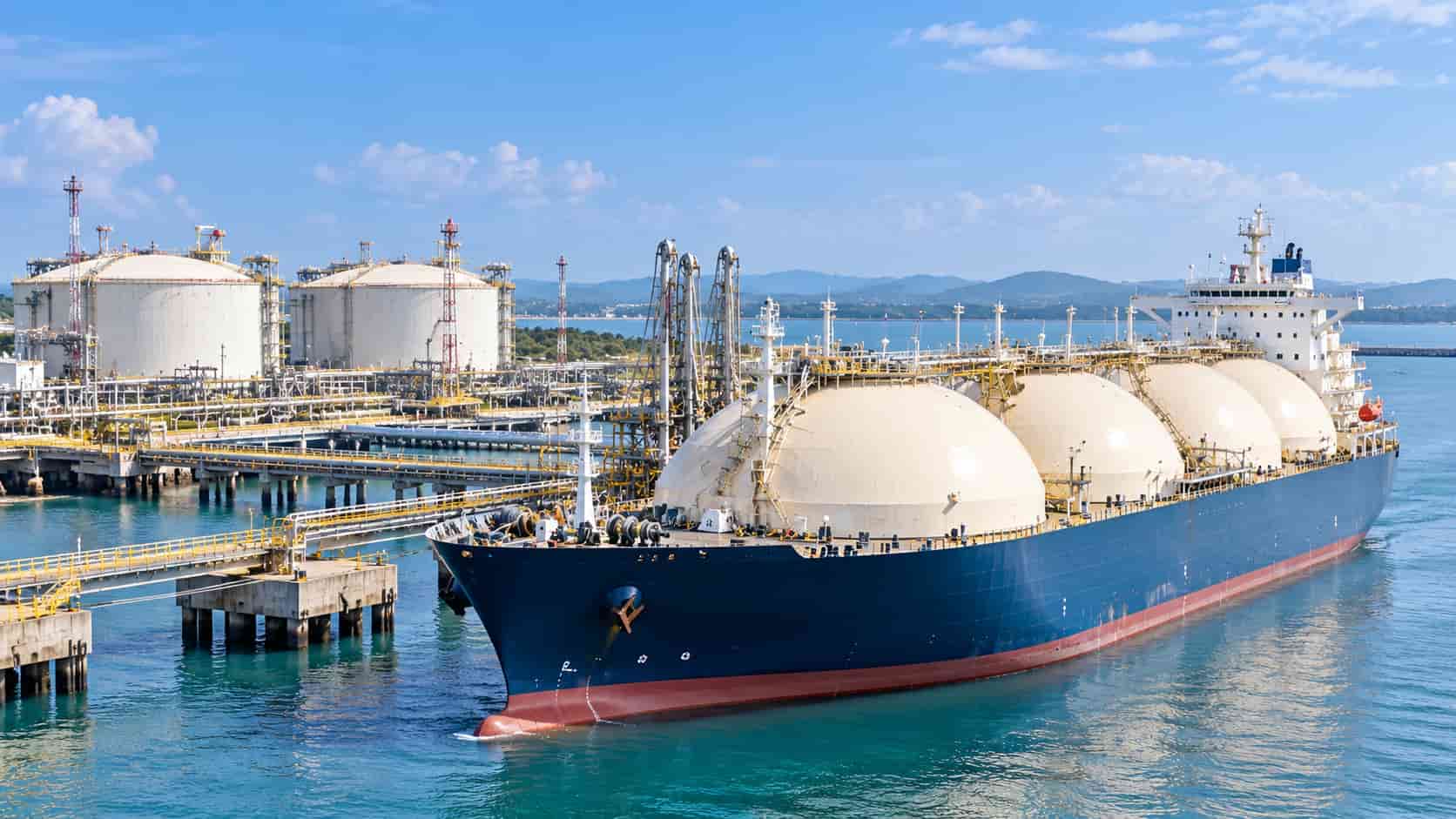

This week’s policy moves, from the six-month gas price ceiling to the new PNG Drive 3.0, assume steady supply that the market cannot yet promise.
Prices ease, but only slightly
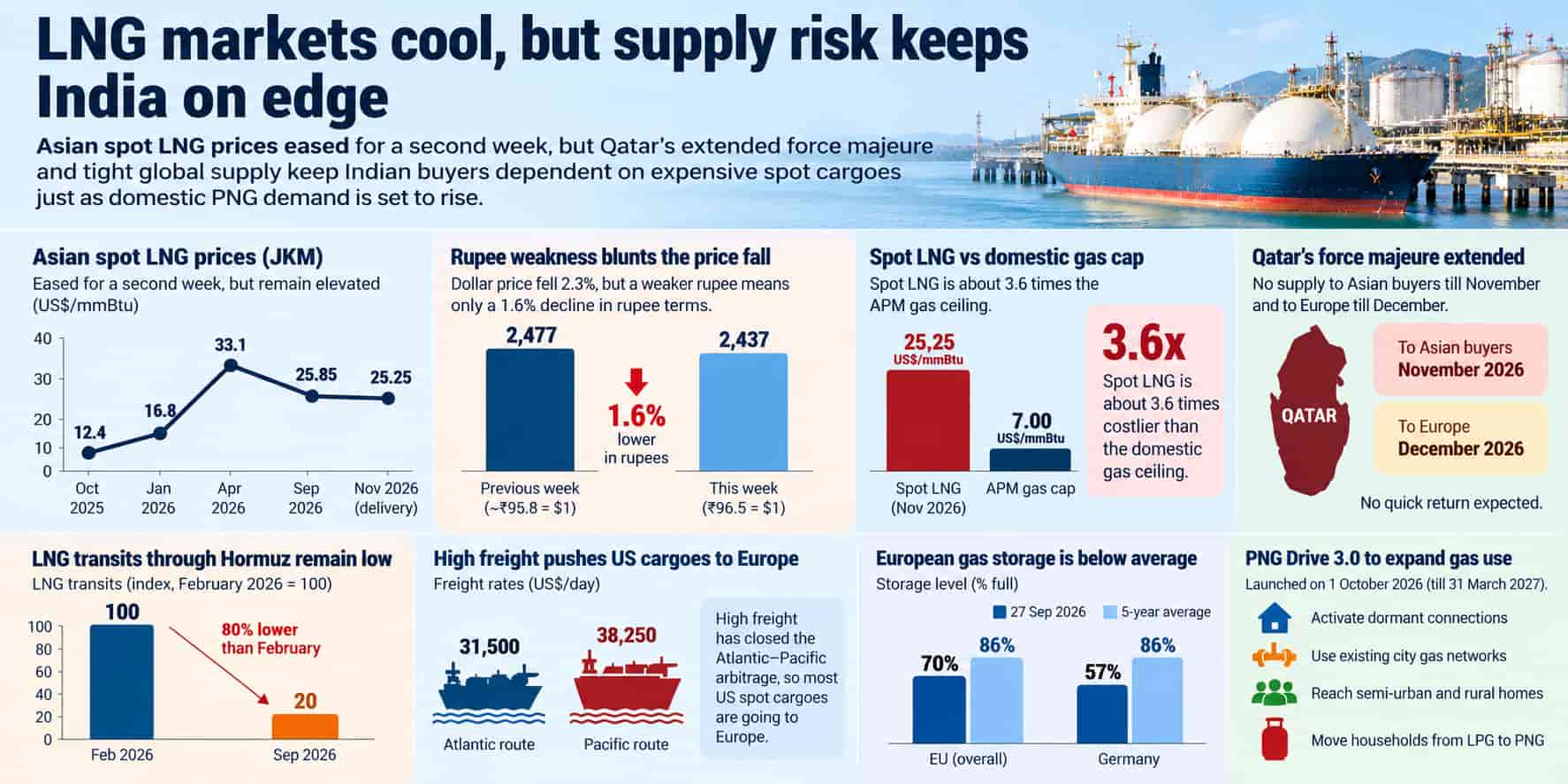
Asian spot LNG for November delivery fell to US$25.25 per mmBtu from US$25.85 the week before, according to a media report. It was the second weekly fall. Demand was thin outside Southeast Asia, and China stayed out of the market.
The driver was supply. More Qatari cargoes crossed the Strait of Hormuz, and September exits were the highest since the war began. Northwest Europe was assessed near US$23.7–23.9, and freight stayed expensive at US$31,500 a day in the Atlantic and US$38,250 in the Pacific.
India saw a smaller relief than the headline suggests. The dollar price fell about 2.3%, but the rupee slipped to ₹96.5 from about ₹95.8 a week earlier. Net, a JKM-linked cargo cost about 1.6% less in rupees, near ₹2,437 per mmBtu (US$25.25), before regasification and pipeline charges. That is still about 3.6 times the US$7 ceiling on APM gas.
Qatar’s absence matters more than the price
QatarEnergy has extended force majeure to Asian buyers through November and to Europe into December. The head of Japan’s largest LNG buyer says he does not expect Qatari supply back soon, with Hormuz LNG transits still 80 per cent below February. He also flagged the EU ban on Russian LNG from January, which will deepen the contest for cargoes.
India has felt this more than most. It received no Qatari cargoes in August, and Petronet’s contracted supply has been on month-to-month force majeure. There is a faint thaw. Industry data shows Indian tender nomination windows widened to 13–58 days by late September, from about 11 days in late August. Most laden vessels leaving Hormuz were reported to be heading to India.
Here is the part that gets less attention. Qatari volumes arrive under term contracts, usually priced off crude. With crude above US$100, a slope in the low teens works out near US$12–13 per mmBtu, by an Indoen Energy estimate. Spot is about double that. Every missing term cargo is replaced at spot, so India’s cheapest gas is the gas that is not arriving.
“A few dark transits do not remove the risk premium. The market wants to see Qatari cargoes sailing openly and on a schedule,” said an analyst tracking global LNG markets.
 The Atlantic–Pacific squeeze
Spot supply is also getting harder to find. As per recent trade data, high freight has closed the Atlantic–Pacific arbitrage for the rest of the year, so most US spot cargoes are going to Europe. EU storage was about 70% full on 27 September, against a five-year average of 86%. Germany was near 57%.
This matters because the United States emerged as India’s largest LNG source during the crisis. Buyers holding fixed US term contracts are less exposed. Those chasing spot cargoes are not. Europe’s low storage will keep it bidding hard.
Power and industry take the squeeze
At about US$25, fuel alone for a combined-cycle plant costs roughly US$190 per MWh, or about ₹18.3 per kWh (US$0.19). This assumes a heat rate of 7.5 mmBtu per MWh, an Indoen Energy estimate. Gas-fired plants therefore sit at the bottom of the merit order and run mainly when the grid is stressed.
The government has protected PNG and CNG first. The allocation order issued in March keeps domestic PNG and transport CNG at full supply, while power, refining and petrochemicals absorb the cuts.
Policy: Price caps and a PNG push
On 30 September, PPAC notified the October domestic gas price and a fresh six-month ceiling for deepwater and high-pressure fields, covering October 2026 to March 2027.
The previous ceiling was US$8.90. APM gas stays bounded by a US$4 floor and a US$7 cap. With crude above US$100, the 10% crude slope would exceed the cap, so the cap decides the price. ONGC and Oil India therefore earn about 28% of the spot price. The cap shields consumers, but it also weakens the signal to produce more.
On 1 October, Petroleum Minister Hardeep Singh Puri launched National PNG Drive 3.0 at the PNGRB’s 20th Foundation Day. It runs until 31 March 2027. The focus is on activating dormant connections, using existing city gas networks and reaching semi-urban and rural homes. The aim is to move households from LPG to PNG and lift gas above its present share of about 6% of the energy mix.
The drive works only if supply holds. More connections mean more protected demand, which adds to spot buying just when the market is tight.
Retail prices: calibrated, not full pass-through
City gas companies have passed on only part of the rise.
As of 1 October, Delhi CNG stayed at ₹86.98 per kg ($0.90), after the ₹3.89 ($0.04) hike on 29 August. Maharashtra raised CNG by ₹2 ($0.02) to ₹88 ($0.91), and Bihar by ₹7 ($0.07) to ₹93 ($0.96). PNG prices were largely unchanged.
“We have passed on only a part of the rise in input cost. Uninterrupted supply is the first priority,” said an executive at a leading Indian gas utility.
Spot LNG is roughly double its level a year ago, so the gap is being absorbed by distributors’ margins. A squeezed margin could slow the connection drive it is meant to support.
What to watch
Three signals will show whether this week was a turning point. First, Qatari cargoes moving openly on a schedule. Second, Indian tender windows staying wide. Third, European storage filling faster than expected. Until then, India’s gas ambitions rest on supply that Hormuz, not Delhi, controls.
Follow us on : X | LinkedIn | Facebook | Bluesky