

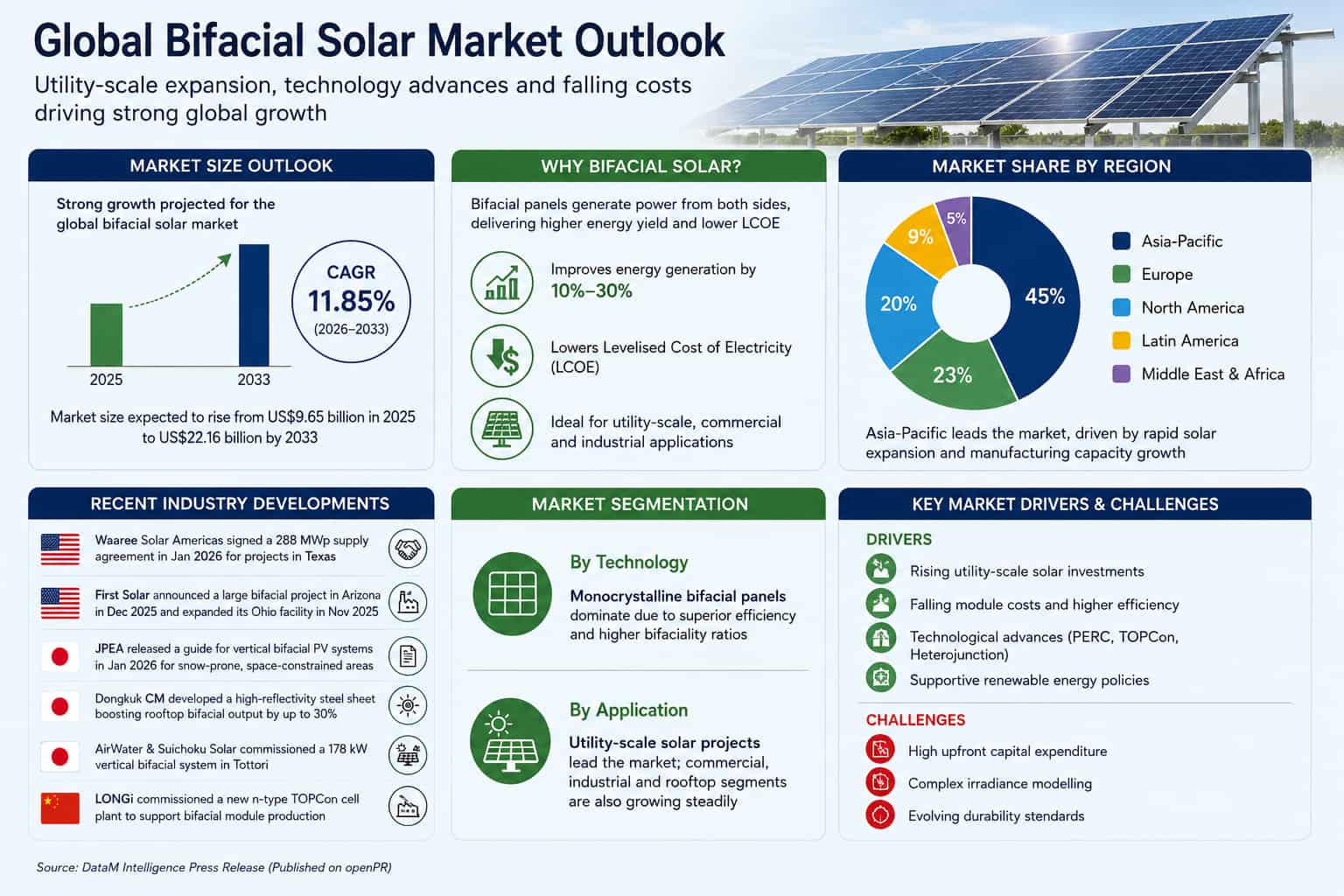
The global bifacial solar market is projected to grow sharply over the coming years, with market size expected to rise from US$9.65 billion in 2025 to US$22.16 billion by 2033, according to a press release issued by DataM Intelligence and published on openPR.
The report forecasts the market to expand at a compound annual growth rate (CAGR) of 11.85% during the 2026–2033 period.
The report attributes the expected growth to rising adoption of high-efficiency solar technologies by utilities, industrial users and independent power producers seeking to maximise electricity generation per unit area.
Falling solar module costs, land-use constraints and supportive renewable energy policies are also accelerating deployment of bifacial solar systems globally.
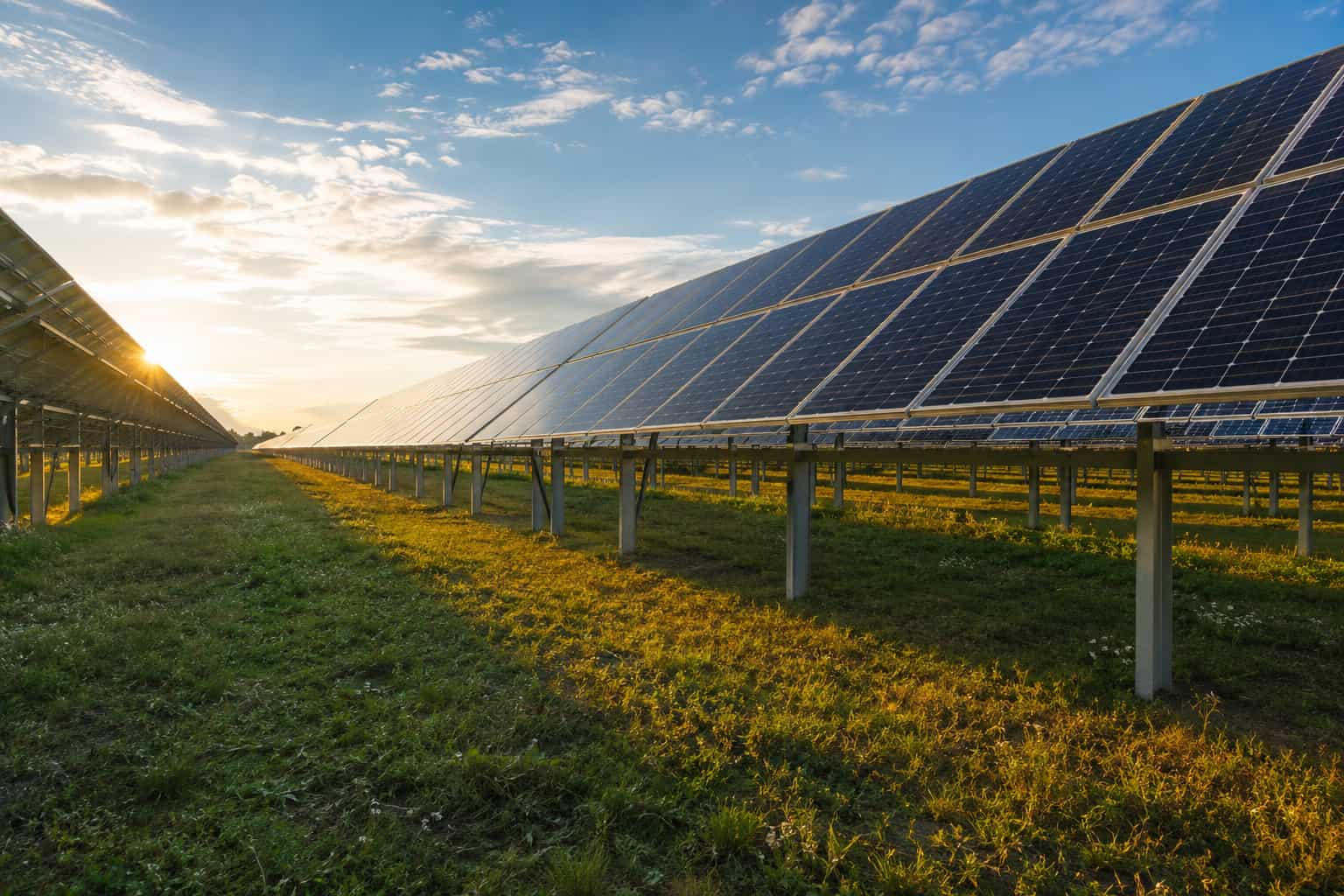
Bifacial solar panels generate electricity from both sides of the module by capturing reflected and diffuse sunlight, enabling significantly higher energy yields compared with conventional monofacial panels.
According to the release, bifacial modules can improve energy generation by 10% to 30% while lowering the levelised cost of electricity (LCOE), particularly in utility-scale and commercial projects.
The report highlights several recent industry developments across major markets.
In the United States, Waaree Solar Americas secured a 288 MWp supply agreement in January 2026 for 620Wp bifacial modules for two utility-scale projects in Texas.
In December 2025, First Solar announced a large bifacial solar project in Arizona expected to improve energy yield by 15%, while also expanding its Ohio manufacturing facility in November 2025 to increase production of advanced bifacial modules.
Japan has also witnessed significant activity in the segment. The Japan Photovoltaic Energy Association (JPEA) released a reference guide for vertical bifacial photovoltaic systems in January 2026 aimed at improving deployment in snow-prone and space-constrained areas.
In another development, Dongkuk CM introduced a high-reflectivity steel sheet capable of improving rooftop bifacial photovoltaic power generation by up to 30%.
Meanwhile, AirWater and Suichoku Solar commissioned a 178 kW vertical bifacial photovoltaic system in Tottori using 525 W heterojunction modules that can supply around 25% of the facility’s electricity demand.
The report also points to growing investments in next-generation solar manufacturing. LONGi Green Energy announced the commissioning of a new 10 GW n-type TOPCon cell manufacturing plant in China in January 2025 to support its bifacial solar module business.
Among major industry players identified in the report are LONGi, LG Electronics, Vikram Solar, Adani Group and Trina Solar.
The report notes that companies are increasingly focusing on higher-efficiency n-type and TOPCon-based bifacial technologies to improve performance and gain market share.
Regionally, Asia-Pacific is expected to dominate the global bifacial solar market with a 45% share, driven by rapid solar expansion and manufacturing capacity growth in China, India and Japan.
Europe is projected to account for 23% of the market, while North America is expected to hold 20%, supported by utility-scale renewable energy projects and policy incentives. Latin America is estimated at 9%, while the Middle East and Africa together account for 5%.
The report identifies monocrystalline bifacial panels as the dominant technology segment because of their superior efficiency and higher bifaciality ratios. In terms of applications, utility-scale solar projects remain the largest demand driver, although commercial, industrial and rooftop installations are also expanding steadily.
According to the release, technological advances in PERC, TOPCon and heterojunction cell technologies, along with innovations in vertical bifacial farms, floating solar and agrivoltaic systems, are expected to further accelerate market growth in the coming years.
However, challenges such as high upfront capital expenditure, complex irradiance modelling and evolving durability standards continue to remain barriers for wider adoption.