
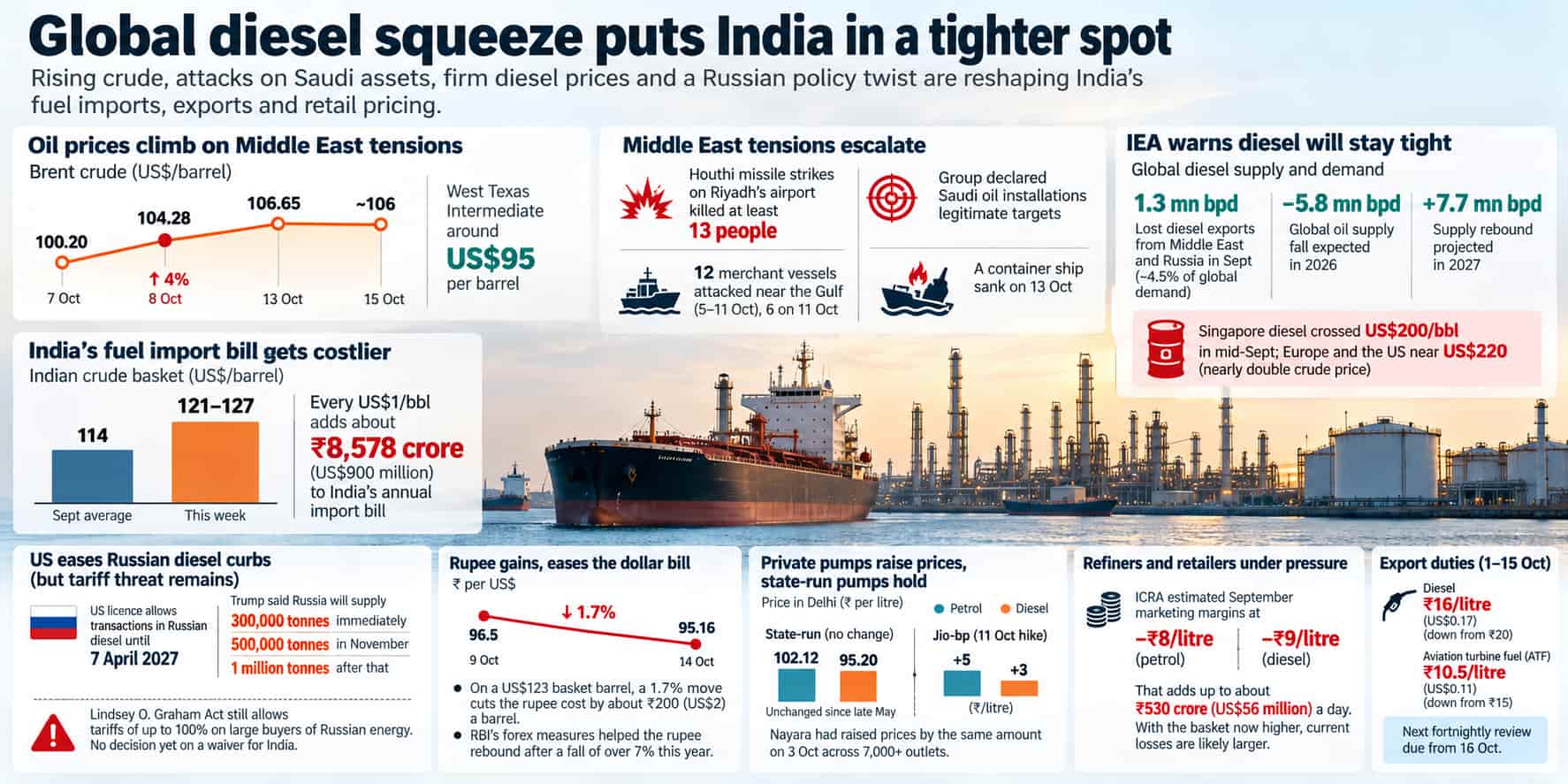
Brent jumped 4% on 8 October to US$104.28 a barrel. It closed at US$106.65 on Monday and settled near US$106 on Wednesday. A week earlier, on 7 October, it had closed at US$100.20. The US benchmark, West Texas Intermediate, held near US$95.
The trigger was Saudi Arabia. Houthi missile strikes on Riyadh’s airport killed at least 13 people over the weekend. The group then declared Saudi oil installations legitimate targets. The Saudi-led coalition hit an oil depot near Sanaa on 13 October.
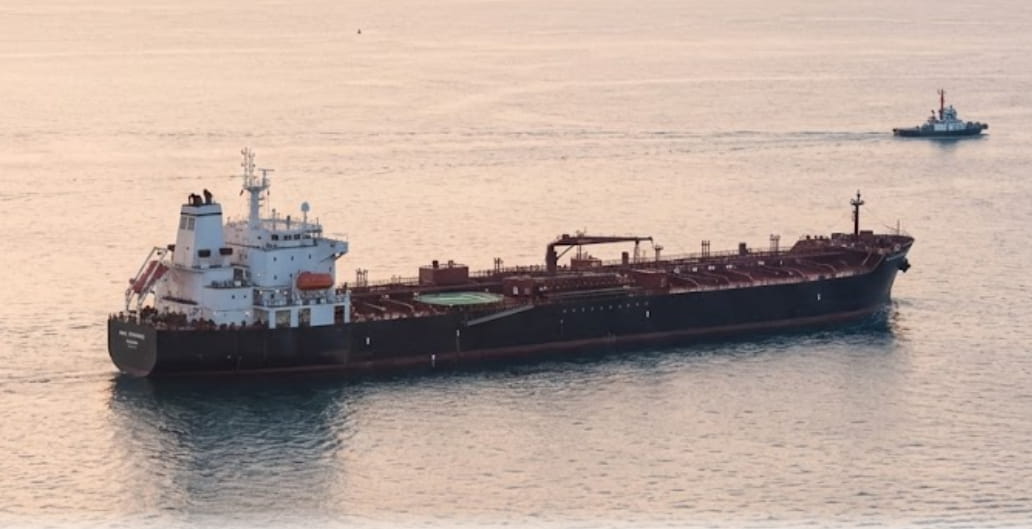
Shipping stayed under fire too. Maritime data shows 12 merchant vessels attacked near the Gulf between 5 and 11 October, six of them on 11 October alone. A container ship sank on 13 October. Some traders point out that no meaningful crude has been shut in yet, which has capped the rally.
For India, every US$1 on the basket adds about ₹8,578 crore (USUS$900m) to the annual import bill. The Indian basket ran between US$121 and US$127 this week, against a September average of about US$114, as per aggregated price data. That is still some US$17-20 above Brent futures, because refiners pay physical prices for Gulf grades, not paper prices.
The diesel problem is not going away
The IEA’s October report, released on Wednesday, says diesel supply will stay tight into 2027. Singapore diesel crossed US$200 a barrel in mid-September, while Europe and the US set records near US$220. That is nearly double the price of crude.
Lost diesel exports from the Middle East and Russia reached 1.3 million barrels a day in September, about 4.5% of global diesel demand. The agency sees 2026 oil demand falling by 2.6 million barrels a day. It expects supply to fall by 5.8 million this year and rebound by 7.7 million in 2027. Government stockpiles are also thinner, as over 200 million of the roughly one billion barrels held by IEA members is diesel.
The agency also warned that attacks on Saudi Arabia could derail the recovery in supply. For India, tight diesel keeps export margins wide. It also keeps the gap between private and state-run pump prices in focus.
 A Russian diesel licence, and a tariff threat that remains
On 9 October the US Treasury issued a general licence allowing transactions in Russian diesel until 7 April 2027. President Trump said Russia would supply over 300,000 tonnes immediately, 500,000 tonnes in November and a million tonnes after that. Brent rose in the sessions that followed. The IEA says the easing will not change the global balance much, because Russia’s real constraint is refinery capacity.
India faces two consequences. First, more Russian diesel could narrow the premiums that Indian exporters now enjoy. Second, the policy looks contradictory. The Lindsey O. Graham Sanctioning Russia and Iran Act still allows tariffs of up to 100% on large buyers of Russian energy. Washington has not yet decided on a waiver for India.
Indian refiners were already cutting back. As we reported last week, Russian crude imports fell to about 1.75 million barrels a day in September.
“Washington has eased the diesel, not the crude. For Indian refiners, the licence is a margin risk and a bargaining chip, not a discount,” said an analyst tracking global crude markets. Some Indian commentators argue the deal strengthens Delhi’s hand. Others note that the tariff framework remains intact.
Rupee rebounds, softening the dollar bill
The rupee was above ₹96.5 to the dollar on 9 October. It closed at ₹95.16 on 14 October, helped by the Reserve Bank of India’s forex measures announced over the weekend. That is a gain of about 1.7% in the week, after a fall of over 7% this year.
On a US$123 basket barrel, a 1.7% move cuts the rupee cost by about ₹200 (USUS$2) a barrel. On our estimate, that is roughly what a US$2 fall in crude would deliver. It is a reminder that currency support can matter as much as crude this week.
Private pumps raise prices, state-run ones hold
Jio-bp raised petrol by ₹5 (USUS$0.05) and diesel by ₹3 (USUS$0.03) a litre from 11 October, its first hike this year. Nayara had made the same move on 3 October across more than 7,000 outlets.
State-run retailers have not moved. Delhi prices stand at ₹102.12 (USUS$1.07) for petrol and ₹95.20 (USUS$1.00) for diesel, unchanged since late May. ICRA estimated September marketing margins at minus ₹8 (USUS$0.08) a litre on petrol and minus ₹9 (USUS$0.09) on diesel. That adds up to about ₹530 crore (USUS$56m) a day. With the basket now higher, current losses are likely larger.
The wider gap carries a risk for private operators. Motorists and fleets may migrate to the cheaper state-run pumps. Jio-bp had earlier capped diesel sales at 50 litres per customer per day.
On exports, the special additional excise duty on diesel is ₹16 (USUS$0.17) a litre and on aviation turbine fuel (ATF) ₹10.5 (USUS$0.11), down from ₹20 and ₹15. Those rates ran for 1-15 October, and the next fortnightly review is due from 16 October. “The export duty follows the cracks; pump prices are a separate and more cautious decision,” said a senior official at the Ministry of Petroleum and Natural Gas.
Where this leaves energy security
India’s import dependence now bites through three channels at once. Sourcing carries a tariff risk, the basket sits far above Brent futures, and frozen state-run pumps push the cost onto retailers’ balance sheets.
Three things to watch next are the duty review on 16 October, the waiver decision in Washington, and whether Houthi threats against Aramco sites turn into actual outages.