
Hydrogen has had a bruising few years. Projects were cancelled, big companies wrote off money, and many people began to ask whether the whole idea was a bubble. The latest numbers tell a more mixed story.
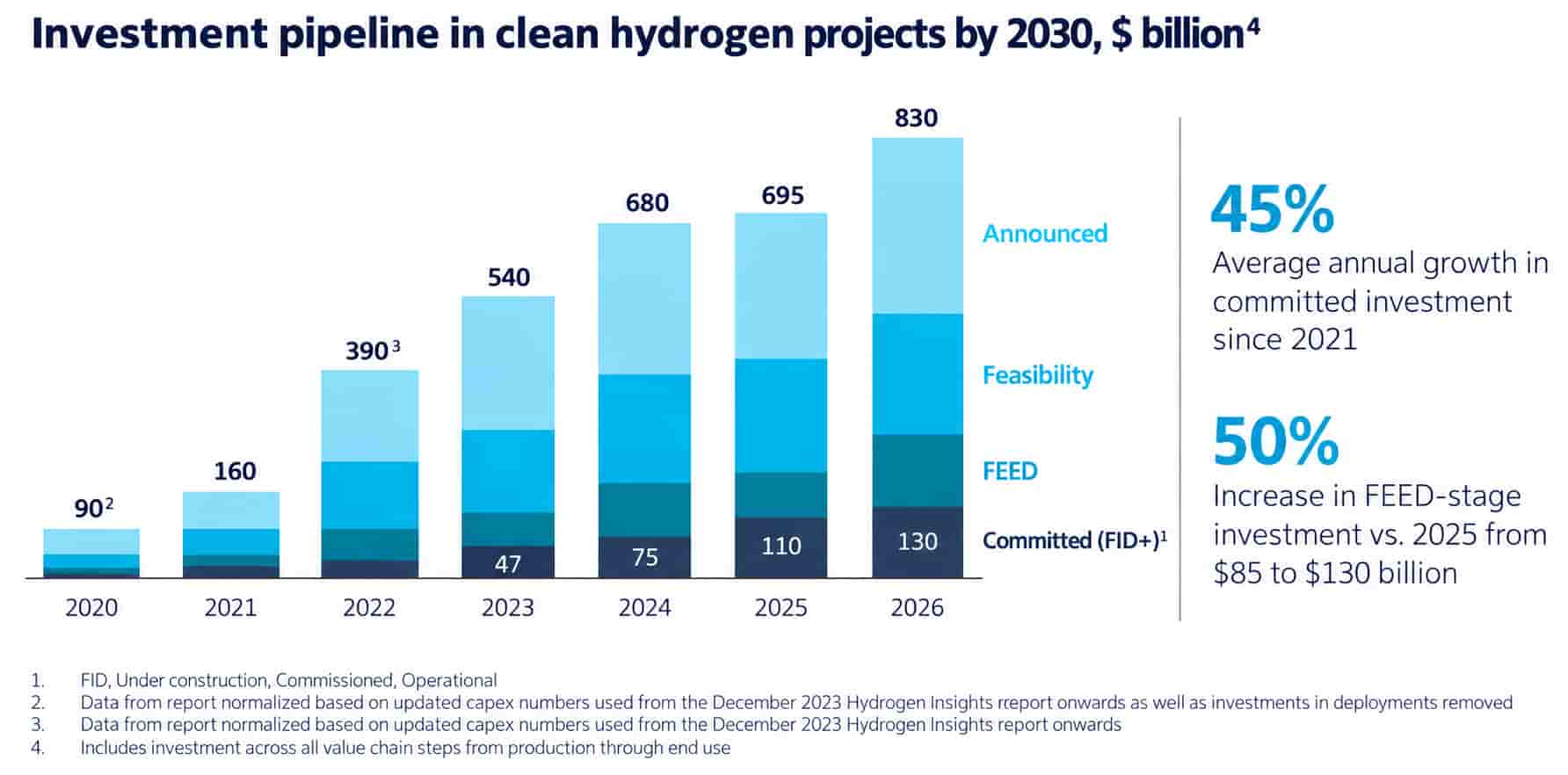
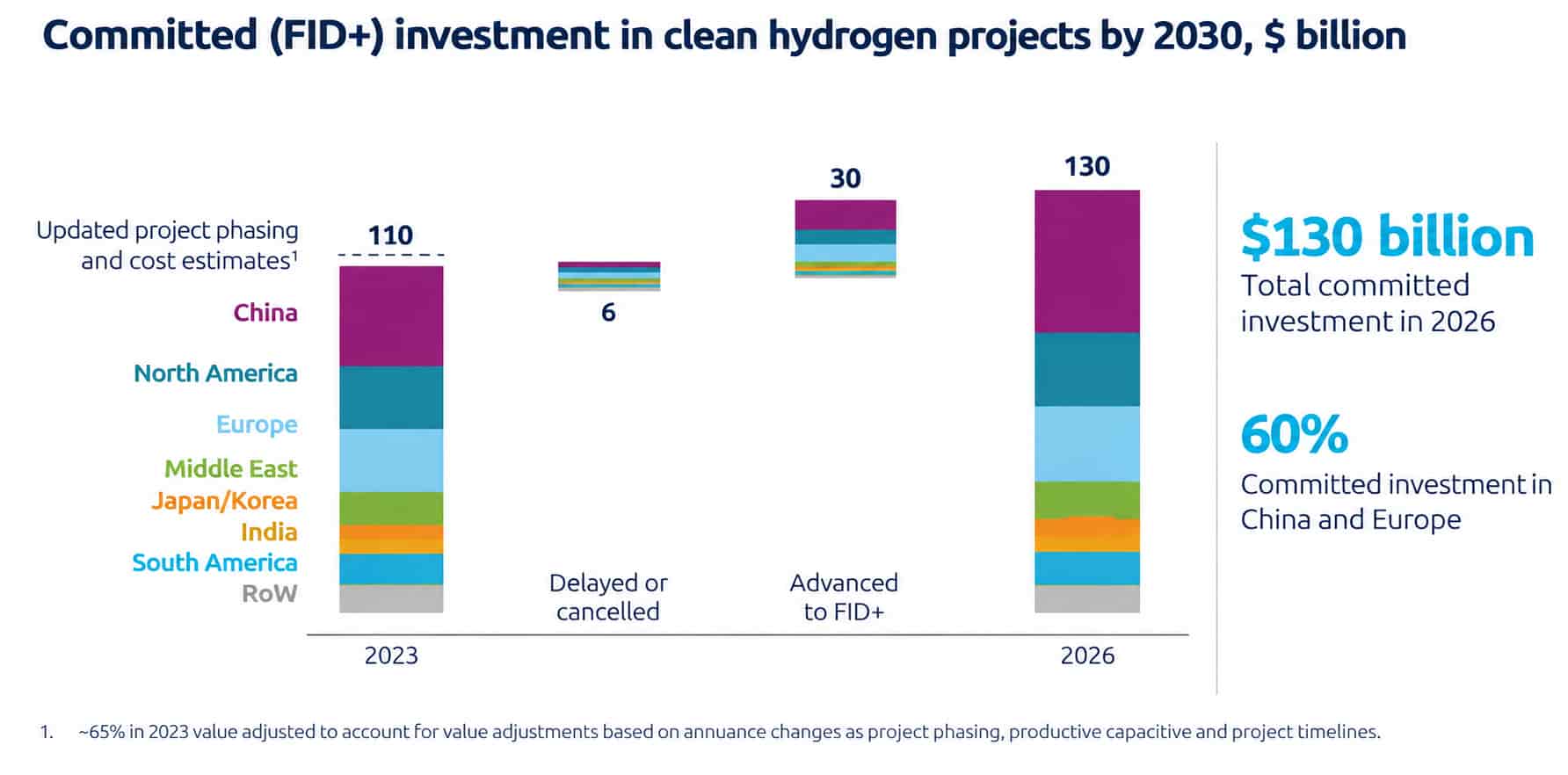
According to the Global Hydrogen Compass 2026, prepared by the Hydrogen Council with McKinsey & Company, committed investment in clean hydrogen has reached US$130 billion. That is up from US$110 billion a year ago. The money is spread across 579 projects and 6.9 million tonnes per annum (Mtpa) of capacity.
From pledges to plants
The word “committed” matters here. It covers projects that have taken a final investment decision, are under construction, or already operate. About 90% of them are in the last two stages.
Operational capacity grew 70% in twelve months, from 1.0 Mtpa to 1.7 Mtpa. It could reach 3.8 Mtpa next year as projects under construction come online. Renewable capacity alone is expected to more than triple in 2027, from 0.5 Mtpa to 1.8 Mtpa.
The report finds that US$30 billion of fresh investment reached the committed stage in the past year. Only US$6 billion was cancelled or delayed. In other words, new money outran the casualties by roughly five to one.
The scale of what is being built is easy to miss. The committed pipeline could avoid 55–60 million tonnes of carbon dioxide a year. That is about what the world’s 50 million battery electric cars achieve together. Few people would guess that a technology still called “emerging” already matches that much of the car market’s climate benefit.
A small slice of a very large market
Now for the other side. The world uses about 100 Mtpa of hydrogen today, and only around 1% comes from clean sources. The committed 6.9 Mtpa equals roughly 7% of current use. Clean hydrogen is still a rounding error in the larger market.
China and Europe account for nearly 60% of committed investment and over 80% of the growth since last year. China added US$11.8 billion and now stands at US$45 billion. Europe added US$7.9 billion and reached US$30 billion. North America has US$26 billion, mostly in low-carbon projects. The Middle East has US$11 billion, Japan and Korea US$7 billion, and India US$6 billion.
China’s lead rests on hardware. Competition among more than 100 domestic manufacturers has cut alkaline electrolyser costs by about 45% in five years, to below US$350 per kilowatt. Chinese overseas electrolyser shipments touched at least 320 MW in the first half of 2026, against under 20 MW a year earlier. For countries planning their own projects, this is a quiet but important fact. Equipment is getting cheaper, and one country largely sets the price.
Security first, climate second
The reasons for building hydrogen are also changing. According to the study, over 60% of committed investment sits in regions where energy security and industrial growth matter as much as, or more than, decarbonisation. In the CEO survey, 64% said recent energy shocks had increased their interest. And 74% expect security to matter even more by 2030.
One executive put it plainly: “The conversation has moved from sustainability targets to protecting the industrial base from outside shocks.”
This explains why import-dependent economies such as India, Japan, Korea and much of Europe are leading the conversation. They depend on imports for 50% to 100% of their natural gas. Hydrogen and its derivatives offer a way to make some of that supply at home, or to buy it from more than one source.
Where policy decides the outcome
The report’s most striking number is about demand. Existing policies could support about 11 Mtpa of clean hydrogen demand by 2030. Of this, 6 Mtpa is already firm, backed by enforced rules. About 4.2 Mtpa is covered by binding offtake contracts, and three-quarters of that is for refining and ammonia.
The remaining 5 Mtpa is waiting. It needs no new invention and no new pledge. It needs governments to finish what they started, such as transposing European renewable fuel targets into national law and implementing carbon pricing. Supply is ready, too. Another 7.5 Mtpa of projects sits at the design stage and could be built if demand turns firm.
That is why 84% of the executives surveyed want existing policy implemented before anything new is designed. Seventy-four per cent called firm demand their top priority. Capital, they say, is available. What is missing is long-term offtake backed by stable rules.
The warning signs are visible. Europe’s industrial targets remain stalled. Korea’s clean hydrogen power programme was cut from 3,000 GWh to 500 GWh. The United States has curtailed its 45V tax credit, which slowed renewable projects there. Several cancellations also show how fragile the economics can be. A Canadian biomethanol plant lost about US$730 million of commitments, the suspension of a US project removed US$850 million, and a Chilean project worth about US$1.5 billion was dropped.
India’s ammonia advantage
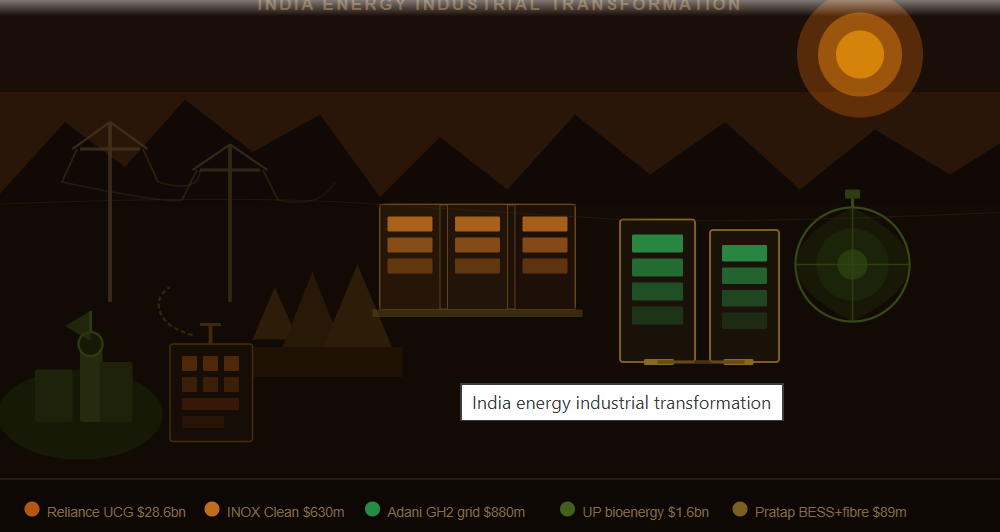
India enters this picture through fertiliser. Around 80% of its ammonia demand depends on imported ammonia or imported natural gas. About 40% of that exposure passes through the Strait of Hormuz, according to the report. For a country that feeds a large population, this is a food security question as much as an energy one. Indoen has also looked at how India’s hydrogen opportunity is taking shape across exports, industry and investors.
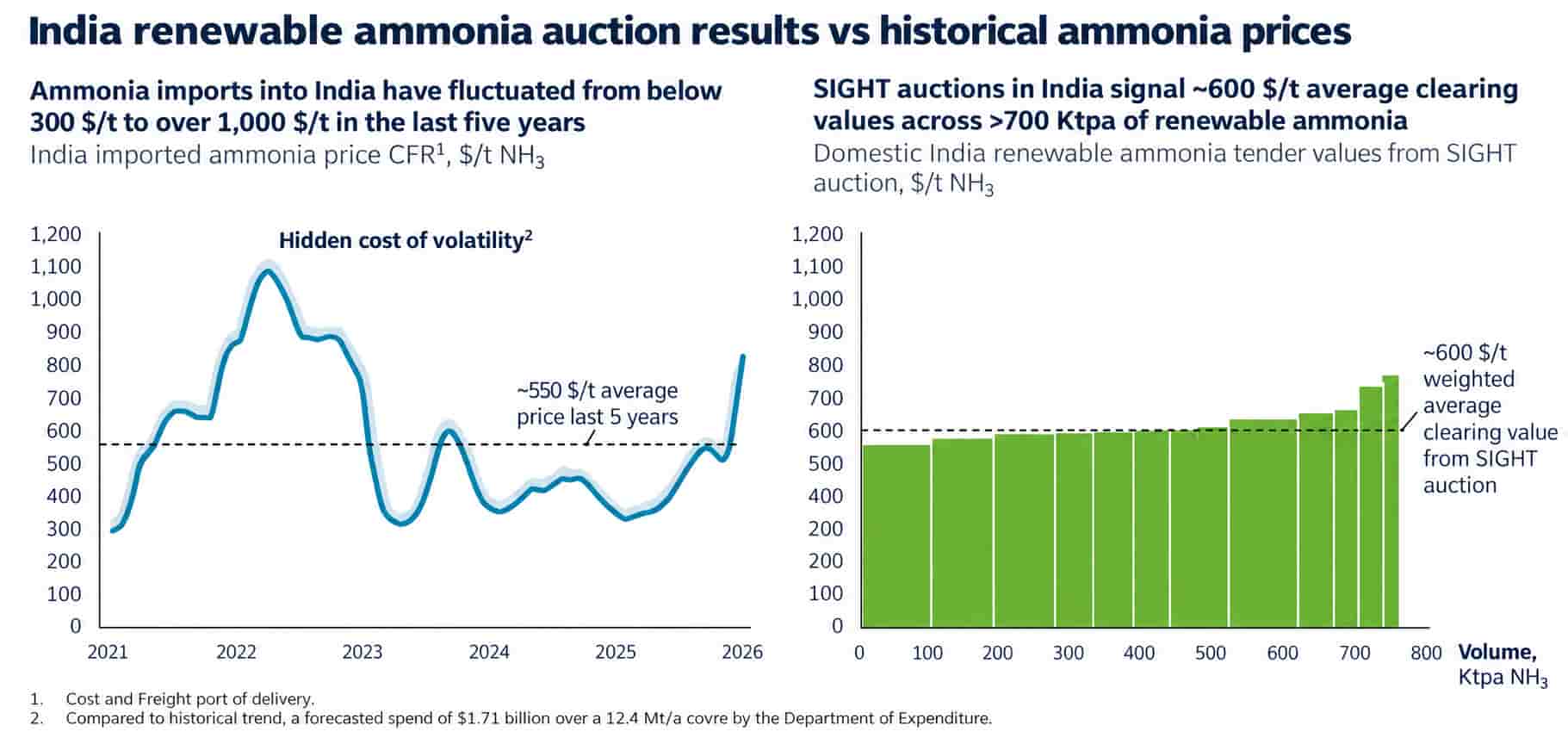
The price swings are sharp. Imported ammonia has ranged from below US$300 per tonne to over US$1,000 per tonne in five years. That volatility feeds straight into the subsidy bill. Fertiliser support for 2026-27 was budgeted at ₹1.71 lakh crore (US$17 billion). Officials and analysts now expect ₹2.4–3.4 lakh crore (US$24–34 billion).
India’s answer is the SIGHT auction scheme under the National Green Hydrogen Mission. Its first round awarded 724 thousand tonnes a year of renewable ammonia on ten-year fixed contracts. Prices cleared between roughly US$570 and US$740 per tonne, averaging about US$600. That volume could replace 25–30% of India’s direct liquid ammonia imports. Yet it equals only about 3% of total ammonia consumption. The report also estimates US$2.5 billion in foreign exchange savings over ten years.
The cost story is the real surprise. Hybrid solar-wind power at US$0.02–0.03 per kilowatt-hour, and Chinese electrolysers that cut installed cost to about US$700 per kilowatt against a European baseline of US$1,700, can bring ammonia to or below US$600 per tonne. Storage and annual matching lift plant utilisation from around 65% to 90%. Recent round-the-clock power awards cleared at ₹5.06 per kWh (US$57 per MWh). European renewable ammonia is estimated at US$900–1,100 per tonne.
The projects behind the numbers
Real plants now stand behind these figures. AM Green’s Kakinada complex in Andhra Pradesh has 1.3 GW of electrolysers and is designed for 1 Mtpa. Its first phase of 500 thousand tonnes a year is backed by Petronas, GIC and ADIA, with commissioning slated for 2028. A binding agreement with Uniper covers up to 500 thousand tonnes a year, an early India-Europe renewable ammonia corridor.
A second project is forming at Gopalpur in Odisha, led by Hygenco with Ameropa. It carries a US$990 million investment, and a final investment decision is expected in the first quarter of 2027. The report treats it as proof of depth. A competing, financed plant at another port means the ecosystem no longer rests on one flagship.
Large developers, including Reliance, Adani, ACME and NTPC, bring balance sheets to the effort. ACME has also signed long-term offtake with Japanese buyers. Surveyed executives rate India and China as the two fastest-accelerating regions, with 92% seeing steady or rising momentum in India.
What could still go wrong
The Indian case has limits, and the report names them. SIGHT incentives, worth US$0.60–1.10 per kg of hydrogen, are front-loaded and taper over time. Waivers on interstate transmission charges apply only to projects commissioned by 2030. Long-term signals such as carbon pricing remain thin.
Exports face their own hurdle. European buyers expect renewable fuel certification, with strict rules on additionality and timing, and that could push costs up. Non-certified ammonia may still compete where carbon costs apply. Bringing prices down to US$470–570 per tonne would put Indian supply close to parity with conventional European ammonia after carbon charges.
India’s identified clean hydrogen demand for 2030 is just 0.1 Mtpa, against 5.7 Mtpa for Europe. The country’s strength is supply and cost. Its weakness is that demand still depends on auctions rather than mandates.
What the next two years will show
Three things stand out. First, delivery risk is real. Only about a quarter of committed capacity is operating, and projects under construction are on average ten times larger than today’s working plants. Bigger plants bring bigger commissioning risks.
Second, hydrogen will not copy solar’s path. As one executive said, “Hydrogen only scales when the whole chain moves together. Building supply and hoping demand follows does not work.” Production, conversion, transport and demand must arrive in step.
Third, ambition is surviving the shake-out. Two-thirds of executives expect hydrogen to stand without subsidies by 2040, although none expects it before 2030. For India, the sensible reading is simple. Cheap power and an import bill that hurts give it a head start. Turning that start into a market will depend on contracts, certification and steady policy, not on targets alone.
Follow us on : X | LinkedIn | Facebook | Bluesky