


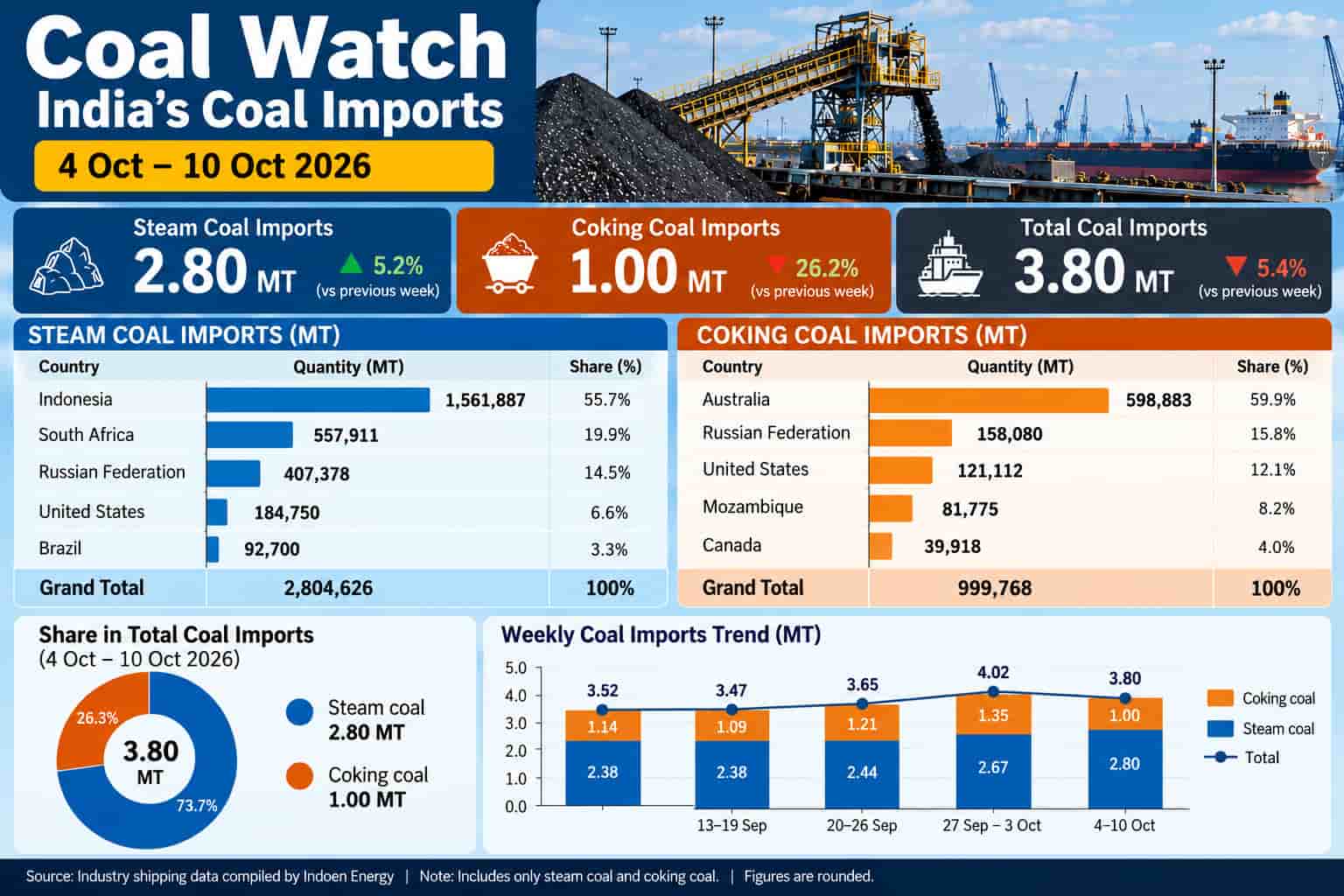
India’s coal imports fell 5.4% week-on-week to 3.80 MT during 4–10 October, as a stronger flow of steam coal was more than offset by a sharp contraction in coking coal arrivals. Steam coal imports rose 5.2% to 2.80 MT, while coking coal fell 26.2% to 1.00 MT.
Indonesia remained the dominant thermal supplier, accounting for 1.56 MT, followed by South Africa at 0.56 MT and Russia at 0.41 MT. In coking coal, Australia remained the largest source at 0.60 MT, although its shipments were considerably below the previous week’s 0.73 MT. Russia, the US and Mozambique supplied most of the balance.
The weekly decline comes against a domestic coal supply situation that is showing some signs of stabilisation. By 10 October, coal stocks at domestic coal-based power plants stood at 18.21 MT, while average rake loading in October had improved to about 469 per day, compared with 426 in September.
The daily rate of stock depletion had also fallen sharply, indicating that improved coal movement was beginning to narrow the supply-demand gap.
However, underlying pressure on the power sector remains significant. As of 7 October, 107 of 191 monitored thermal plants had only 0–5 days of coal stocks, even though supplies had improved and October daily coal deliveries were running above September levels.
NTPC was also increasing procurement as its stocks fell to around 5–6 days of generation, while its FY27 coal requirement is expected to reach 297 MT.
The broader demand outlook remains supportive. The IEA expects India’s coal demand to rise 4.2% to 1.353 billion tonnes in 2026, driven by electricity and industrial demand, while India is expected to remain the primary source of growth in global metallurgical-coal demand.
Subsequent developments reinforce the pressure: the CEA said on 13 October that peak power demand this year is running 45–50 GW above last year, partly because weaker hydropower has increased reliance on coal generation.
Follow us on : X | LinkedIn | Facebook | Bluesky