
Something changed in India’s storage market this year. Between January and June 2026, the country added 8.2 GWh of new battery energy storage system (BESS) capacity. In the same period of 2025, it added less than 100 MWh. That is a jump of more than 80 times in twelve months.
The number is striking, but the base is small. As of 31 August 2026, operational BESS capacity stood at 9.08 GWh. That is about 26% of the 34.72 GWh that official planning says the country needs in FY2026–27. The market has started moving. It has not yet caught up.
A requirement that grows almost sevenfold
The Central Electricity Authority’s National Electricity Plan expects India’s storage power need to rise from 16.13 GW in FY2026–27 to 73.93 GW by FY2031–32. Batteries are expected to supply 47.24 GW of this, or about 64%. In FY2026–27, the figure is 8.68 GW, or about 54%.
In energy terms, the BESS need grows from 34.72 GWh to 236.22 GWh over the same period. That is nearly seven times. Batteries would then make up about 57% of total storage need, against about 42% in FY2026–27. By 2047, the plan sees batteries carrying roughly 77% of storage in energy terms.
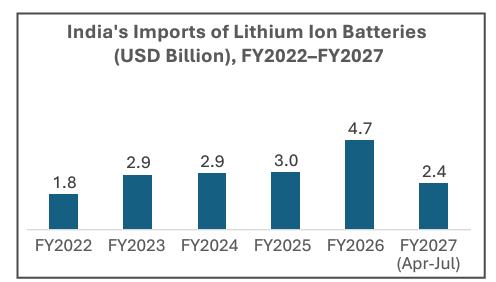
Peak demand explains the push. It is expected to rise from 289 GW in FY2026–27 to 459 GW by FY2035–36, an increase of 58.8%. In the first half of 2026 alone, India added about 29 GW of solar and wind capacity, with solar installations up 43% year on year. More variable power means more need to shift it by the hour.
Two states, and a slow spread
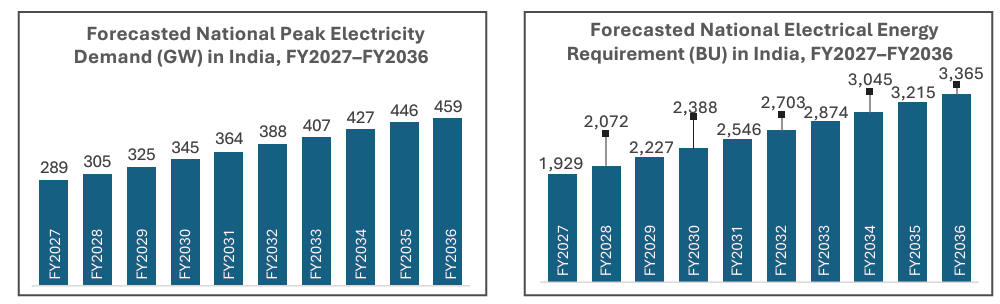
The map today is lopsided. Gujarat holds 44.0% of installed utility-scale BESS capacity and Rajasthan 43.7%, together nearly 88%. Maharashtra follows at 5.1%. Bihar, Karnataka and Chhattisgarh add 6.4% between them. The remaining states and union territories share less than 1%.
The reason is simple. These two states also lead in installed renewable capacity, with 18% and 17% shares at the end of August 2026. Storage went where the solar is.
Newer projects point elsewhere. Karnataka and Madhya Pradesh have received 2 GWh and 1.5 GWh under viability gap funding (VGF). Andhra Pradesh has finalised a 1.2 GWh project with the Solar Energy Corporation of India. Maharashtra has written storage into its renewable energy policy for 2025–26 to 2035–36.
Policy is carrying the market
Almost every large driver here is a policy lever. The Energy Storage Obligation requires distribution companies to buy a rising share of power through storage. It climbs from 1% in FY2023–24 to 4% by FY2029–30.
A bigger push may be coming. India plans to require new solar and onshore wind projects commissioned from 1 July 2027 to add storage equal to at least 10% of capacity for two hours. From July 2029, the duration would rise to four hours. The proposal is not yet in force.
Direct funding has stretched further than planned. The 2023 VGF scheme offered ₹3,760 crore (US$390 million) to support 4 GWh, covering up to 40% of project capital cost. As battery prices fell, the same budget now supports 13.2 GWh, more than three times the original target. A June 2025 scheme adds 30 GWh, taking targeted support to about 43.2 GWh. This is supported capacity, not installed capacity.
Other measures cut costs from different sides. Eligible co-located projects commissioned by 30 June 2028 get a full waiver of inter-state transmission system (ISTS) charges. The production linked incentive (PLI) scheme for advanced chemistry cells has an outlay of ₹18,100 crore (US$1.9 billion). It aims at 50 GWh of domestic cell capacity, of which 40 GWh has gone to four firms. In July 2026, the government set aside 10 GWh for grid-scale storage.
The latest step is the ₹1.86 lakh crore (US$19.2 billion) PM-DHARA scheme, cleared by the Union Cabinet. The October 2026 Rubix Industry Insights report notes that it carries ₹50,000 crore (US$5.2 billion) to deploy 50 GWh of batteries by FY2032–33. It also aims to help evacuate up to 135 GW of renewable energy.
Indoen Energy has looked at this corridor and storage funding earlier.
Cheaper cells, thinner margins
Falling battery costs are the other big support. Global lithium-ion pack prices fell to about US$108 per kWh in 2025. Packs for stationary storage fell to about US$70 per kWh, a 45% drop from 2024. Lithium iron phosphate (LFP) prices fell by more than 15%, against less than 5% for nickel manganese cobalt oxide. LFP now makes up over 90% of BESS deployments worldwide.
Here the story turns. Cheaper batteries have not made life easier for developers. Winning tariffs have fallen faster than costs. In 2025, the lowest tariff for a two-hour system touched ₹1.48 lakh per MW per month (US$1,526), against an indicative benchmark of ₹2.3 lakh (US$2,372). Tariffs fell more than 71% between 2022 and 2025. Battery pack prices fell 36%.
The report finds that nearly 75% of allocated two-hour capacity is classed as “at risk.” Developers may struggle to recover costs. It is a counterintuitive result: the cheaper the technology, the thinner the cushion for those who bid aggressively.
Imports, money and wires
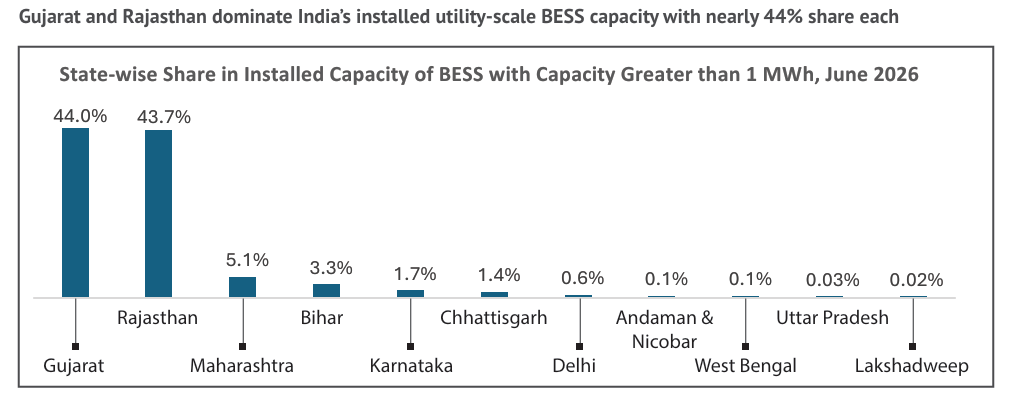
Supply is the next worry. Imports of lithium-ion batteries and accumulators rose from US$3.0 billion in FY2025 to US$4.7 billion in FY2026, a 56% increase.
China supplied around 75% of these in FY2025 and 84% in FY2026. From April to July of the current fiscal year, imports already stand at US$2.4 billion. A shipping delay or price swing tied to one country can reach Indian project budgets quickly. Indoen Energy has also tracked how this import reliance shapes India’s battery boom.
Money and capability are stretched too. Only 46.3% of the 10.4 GW of standalone capacity allocated in 2025 went to developers with standalone BESS execution experience. Investors typically expect an internal rate of return of 15% to 20%. Delays of 9 to 18 months may arise from financial closure, procurement and commissioning.
Procurement shows the same strain. In the first half of 2026, 28 GW was tendered, up 86% from 15 GW a year earlier. But auctioned capacity fell 18% to 9 GW from 11 GW. Tenders are multiplying faster than contracts are being signed.
Then there is the grid. Nearly 21 GW of renewable capacity ran on temporary connections in 2026, and about 12 GW faced evacuation limits at peak solar hours. During FY2026, around 6,900 GWh of renewable electricity could not be evacuated because plants were not ready before their transmission systems. That is about 29 times the 236.22 GWh BESS requirement for FY2031–32, though the two numbers measure different things. Connectivity applications with the Central Transmission Utility now exceed 500 GW. Key inter-state networks are expected by 2027, which should ease curtailment.
The two facts point the same way. Wasted solar power is the clearest case for storage. But storage also needs a grid connection, and the same delays can hold up batteries.
Manufacturers place their bets
Industry is not waiting. Waaree Energies plans 20 GWh of BESS capacity at a total outlay of about ₹10,000 crore (US$1.0 billion). Solex Energy has signed an agreement with Gujarat for a 10 GW BESS facility alongside a 5 GW solar cell plant, with investment of around ₹4,000 crore (US$410 million). Vikram Solar’s VSL PowerHive plans ₹4,370 crore (US$450 million) in its first phase.
Smaller plants are already coming up. AmpereHour opened a 5 GWh facility at Chakan, Pune, in July 2026. Invergy opened a 3 GWh plant at Dasna, Uttar Pradesh, with investment above ₹200 crore (US$21 million). Mecpower has signed for a 5 GWh assembly plant in Karjan, Gujarat, at about ₹160 crore (US$17 million). Amara Raja Advanced Cell Technologies plans 5 GWh at about ₹280 crore (US$29 million).
Several of these are assembly and integration plants, though Vikram Solar’s plan reaches into cells. Solex has also created a separate BESS subsidiary, which suggests storage is now a business line of its own. As one policymaker has said, “India can become a global manufacturing hub for BESS, from batteries and inverters to software and control systems.”
The commissioning cliff
The central table tells the sharpest story. The pipeline stands at 176.66 GWh across 187 projects: 9.08 GWh operating, 79.92 GWh under construction, 24.13 GWh awarded and 63.53 GWh in tendering. That equals about 75% of the 236.22 GWh needed by FY2031–32.
Now look at timing. Some 74.07 GWh is scheduled for FY2027–28 and 69.44 GWh for FY2028–29. The first figure is more than eight times everything operating today. Even FY2026–27, with 26.36 GWh expected, falls short of its 34.72 GWh need.
The later years rest on shakier ground. Of the 69.44 GWh due in FY2028–29, 50.69 GWh, or 73%, is still at the tendering stage. That links directly to the gap between tenders and auctions.
Deadlines also pile up. The proposed storage mandate starts in July 2027. The ISTS waiver covers projects commissioned by June 2028. The biggest commissioning wave falls in FY2027–28. Developers will face policy dates, supply risk and grid readiness in the same window.
The money involved is large. The estimated BESS investment requirement by FY2031–32 is about ₹3.49 lakh crore (US$36.0 billion). Separately, the India Energy Storage Alliance estimates the wider storage sector could draw about ₹4.79 lakh crore (US$49.4 billion) by 2032.
What to watch
The direction is not in doubt. Speed and quality are. As one industry executive has argued, “targeted incentives to reduce upfront capital costs will be critical to accelerating energy storage deployment.” The numbers suggest incentives alone may not be enough. Tariffs that cover costs, steady cell supply, financing for experienced developers and transmission that arrives on time matter just as much.
India’s storage market has passed its first test of proving demand and policy support. The next is harder: turning 176.66 GWh of paper into working capacity before the deadlines arrive.
Follow us on : X | LinkedIn | Facebook | Bluesky