
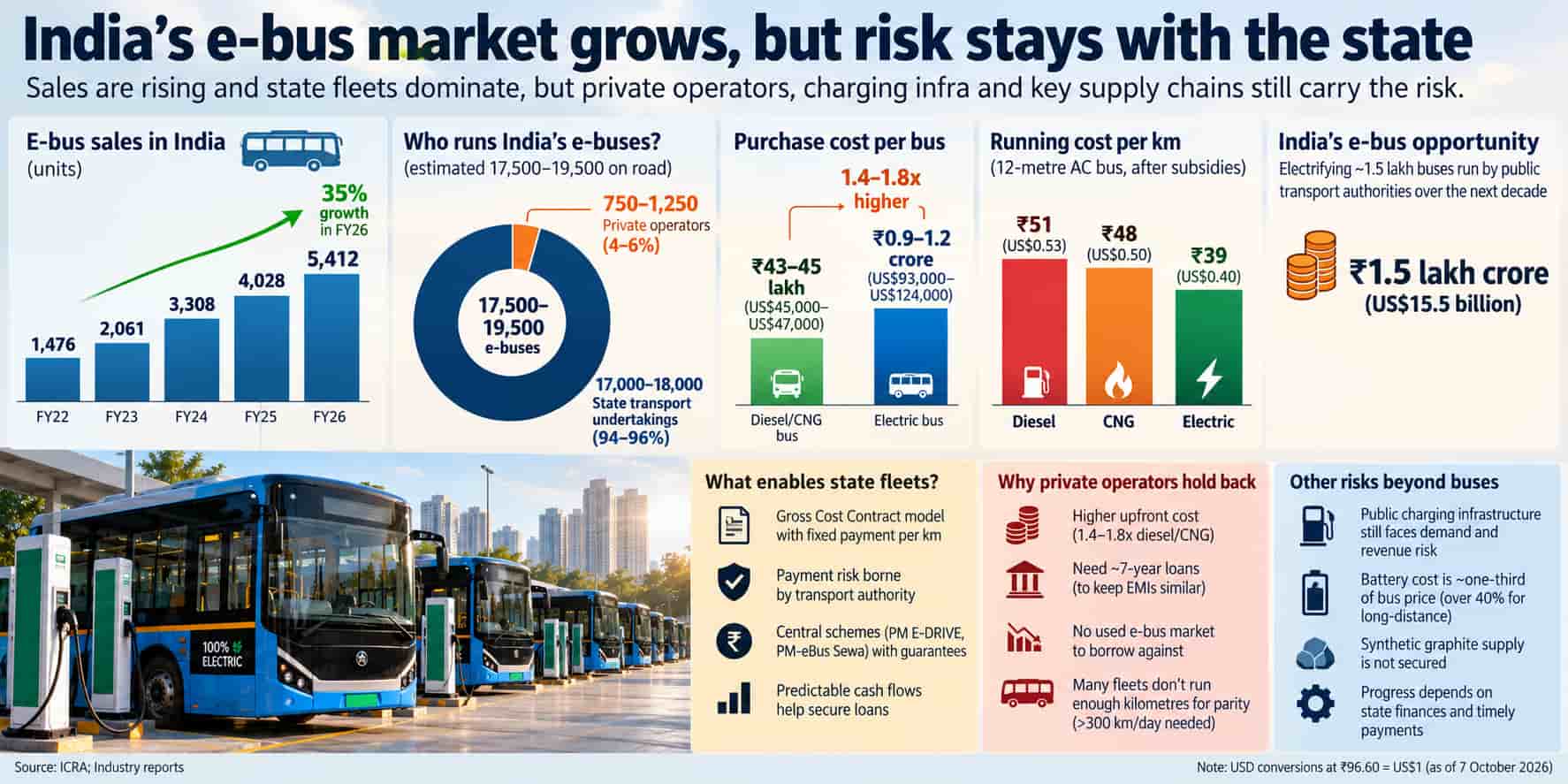
India’s electric bus market is finally behaving like a market. Sales rose about 35% to 5,412 units in FY26. The segment grew at a compound annual rate of 46% between 2015 and 2025, industry reports suggest.
Look closer, and the picture narrows. Of an estimated 17,500–19,500 electric buses on the road, state transport undertakings (STUs) run about 17,000–18,000. Private operators own only 750–1,250, or 4–6%. Yet private players account for 85–90% of India’s overall bus fleet.
Electric penetration in the medium and heavy passenger segment is about 7.2%. ICRA expects it to reach around 30% by FY30, but the current pace is well below what that needs.
The guarantee behind the bus
Why do STUs buy while private operators hold back? The answer lies in contract design. Most STUs use the Gross Cost Contract model. The operator is paid a fixed rate for every kilometre run, and the transport authority carries the risk of poor ridership.
That gives lenders predictable cash flow to lend against. Central schemes such as PM E-DRIVE and PM-eBus Sewa are also built around STUs as the buyer, with payment guarantees and bulk purchase.
The model has its own weak spot. Payment starts only after buses are running, so operators must raise money for vehicles, chargers and depots well before revenue arrives. States often take six to eight months just to issue a letter of award. Some have been slow to pay.
A new Payment Security Mechanism now aims to fix this. It works through Convergence Energy Services Limited and is backed by an RBI rule that allows dues to be drawn directly from a state’s accounts. ICRA calls it structurally positive.
The buses themselves have delivered. They mostly run more than the promised distance, and cost overruns have stayed under 10%. The real risk is whether financially weak transport authorities pay on time.
The scale makes this important. ICRA estimates that electrifying the roughly 1.5 lakh buses run by public transport authorities over the next decade would cost about ₹1.5 lakh crore (US$15.5 billion). A payment guarantee can carry that burden only if state finances hold.
 Where the guarantee stops
Private operators have no such cushion. An electric bus costs ₹0.9–1.2 crore (US$93,000–US$124,000). A diesel or CNG bus costs ₹43–45 lakh (US$45,000–US$47,000). That is 1.4 to 1.8 times as much. The battery alone is about a third of the price, and over 40% for long-distance buses.
Financing makes it harder. To keep monthly payments close to a diesel bus, an electric bus loan must run about seven years. Diesel buses are usually financed over three to five. Many lenders hesitate, and there is no used-electric-bus market to borrow against.
“Lenders do not fear electric buses. They fear a buyer with no guaranteed income,” said a senior executive at a non-banking financial company that funds commercial vehicles.
This is not a story of poor economics. ICRA’s analysis shows that a 12-metre air-conditioned electric bus costs about ₹39 per km (US$0.40) to run, after subsidies. The figure is ₹51 (US$0.53) for diesel and ₹48 (US$0.50) for CNG.
One manufacturer says parity arrives beyond 300 km a day. STU buses clear that bar easily. Many school and staff buses do not. Leasing is being tried to bridge the gap.
Commentary on commercial EV lending makes a related point. Fleets need cash-flow-linked underwriting, not the borrower-based approach used for cars. Indoen Energy has earlier examined how resale-value uncertainty is weighing on India’s EV financing.
Regulation may do what finance has not. Delhi’s EV Policy 2026 and a clean fuel mandate from November 2026 add binding requirements. A proposal for 30% of Delhi’s school bus fleet to be electric by FY30 would be the first mandate on a genuinely private fleet. Credit guarantees and interest subsidies for private operators are reportedly under consideration.
Kashmir tests the idea
Jammu and Kashmir’s EV Policy 2026 applies the same logic in a different market. Notified for 2026–2032, it targets 1.40 lakh EVs across all 20 districts. It offers interest subvention of 3–5% on EV loans for up to 36 months. Scrappage-linked incentives are backed by ₹50 crore (US$5 million) a year.
Early-adopter top-ups are the sharper tool. They are ₹15 lakh (US$15,500) for the first 300 e-buses, ₹1 lakh (US$1,035) for the first 1,500 personal cars and ₹5,000 (US$52) for the first 10,000 two-wheelers.
Set the ₹15 lakh against the ₹0.9–1.2 crore price tag, and the top-up covers roughly one-eighth to one-sixth of an e-bus. It is a useful nudge, not a guarantee. The state is encouraging, not underwriting.
The policy’s more unusual feature is a Specialized Winter Validation Protocol. EVs will be validated for performance in snow and sub-zero conditions. That tests outcomes, not just unit counts. Elsewhere the policy sticks to targets: 900 public charging sites, including 140 fast-charging hubs, and 20% of parking capacity to be EV-ready under building bye-laws.
Chargers counted, not guaranteed
Public charging shows the same pattern. India had 29,151 public charging stations in December 2025. By July 2026, the number had reached 52,718, according to Ministry of Heavy Industries data cited in a recent report. That is a rise of about 81% in seven months.
Yet a September 2026 report from the Institute for Energy Economics and Financial Analysis finds that more chargers alone do not make a reliable experience. It flags charger reliability, interoperability, charging cost, home-charging problems and delays in grid connection. Different networks may need separate apps, accounts or payment systems.
The economics explain part of this. A charging operator typically needs five to ten years to break even on a sub-7 kW charger. Land leases, however, are often available for only one to three years.
Nobody guarantees uptime, and nobody underwrites the payback. Indoen Energy has earlier written about how India’s power grid is becoming a queue. Charger connection delays are a small version of the same problem.
The layer beneath the cell
The same gap appears upstream. An industry executive argues in an opinion column that India has built the visible layers of its EV ecosystem. These include PLI incentives for advanced chemistry cells and state demand policies. The materials beneath the cell are another matter.
The numbers are striking. The anode accounts for only 10–15% of a cell’s cost, yet it shapes range, charging speed and cycle life. China holds over 90% of anode-grade graphite and graphitisation capacity. Synthetic graphite, made at temperatures above 3,000°C, accounts for more than 80% of battery-grade anode demand.
India lists graphite among its thirty critical minerals. But that listing centres on natural graphite, while battery demand is for the synthetic kind. The Ministry of Heavy Industries is reportedly working on a components PLI scheme that could extend to anode materials.
“If the anode is imported, India has built a factory, not an industry,” said a researcher at a New Delhi-based energy think tank. “Policy support has to follow the real bottleneck, not just the mineral on the list.”
A caution is due. The argument comes from an industry voice, and any new support would need independent costing. Indoen Energy has earlier noted that India’s next energy security challenge lies in critical minerals. Graphite shows how specific that challenge can get.
What could close the gap
Several fixes are already in view. The Payment Security Mechanism could be extended, or copied, for private fleets. Credit guarantees for private operators are under consideration. Delhi’s mandates start in November 2026. A components PLI could reach anode materials.
Each of these moves risk from the party that must act to a party that can bear it. That is the common thread running from bus depots to graphite furnaces.
The lesson for Indian EV policy may be uncomfortable. The state has proved it can build a market where it is both buyer and guarantor. It has been less effective where it is only a well-wisher.
The next phase will test whether guarantees can reach private fleets, chargers and graphite plants without straining public finances that already struggle to pay on time. If they cannot, electric buses will stay public, and the wider EV story will remain one of counts rather than commitments.