
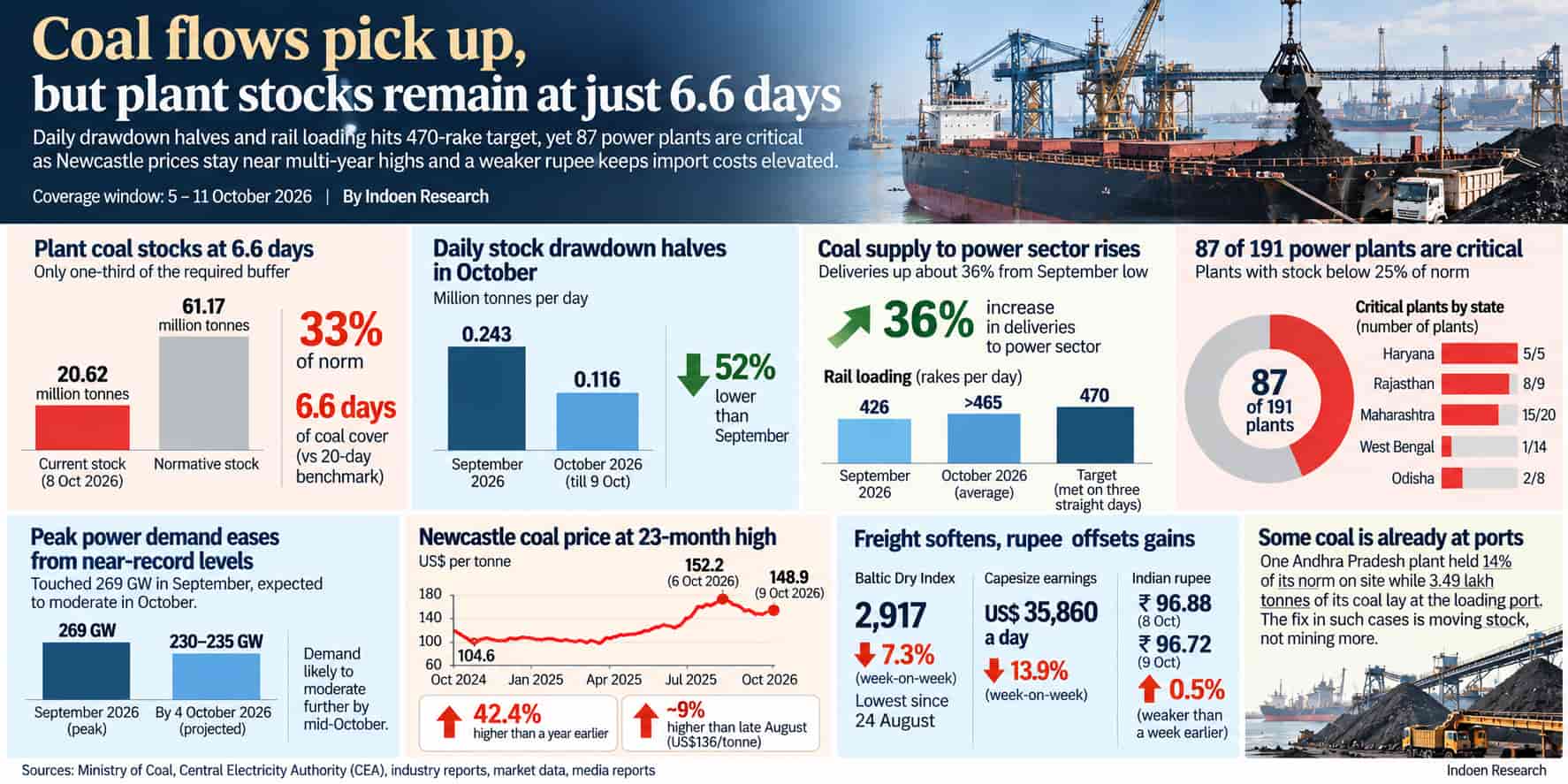
Stocks are still falling, only more slowly. The Ministry of Coal said on 9 October that the daily drawdown at power plants fell to 0.116 million tonnes in October, from 0.243 million tonnes in September, according to a ministry statement.
The Central Electricity Authority (CEA) data for 8 October explains why that is not yet comfort. The 191 monitored plants held 20.62 million tonnes against a norm of 61.17 million tonnes. That is about 33% of the norm, or 6.6 days of coal against a 20-day benchmark. Plants took in 2.68 million tonnes that day and burnt 2.73 million tonnes.
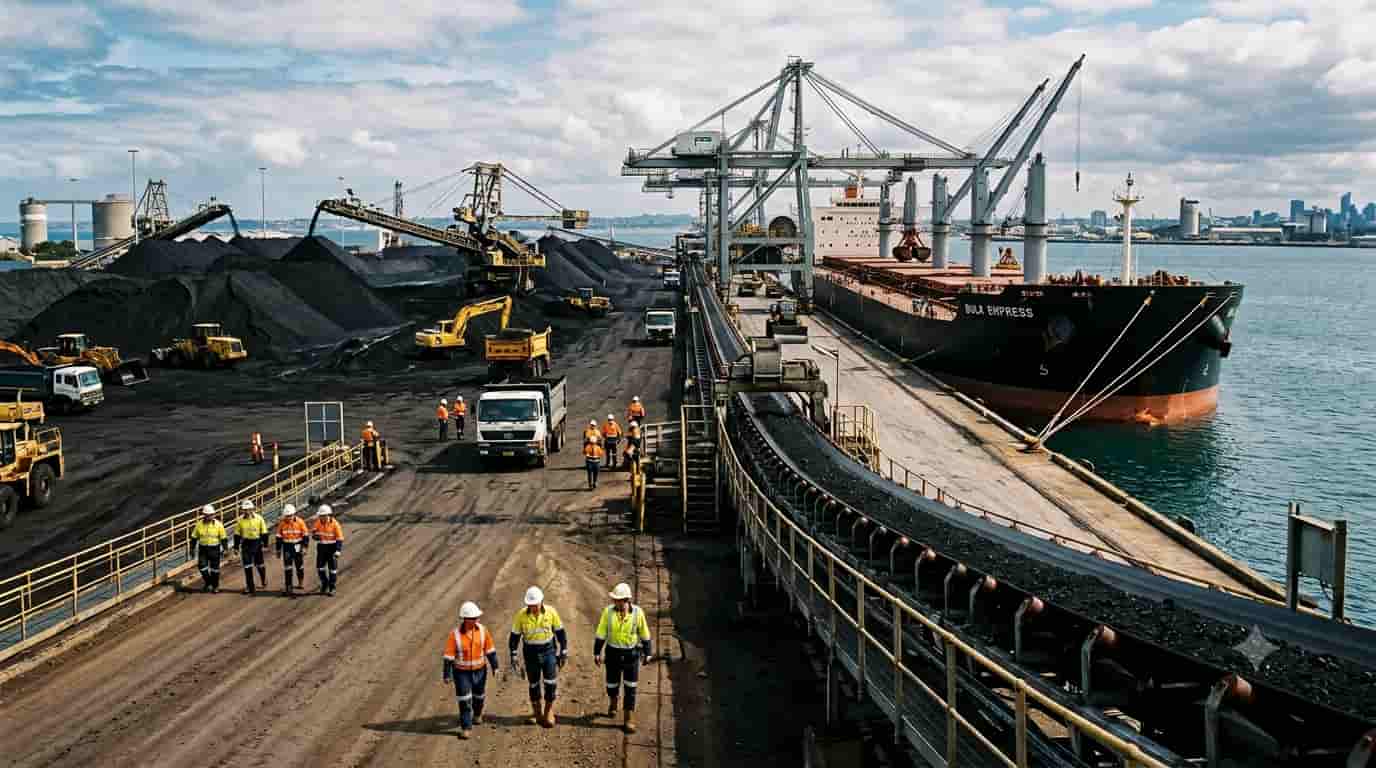
Supply has improved. Deliveries to the power sector are up about 36% from the September low. Rail loading averaged over 465 rakes a day in October, against 426 in September, and the 470-rake target was met on three straight days.
“Many stations now run on a delivery-to-burn basis. Whatever arrives by rake is consumed within the day, so there is nothing left to build a buffer,” an executive at a leading thermal utility said.
Demand is helping. Peak demand touched a near-record 269 GW in September, one report notes, and was projected to ease to between 230 and 235 GW by 4 October, trade reporting shows. The ministry expects demand to moderate further by mid-October.
What the “critical” tag really measures
The count of critical plants rose to 87 of 191 on 8 October, from 82 on 27 September. The headline needs careful reading.
The CEA marks a plant critical when stock falls below 25% of its norm. That norm differs by location: 21 days for plants far from mines and 13 days for pithead plants. The trigger is therefore a little over five days of coal for the first group and just over three for the second. Pithead plants held 48% of their norm and distant plants 29%, yet both had roughly six days of cover.
“The critical list is an early-warning trigger. It flags plants early so that coal can be redistributed before any generation is lost,” a senior official at the Ministry of Coal said.
That is a fair reading, but it has limits. Sixteen plants held less than a tenth of their norm, and some of the thinnest stocks sat at plants running flat out. The 600 MW Warora plant held 2% of its norm at a 97% plant load factor. The 1,350 MW Amravati plant held 3% at 96%.
 The shortage is regional, and some coal sits at ports
The strain is not spread evenly. All five plants in Haryana were critical, as were eight of nine in Rajasthan and 15 of 20 in Maharashtra. In West Bengal only one of 14 was critical, and in Odisha two of eight.
The CEA’s remarks against each critical plant carry an underexplored detail. For 67 of the 87, it asked specific coal companies to ensure supply, naming SECL for 22 plants, CCL for 18 and MCL for 15. At some coastal plants, the same report shows, the coal was not missing at all. One Andhra Pradesh plant held 14% of its norm on site while 3.49 lakh tonnes of its coal lay at the loading port. There, the fix is moving stock, not mining more.
Newcastle tests highs as Australia adds a supply risk
Newcastle thermal coal touched US$150 a tonne on 5 October and US$152.20 on 6 October, its highest in 23 months. It eased to US$148.85 by 9 October, still 42.4% above a year earlier, market data shows.
A court ruling added support. Australia’s High Court rejected Mach Energy’s appeal over a New South Wales mine expansion, after finding that planners had not properly counted emissions from customers who burn the coal. The country’s Minerals Council warned that this could deter investment and squeeze future supply.
For Indian buyers, the effect is indirect but real. Tougher approvals for new Australian mines keep a floor under Newcastle just as utilities prepare to rebuild stocks through blending. The benchmark was assessed near US$136 a tonne in late August, according to the IEA’s mid-year coal update, so the climb since then is about 9%.
The same update expects record global coal demand this year, as costlier LNG from the Hormuz disruption pushes China, India, Japan, South Korea and parts of Europe towards coal. India is therefore short of coal at home while competing for the same marginal tonne as every gas-short economy in Asia.
Landed cost: A weaker rupee offsets cheaper freight
The rupee closed at 96.88 on 8 October and 96.72 on 9 October, exchange-rate reports show, close to record lows and about 0.5% weaker than a week earlier. That raises the rupee cost of every dollar cargo.
Freight gave less relief than the headline suggests. The Baltic Dry Index fell 7.3% over the week to 2,917, its lowest since 24 August, and capesize earnings dropped 13.9% to US$35,860 a day. Panamax rates rose 2.2% and supramax 1.4%, shipping data shows. Those mid-sized ships carry much of the coal on shorter Indonesia–India routes, so importers saw little benefit from the capesize slide.
Put together, Newcastle was flat to slightly lower in dollars from US$149.30 on 1 October, the rupee was weaker and mid-size freight edged up. Landed cost in rupees was roughly unchanged to marginally higher.
Policy: Redistribution, not rationing
The response this week was administrative. The ministry said coal is being redistributed on a requirement basis to vulnerable stations, with the Railways and Power ministries coordinating. The Section 11 order on captive plants, examined in Indoen Energy’s Power coverage, runs to 31 December. A proposal for mandatory imported-coal blending, reported as under consideration late last month, had not been notified in the reports reviewed.
For the six critical import-based plants, the CEA’s listed remedy was to build stock through imports. Indoen’s Coal Watch tracks those arrivals each week.
What this means for energy security
The week’s data support an uncomfortable reading. The system moves more coal every day, and plants still hold about six days of it. Rail capacity, not mine output, sets the pace, as Indoen noted last week, when record production failed to cool e-auction premiums. Festive, winter and summer demand all arrive before the stockyards are full.
A grid that leans on coal for most of its generation has little room for error when hydropower is weak and LNG is dear. That is why plant flexibility and the renewable build-out are security questions as much as climate ones.
Follow us on : X | LinkedIn | Facebook | Bluesky