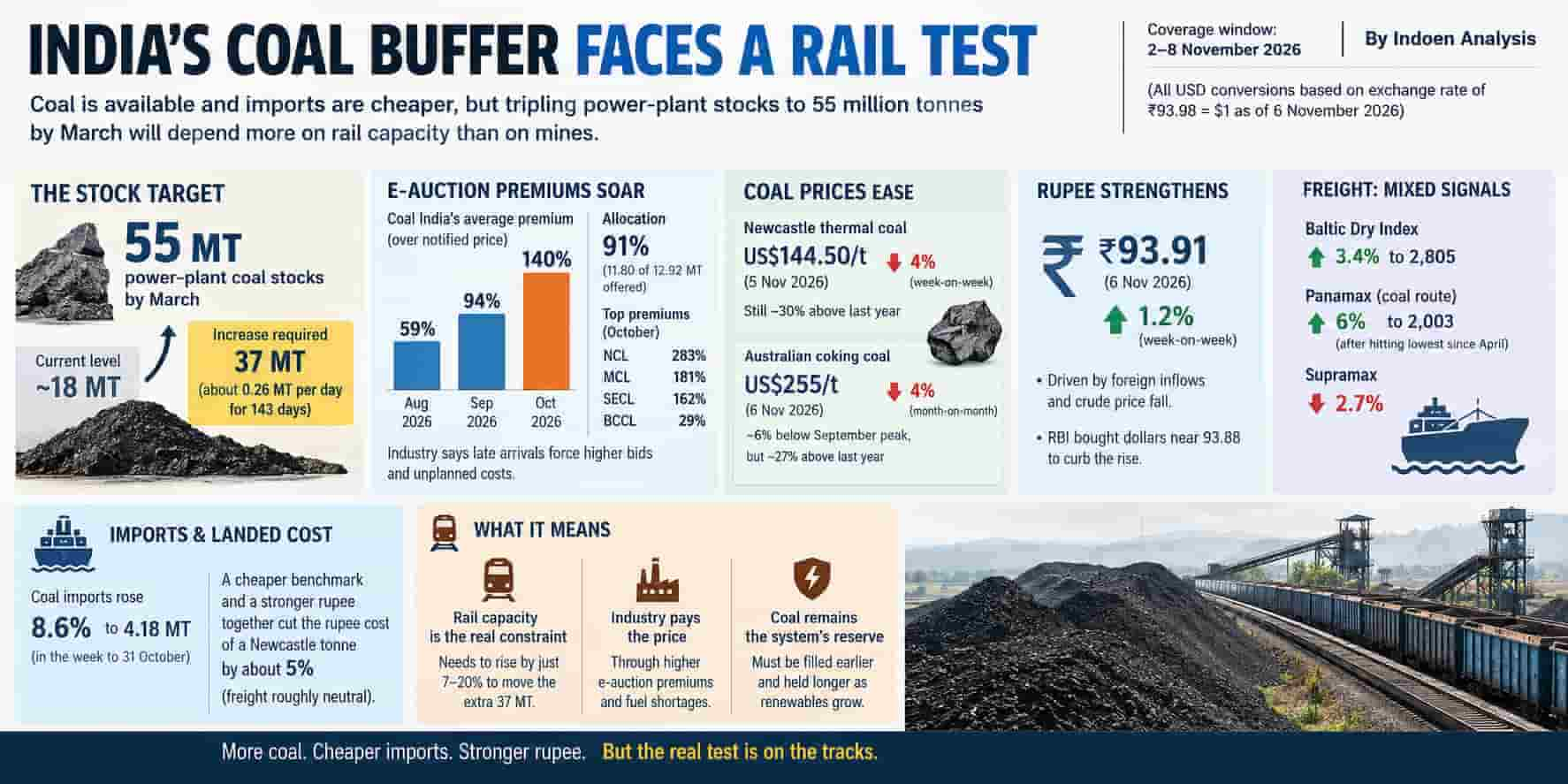
The coal, power and railways ministries have jointly asked miners and railways to lift plant stocks from about 18 million tonnes to at least 55 million tonnes by March. That would only restore what plants held at the same time this year. Railways reportedly raised coal carriage capacity by 20% in October and have been asked for 7% more by March.
The arithmetic is demanding. Adding 37 million tonnes in about 143 days needs receipts roughly 0.26 million tonnes a day above consumption, or about a tenth above daily burn. Even the best recent day, 25 October, added only 0.24 million tonnes.
“Tripling stocks means receipts must stay about a tenth above burn for five straight months. That is a rail problem more than a mining one,” an analyst tracking Indian thermal coal markets said.
Priority for power, and the price industry pays
The same report says Coal India’s priority for power plants has left factories short of fuel. The e-auction market shows the strain. Coal India’s average premium over notified prices jumped to 140% in October, from 94% in September and 59% in August. It allocated 11.80 of the 12.92 million tonnes offered, or 91%. NCL fetched 283%, MCL 181% and SECL 162%, while BCCL managed only 29%.
“Our notified-price coal arrives late, so we bid in auctions at a premium we never budgeted for,” an executive at an industrial company with captive power said.
There is a counter-signal. Draft prospectuses of IPO-bound Mahanadi Coalfields (MCL) and South Eastern Coalfields (SECL) show premiums falling sharply over two years. MCL’s average premium dropped from ₹802 a tonne (US$8.5) in FY24 to ₹274 (US$2.9) in FY26. SECL’s fell from ₹911.61 (US$9.7) to ₹631.94 (US$6.7), as per the filings.
MCL’s premium revenue fell from ₹1,833 crore (US$195m) to ₹728 crore (US$77m). The filings link part of the decline to more coal moving under fuel supply agreements. October’s 140% therefore reads as a rationing spike, not a new normal.
 Newcastle slides on Iran-deal hopes
Newcastle thermal coal fell to about US$144.50 a tonne on 5 November from US$150.45 a week earlier, a drop of about 4%. It is still about 30% above a year ago, market data shows. European gas hit a two-week low as the US midterm result lifted hopes of an Iran deal and a return of LNG flows through Hormuz, as per an energy report. Coal’s war premium came off with gas. Indoen covered the crude side in its note on the 17% oil plunge.
For India, the move helps. Cheaper seaborne coal lowers the cost of import-led stock-building, which stays voluntary because mandatory blending has been ruled out. Imports rose 8.6% to 4.18 million tonnes in the week to 31 October, as Coal Watch recorded. The relief may not last, since Hormuz shipping risk remains.
Australian coking coal was US$255 a tonne on 6 November, about 4% lower on the month and about 6% below its September peak of US$271. That eases some pressure on steelmakers, though it is still about 27% above last year.
Landed cost: A rare double relief
The rupee closed at 93.91 on 6 November, its strongest since 22 April and 1.2% up on the week. Foreign inflows and the crude collapse drove the gain, currency reports show. The RBI bought dollars near 93.88 to temper the rise.
Freight was mixed. The Baltic Dry Index rose 3.4% to 2,805. The panamax index, which covers ships that often carry coal, gained 6% to 2,003 after touching its lowest since April. Supramax fell 2.7%, shipping data shows.
A cheaper benchmark and a stronger rupee together cut the rupee cost of a Newcastle tonne by about 5%, with freight roughly neutral. The saving is fragile, because it rests on portfolio flows and a geopolitical premium that can reverse.
What it means
The week points to a simple constraint. Coal exists, and imports are cheaper, but moving 37 million tonnes more than plants burn needs rail capacity growing by only a few per cent. Industry pays in the meantime, through auction premiums. Last week’s analysis showed output jumping 19% without lifting stocks off six days. This week puts a number on a safe buffer.
For energy security, coal remains the system’s reserve. As renewables grow, that reserve must be filled earlier and held longer, a point Indoen explored in Cheap at noon, capped at dusk. The test is whether stocks rise before the Section 11 order lapses on 31 December and before summer demand arrives.