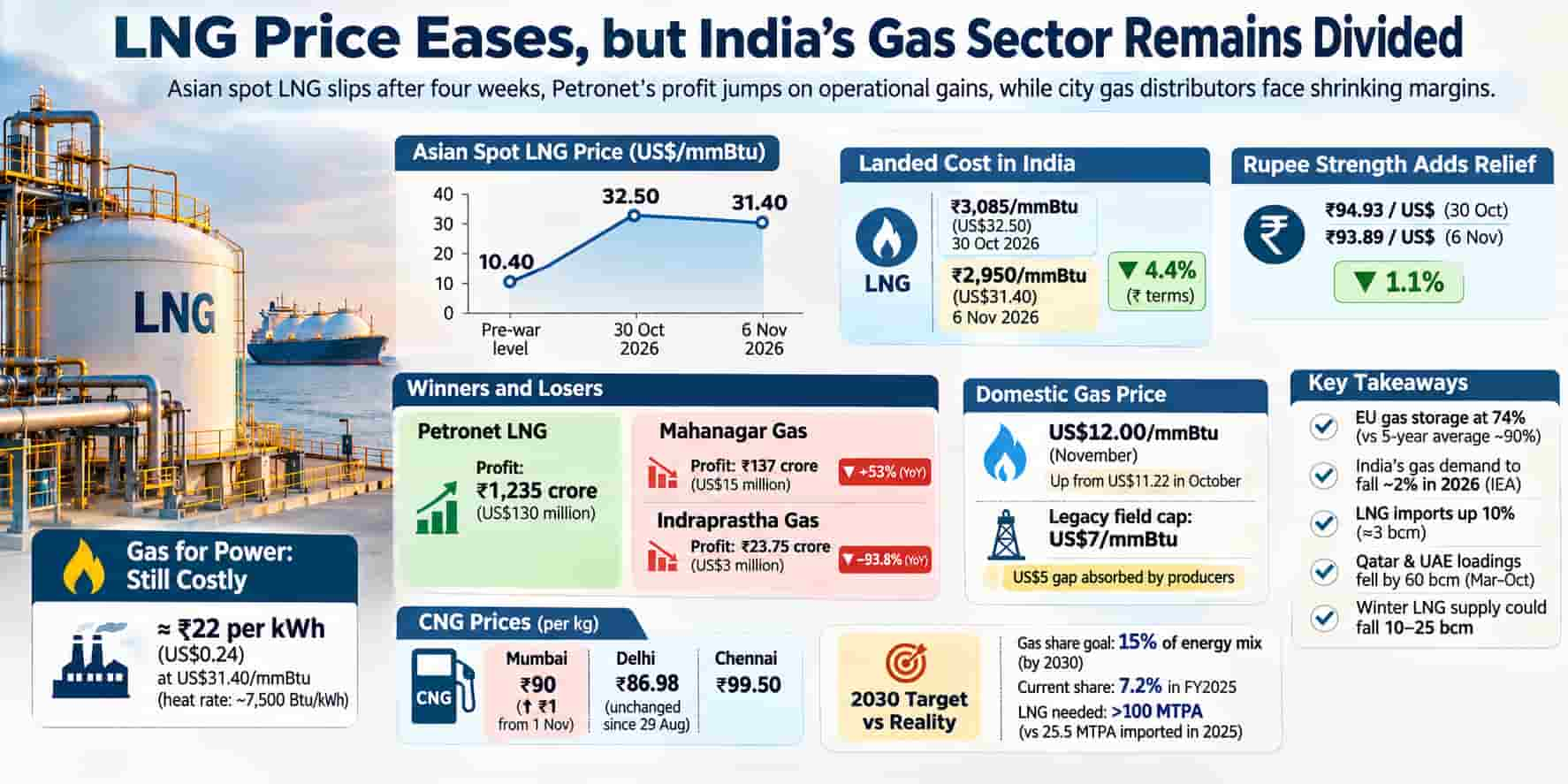
Asian spot LNG for December delivery averaged US$31.40 per mmBtu in the week to 6 November, down from US$32.50 a week earlier.
This was the first fall after four weekly rises, and prices stayed near a four-year high, as per recent trade data. Asian demand was subdued. More tankers moved through the Strait of Hormuz. Europe also became the more attractive destination for cargoes. Dutch TTF fell about 17%, to around €86 per MWh on 6 November, from about €104 on 30 October.
Risk did not go away. On 5 November, Iran reported that three more tankers had been damaged in the strait, as per a media report.
Qatar said on 3 November that Washington and Tehran remained committed to its mediation. Spot LNG is still about three times its pre-war level of US$10.40.
Europe’s buffer is also thin. EU storage is about 74% full, against a five-year average near 90%, and withdrawals have begun. For India, this means Atlantic cargoes will stay contested all winter.
An analyst tracking global LNG markets said: “The fall is sentiment, not supply. Qatar is not back at scale, and Europe must now draw from storage all winter.”
Landed cost: The rupee adds to the fall
The rupee closed at ₹93.89 on 6 November, against ₹94.93 a week earlier. That is a gain of about 1.1%. Foreign inflows and lower crude prices helped, as Indoen reported when Brent settled at US$94.62 on 4 November.
So spot LNG now equals about ₹2,950 per mmBtu (US$31.40), against ₹3,085 (US$32.50) a week ago. The dollar price fell 3.4%. The rupee price fell 4.4%. Regasification and pipeline charges come on top.
Contract prices tell another story. The November domestic gas price of US$12.00 is 10% of the Indian crude basket, which puts the basket near US$120 a barrel. At 12–13% of that, oil-linked LNG works out near US$14–15 per mmBtu, on Indoen’s estimate. Spot is more than twice that. Term prices follow crude with a lag, so Brent’s fall should lower them in coming months. Spot will not follow unless Hormuz opens.
Gas-fired power remains costly. At US$31.40, fuel alone for a plant with a heat rate near 7,500 Btu per kWh costs about ₹22 per kWh (US$0.24), on Indoen’s estimate. Market participants still expect Indian gas-for-power demand to support Asian prices next week. That fits the grid, where plant coal stocks remain near six days. Gas plants are called when coal falls short, not because they are cheap.
 Terminals profit, distributors pay
Petronet LNG shows who gains. On 2 November it reported a net profit of ₹1,235 crore (US$130 million) for the quarter to 30 September, up 53% from ₹806 crore (US$85 million). Revenue fell 35%, to about ₹7,200 crore (US$770 million) from ₹11,009 crore (US$1.2 billion). Dahej ran at 73% utilisation, against 92% a year earlier, but up from 66% in the previous quarter. Management credited ₹658 crore (US$70 million) of gains to operational and commercial efficiency, against ₹41 crore (US$4 million) a year earlier.
This is the first surprise. A terminal earns on capacity, so the price risk sits with those who buy the gas.
Distributors carry that risk. Mahanagar Gas reported on 3 November that profit fell 28% to ₹137 crore (US$15 million), even as volumes grew 6.5%. Its EBITDA margin fell to 12.0% from 16.5% a year earlier. Indraprastha Gas, which reported on 30 October, saw profit fall 93.8% to ₹23.75 crore (US$3 million) from ₹384.95 crore (US$41 million). Analysts blamed costlier spot LNG and warned that pressure may continue this quarter.
An executive at a leading Indian gas utility said: “Volumes are growing, but each extra cubic metre we buy at spot costs more than we can recover. Margin, not demand, is the problem.”
Retail prices are moving unevenly. Mahanagar Gas raised Mumbai CNG by ₹1 (US$0.01) to ₹90 per kg (US$0.96) from 1 November, its sixth hike in seven months of the war, as per city price listings. Delhi CNG stays at ₹86.98 (US$0.93), unchanged since 29 August. Chennai is ₹99.50 (US$1.06). Household PNG rates were broadly unchanged for November.
Domestic gas: formula and cap drift apart
The government notified the domestic gas price for November at US$12.00 per mmBtu, up from US$11.22 in October. The formula follows crude. But gas from ONGC and Oil India’s legacy fields remains capped at US$7. The US$5 gap is carried by producers. The cap shields city gas networks and fertiliser plants. With oil lower, December’s formula price should ease, but on Indoen’s reading it will still sit above the cap.
The energy-security question
The IEA’s Global Gas Security Review, released this week, finds that India’s gas demand will fall about 2% in 2026, yet LNG imports rose 10%, nearly 3 bcm. Domestic production weakened more than demand. The agency adds that Qatar and UAE loadings fell by 60 bcm between March and October, and winter LNG supply could fall 10–25 bcm.
This runs against India’s goal of a 15% gas share by 2030, from 7.2% in FY2025. Petronet’s chief executive has said the target needs over 100 million tonnes of LNG a year, against 25.5 million imported in 2025.
There is some relief. Prices have eased, talks continue through Qatar, and rupee strength helps. But about 17% of Qatar’s capacity was damaged in March. Watch the US–Iran talks, mine incidents in Hormuz, CNG price decisions by Delhi and Mumbai distributors, and the December gas price due by 30 November.