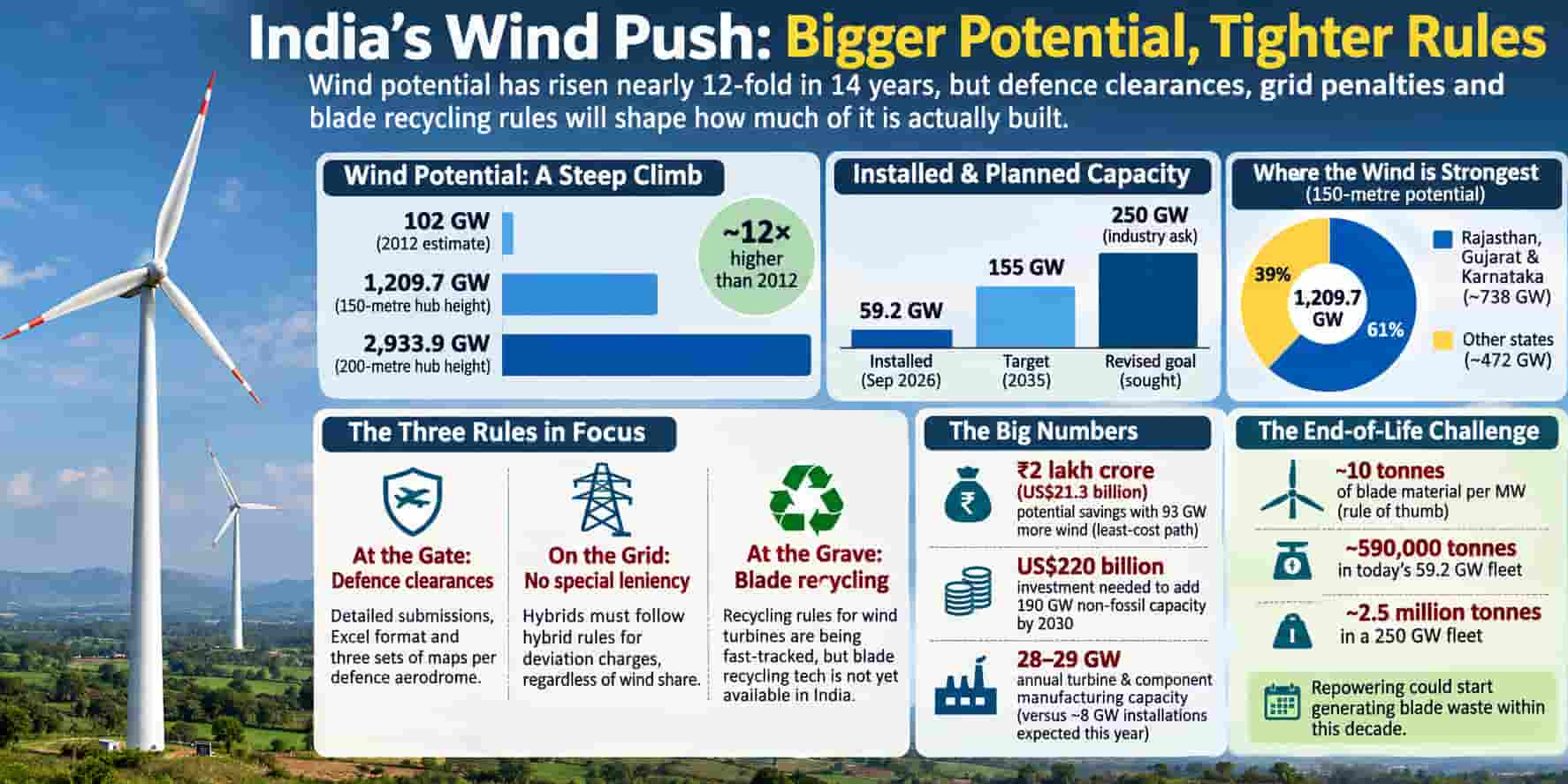
India keeps finding more wind. A New Delhi-based think-tank, TERI, now puts the country’s theoretical onshore potential at 1,209.7 GW at a 150-metre hub height and 2,933.9 GW at 200 metres, according to a statement issued on 2 November. Rajasthan, Gujarat and Karnataka together hold about 61% of the 150-metre figure.
Set that against history. In 2012, the official estimate stood at 102 GW. It assumed that only 2% of windy land was available, as a US national laboratory study noted that year. The figure has since grown nearly twelve-fold. The sky did not change. Towers grew taller, blades grew longer and maps got better. Potential, in short, moves with the assumptions behind it.
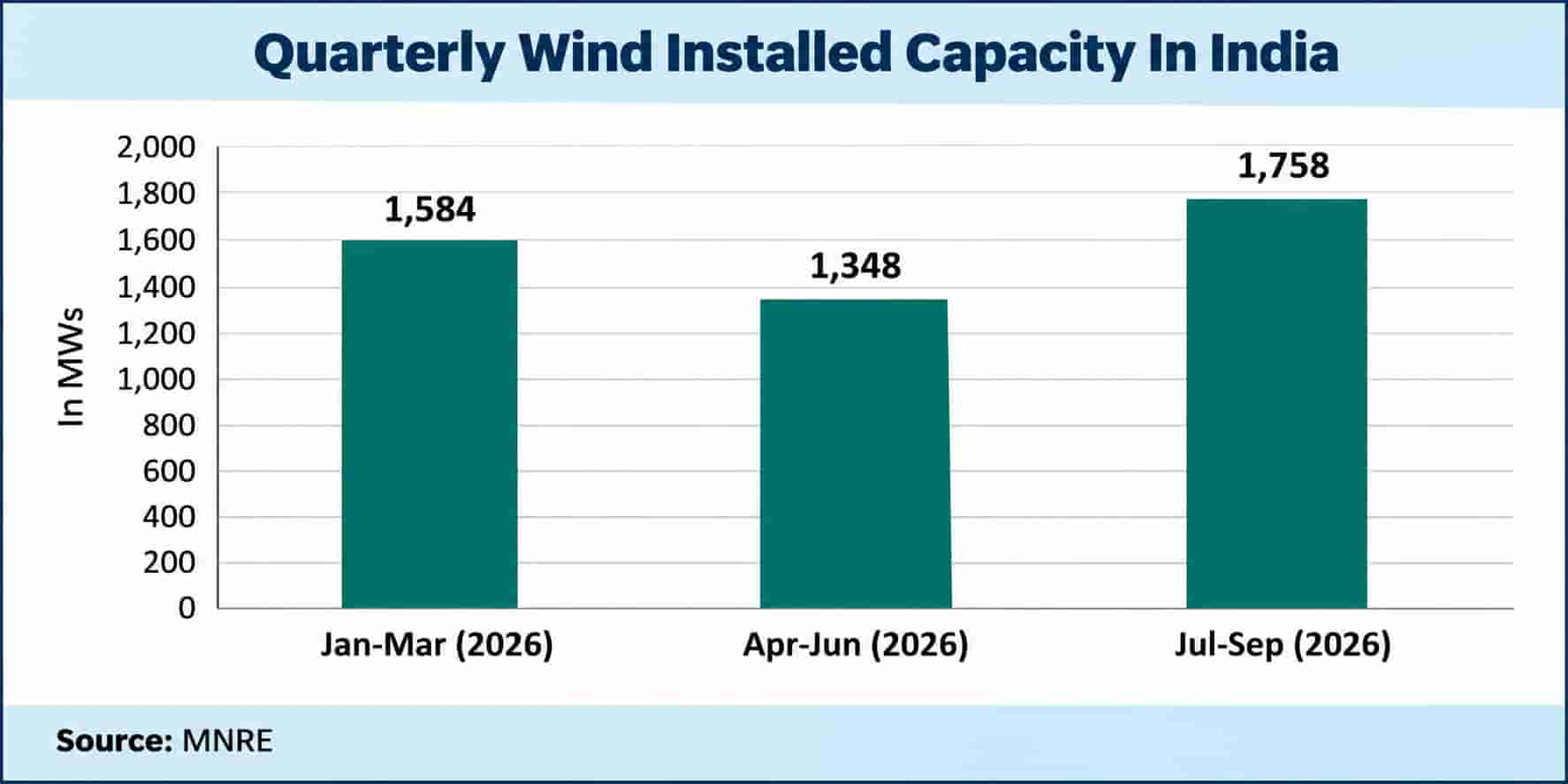
Actual capacity is humbler. India had 59.2 GW of wind installed on 30 September, roughly 5% of the 150-metre estimate.
So the useful question is not whether India has enough wind. It is who must say yes before a turbine turns, while it runs and after it retires. Three decisions from the past five weeks answer that.
A bigger prize, and a bigger ask
The prize is large. Suzlon co-founder Girish Tanti expects the Centre to raise the 2035 wind target from 155 GW to about 250 GW, as he said in a recent interview. State demand plans point to roughly 147 GW of wind by 2035, he says. Commercial and industrial open-access buyers could add another 100 GW. A government study found that a least-cost path, with 93 GW more wind, could save about ₹2 lakh crore (US$21.3 billion).
He speaks for a turbine maker with orders to win, so the optimism has an interest behind it. Still, the factories are ready. Annual turbine and component capacity is 28 GW to 29 GW, against roughly 8 GW of installations expected this year. That is under a third of capacity. Tanti calls the 100 GW target for 2030 as good as achieved, with 59 GW built, 29 GW bid out and 15 GW coming for private buyers.
The wider bill is steep. The renewable energy minister says India needs over US$220 billion to add 190 GW of non-fossil capacity by 2030. Yet an opinion piece by the head of an Indian clean energy developer argues that ambitious targets will not be reached without more regulatory help. Here lies the paradox. Regulation is arriving, but not always as help.
 At the gate: Maps in triplicate
On 1 October, the Ministry of New and Renewable Energy issued a memorandum for wind projects near defence installations. Developers must now send a soft copy and a standard Excel sheet at the start. They must also submit three physical sets of maps for every defence aerodrome nearby. A project near two facilities needs six sets. All hard copies must reach the ministry within seven days, or the file may be rejected or returned. Break a condition after clearance, and the approval can be revoked.
Paper maps look odd in a sector chasing 100 GW. The ministry’s logic is simple, though. Incomplete files were clogging the queue.
“A complete file moves faster. An incomplete one stalls, and it holds up everyone behind it. The standard format protects applicants as much as the ministry,” said a senior official at a central government ministry.
There is a deeper point. Taller towers are what lift the potential figures. Turbine height is also one of the details the defence rules ask developers to fix. Rajasthan and Gujarat are border states with a sizeable defence presence. TERI itself flags priority areas for further resource validation. Defence zones are likely to be one more filter between map and metal.
On the grid: A label buys no leniency
On 4 November, the Central Electricity Regulatory Commission rejected a petition on a 160 MW wind-solar project in Karnataka. The developer wanted it treated as a wind station for deviation charges, since most capacity was wind. The Commission ruled that wind share does not decide the classification. Hybrids must follow hybrid rules.
This follows the end of special leniency for wind and solar on deviation charges from 31 August, which Indoen covered earlier. Hybrids are expected to scale fast, so this ruling sets the template.
The cost of a forecasting miss is not abstract. A media report put the fall in Gujarat’s wind generation at 56% as demand hit a record high. The state’s peak touched 29,822 MW on 16 October. In such weeks, a hybrid plant that scheduled wind that never came would face deviation charges, whatever its label. Indoen has tracked how a similar lull pushed Tamil Nadu’s evening power prices far beyond the exchange ceiling.
Tanti is upbeat about the wires. He expects grid build-out to match project timelines within 18 to 24 months. Renewable projects take 18 to 36 months to build, against about four years for conventional plants. The gap may narrow. But penalties apply today, while transmission arrives later.
 At the grave: Blades nobody can yet recycle
India is now fast-tracking recycling rules for solar modules and wind turbines.
The renewable energy secretary said turbine recyclability is fairly high. Yet technology to recycle blades and their epoxy is not available in India, he added. Suzlon and the Aditya Birla Group have signed an agreement to make the epoxy fully recyclable. Waste modules, meanwhile, must be stored until 2035.
India also has no specific law for wind turbine waste. A 2022 private member’s bill never became law.
Consider the scale. A common rule of thumb needs about 10 tonnes of blade material per megawatt. On that basis, today’s 59.2 GW holds roughly 590,000 tonnes. A 250 GW fleet would hold about 2.5 million tonnes.
The first batch may not wait for the 2040s. Repowering old wind farms replaces blades, so discards could start within this decade.
Europe is ahead on this. Germany, for one, bans landfilling of blades. Tanti wants exports to Southeast Asia, Europe and the wider Global South, and notes that 133 countries use wind power. A blade with an end-of-life answer could become a sales point.
“Buyers abroad are asking what happens to a blade after twenty-odd years. Indian makers who have an answer will win orders that others cannot,” said an executive at one of India’s leading wind turbine manufacturers.
What the rulebook adds up to
Each rule makes sense alone. Defence clearance is a national requirement. Deviation discipline pushes better forecasting. Early recycling rules beat the old habit of legislating after the dump has grown. The minister himself said solar waste would arrive in two to three years, with a policy promised before it.
The risk is cumulative. A developer faces a map regime at the gate, a penalty regime on the grid and an unfinished liability regime at the grave. Each adds cost or delay. None shows up in the headline potential figures. If the target rises to 250 GW, those burdens rise with it.
Three things are worth watching. Will the Centre formally revise the 2035 target? Will the Commission clarify forecasting tolerances for hybrids? Will the recycling guidelines set blade-specific duties, and not only module ones? A single window covering defence, grid and end-of-life obligations could help more than another round of target-setting.
India has found the wind. It now needs rules that move as fast as its map.