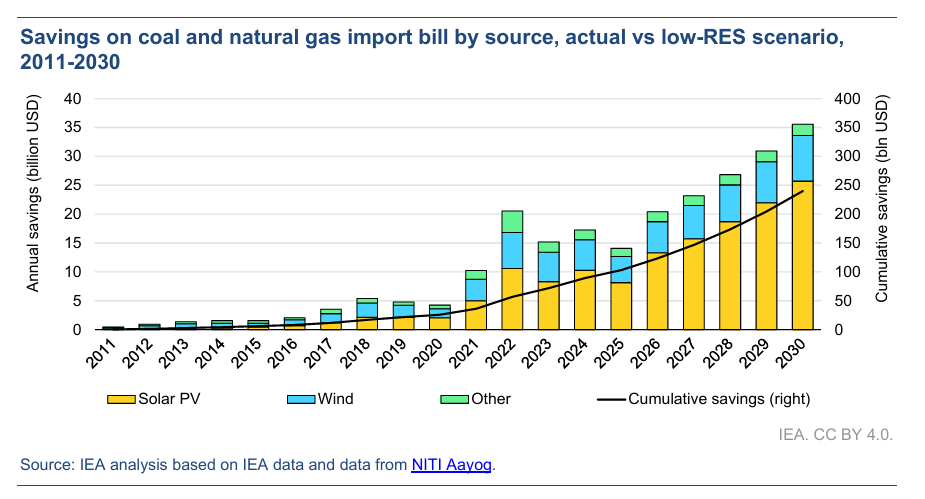
India’s clean energy push has paid off in hard numbers. The IEA says renewable electricity saved India more than US$100 billion in coal and natural gas import costs between 2011 and 2025. Installed clean capacity now exceeds 300 GW, and the non-fossil share of power capacity reached 50% in 2025, five years ahead of target.
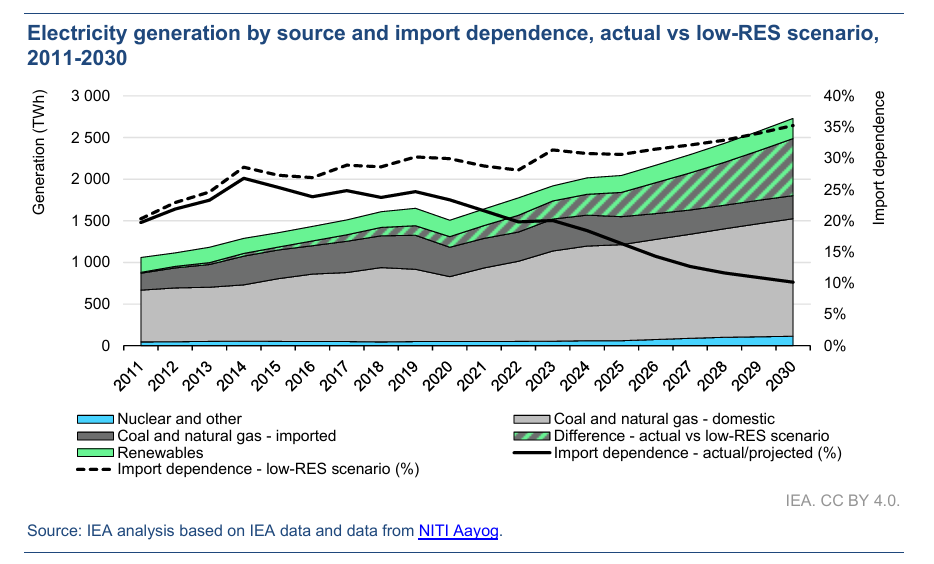
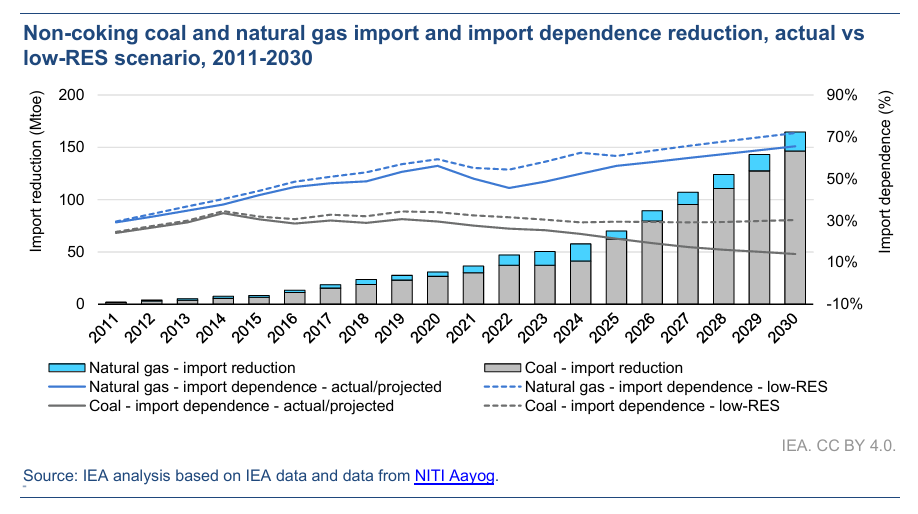
The IEA credits solar with about 60% of the projected savings and wind with about 30%. Without the solar, wind and bioenergy added since 2010, coal imports in 2025 would have been about 110 million tonnes higher.
The agency expects this to more than double. As per recent reporting on the report, cumulative savings could near US$240 billion by 2030. Annual savings of about US$35 billion would then exceed India’s FY2024-25 bill for non-coking coal and gas. The estimate assumes fuel prices stay near 2024-25 levels. With 2026 prices far higher, the real figure may turn out bigger.
Here is the catch. Those savings were earned in electricity. The 2026 shock was not an electricity story.
Where Hormuz actually hurt
The Strait of Hormuz effectively shut after war broke out in late February. Brent rose from around US$70 a barrel in January to over US$120 in March, according to UNCTAD analysis. It eased when talks progressed, then climbed again when they collapsed. India imports close to 90% of its crude, so it felt every swing.
The damage was uneven across the world. UNCTAD also warns that a 25-cent rise in the price of a litre of fuel can cut household purchasing power by more than 5%. For a family that spends most of its income on essentials, that is hard to absorb.
Cooking gas took the hardest knock. As per reporting based on Kpler shipping data, India bought about 0.89 million tonnes of LPG from the United States in July and 0.62 million tonnes in August. That was more than 73% of its LPG imports. The UAE sent only about 140,000 tonnes in August. Qatar sent around 60,000. Saudi Arabia sent none. Qatari LNG, once worth up to 1.2 million tonnes a month, fell to zero in April.
A senior official at a central government ministry put the problem plainly. “Our renewables have protected the power sector’s import bill. But a solar panel cannot fill a cooking-gas cylinder, and it cannot run a diesel truck.”
 Ethanol: Right instinct, narrow target
Ethanol is India’s other big hedge. Official figures summarised by a policy explainer show average blending of 20% between November 2025 and August 2026. Cumulative crude substitution is put at about 31.6 million tonnes. Foreign-exchange savings exceed ₹1.97 lakh crore (US$21.0 billion), and farmers and distillers have received more than ₹1.66 lakh crore (US$17.7 billion).
These are large sums. Yet India’s crude import bill was about US$137 billion in FY2024-25 alone. A decade of ethanol savings equals roughly 15% of a single year’s bill.
A recent newspaper column argues that E100 cannot solve India’s oil import problem. The logic is simple. Ethanol displaces petrol. India’s sharpest 2026 pain was in LPG and diesel.
There are fiscal and resource costs too. Surplus FCI rice was sold to distillers at ₹22.50 a kg (US$0.24) against an economic cost of ₹40.42 (US$0.43). A credit-rating assessment cited in the same explainer found only about 60% of offered ethanol was being absorbed by mid-2026. Plant utilisation may stay at 65 to 75%. Ethanol helps. It does not close the gap.
 Diversification has a price
India did find new suppliers. Russia sent nearly 2 million barrels a day in August, over three times the UAE’s volume. Venezuelan crude reached 383,000 barrels a day. But a Kpler analyst cautioned against reading this as a deliberate shift. Much of it reflects scarce Gulf availability, he said, and India is effectively paying a premium for security.
The premium is visible. Freight for crude from Fujairah to India’s west coast hit US$7.51 a barrel in October, up from US$1.57 in February, according to a media report. That is a rise of about 377% on a route meant to dodge the strait. Heavy Venezuelan barrels also suit only some refineries, and US Gulf Coast plants compete for them.
Someone also absorbed the shock. A mid-year opinion column noted that the government chose not to pass it on to consumers. It added that fortune helped. Had the conflict dragged on, or oil stayed near US$120, the picture would have looked less comfortable.
 Storage is the missing link
The IEA is blunt about what comes next. Sustaining the renewable expansion needs faster investment in grids, storage and system flexibility, along with stronger utility finances and fewer project delays. A McKinsey study puts Asia’s energy security investment need at about US$1 trillion a year for the next 15 years. Asian energy demand is forecast to reach 370 million terajoules by 2040, so the bill only grows.
Storage matters on the fuel side as well. India holds strategic crude, but an analyst told reporters it keeps no strategic LPG reserves. In May, the Prime Minister’s Office said India could hold part of its reserve at Fujairah, where tankers load outside the strait. ADNOC and Indian Oil are also exploring long-term LPG supply.
One quiet signal deserves attention. The IEA noted separately that LPG shortages triggered a sharp rise in induction cookstove sales in India. This may be the real bridge from solar to the kitchen. But it only works if the grid can carry the evening cooking peak.
A researcher at a New Delhi-based energy think tank framed it this way. “We talk about energy security as supply. For the next decade it is as much about storage: batteries for the evening peak, caverns for crude and tanks for LPG.”
What a price-taker can control
India cannot set the oil price. A US commentator argues that only more supply or weaker demand can pull prices down, and that no government can change that. He expects further rises. He notes that WTI rose 33.3% in the first 99 days of the Iran war, against 36.1% in just 12 days after Russia invaded Ukraine, and that the Iran war removed about a fifth of global supply. OPEC accounts for roughly 32% of world output and non-OPEC for about 65%.
The levers sit with producers India does not influence. Others see relief. Recent reports suggest Brent slid on hopes of a US-Iran deal, which shows how fast sentiment turns.
There is also a fiscal angle. UNDP estimates that fossil-fuel subsidies could reach US$1.1 trillion worldwide in 2026. India’s decision to hold retail prices is part of that pattern. Money spent holding down diesel and LPG prices is money not spent on storage or electrification.
What India can control is exposure. UNCTAD found diesel in Nigeria rose about 83% between late February and August, against 9% in Ireland. It also notes that renewables have been cheaper than the cheapest new fossil option in over 90% of cases. India sits between these extremes. It is cushioned in power, exposed in cooking gas and diesel.
So the next headline number should not be in dollars. It should count cylinders replaced, diesel litres displaced and days of cover built.
The IEA’s US$240 billion is a forecast, not a guarantee. It depends on grids, discom finances and steady policy. Peace could also dull the urgency that war created. India has earned one dividend. The test is whether it can earn the next where the pain actually was.