
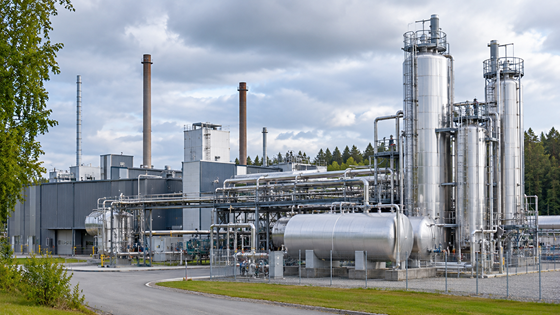
Nordic Ren-Gas has taken a final investment decision on its e-methane facility in Tampere, Finland, backed by more than €300 million ($330 million) of investment. Financing is closed, construction begins immediately and completion is targeted for 2029. The plant combines green hydrogen with biogenic CO2 to make synthetic methane. Earlier project disclosures point to a 50 MW electrolyser from Sunfire, about 200 GWh of fuel a year and roughly 40,000 tonnes of CO2 captured from a local waste-incineration plant. Waste heat will also feed Tampere's district heating network.
The capital stack matters more than the plant's size. Equity comes from Allianz, Tesi, the Japan Hydrogen Fund and Schroders Greencoat. Debt comes from the European Investment Bank, Société Générale, Standard Chartered, Nordea and Finnvera, with the EIB's €60 million ($66 million) loan backed by the InvestEU programme. Finnvera, Finland's export credit agency, also provided its first-ever power purchase agreement counter-guarantee. Electricity is the largest cost and risk in any power-to-gas project, and the sponsor had already signed long-term hydrogen PPAs with Helen and a second supplier in September. Those contracts bundle physical power, guarantees of origin and compliance with the EU's renewable fuels of non-biological origin (RFNBO) rules. A state guarantee behind that supply contract is what makes the cash flows financeable.
Demand is the other half of the structure. Allianz Global Investors says long-term offtake arrangements and the financing structure drew a broad institutional investor base, and that the fuel will help decarbonise heavy transport in Germany. The plant is also designed to flex its electricity use, ramping up when renewable supply is abundant and easing back when the grid is tight. That makes it a grid-balancing asset as well as a fuel producer. Taken together, e-methane is being financed as long-life infrastructure with contracted inputs and contracted outputs, not as a technology bet.
For India, the relevance is in the financing model rather than the molecule. India's green hydrogen push is still concentrated on export-oriented ammonia, and Indoen has noted that Europe, Japan and East Asia are seeking long-term supply partnerships. The Tampere deal shows what those buyers' capital markets will underwrite: fixed offtake, locked power supply, regulatory compliance built into contracts and sovereign credit support for the weakest link. Indian developers courting the same investors, including Japanese hydrogen funds and banks such as Standard Chartered, will face a similar bar. The structure also offers a lesson for domestic policy. A counter-guarantee on renewable power contracts could lower the cost of capital for hydrogen and biogas-linked projects in India, where power pricing and offtake risk remain the main obstacles to bankability.