RWE–KKR’s $16.1bn Norfolk deal makes offshore wind bankable at scale
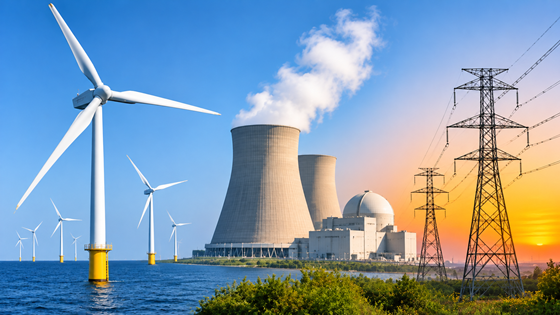
RWE and KKR have reached financial close on the Vanguard East and West offshore wind farms off the Norfolk coast, a £12 billion ($16.1 billion) package that the UK government describes as the largest renewable energy investment in the country’s history.
The two projects total about 2.8 GW and sit in a 50:50 joint venture. Offshore construction begins in early 2027, with full commissioning scheduled for 2030. The sum covers the wind farms and their associated transmission infrastructure, and it exceeds the $15 billion-plus cost KKR flagged when the partnership was announced in January.
The financing structure is the real story. Debt comprises £11.1 billion ($14.9 billion) in cash facilities and £1.7 billion ($2.3 billion) in ancillary lines, arranged with 35 international banks. Export-credit cover comes from Germany’s Euler Hermes and Denmark’s EIFO.
The state-owned National Wealth Fund contributes £1 billion ($1.3 billion), its largest offshore wind commitment to date. RWE calls it the largest non-recourse project financing yet arranged for UK offshore wind. Revenue certainty underpins all of it: 20-year, inflation-indexed Contracts for Difference at £91.20 ($122) per MWh in 2024 prices, awarded in January 2026. Each farm will use 92 Vestas V236-15 MW turbines.
The timing is also political. Prime Minister Andy Burnham welcomed the investment on his way to COP31 in Antalya, three weeks after his government cleared the Jackdaw gasfield and announced a £2 billion ($2.7 billion) New Energy Wealth Fund. London is pursuing domestic gas and domestic wind together as an energy-security strategy.
For India, the relevance lies in the template, not the turbines. India’s offshore wind ambitions, a 30 GW-by-2030 aspiration with the first tranches leaning on viability gap funding, remain at an early stage.
Norfolk shows what moves lenders at this scale: a long-dated, indexed revenue contract, export-credit wrap, a public balance sheet in a catalytic role and a turbine order large enough to lock in supply.
The 15 MW-class machines also underline the port, vessel and grid-evacuation demands that Gujarat and Tamil Nadu will have to meet. Global infrastructure funds such as KKR, which already invest in Indian renewables, will price India’s offshore wind against exactly this benchmark.
Turkey’s $500bn plan targets 175 GW renewables and 10 GW nuclear
Turkey has unveiled an energy infrastructure plan worth $500 billion through 2040, Energy Minister Alparslan Bayraktar said. It aims to reduce an import bill that has recently reached as much as $70 billion for coal, oil and gas.
The plan targets a fourfold rise in wind and solar capacity to 175 GW, with renewables reaching 77% of installed generation capacity. It adds 10 GW of new nuclear and sets a goal of 20 million electric vehicles. The stated ambition is to meet all petroleum and gas consumption from domestic resources, including Black Sea gas, though the plan provides no volumes or timelines.
The starting point shows how steep the climb is. Coal is still Turkey’s largest source at 34% of generation, and wind and solar together account for about 22%, according to Ember data cited by Oilprice.
Nuclear is anchored by Russia’s Rosatom-built Akkuyu, whose 4,800 MW is expected to meet about 10% of demand. Electric vehicles took 17% of new-car sales in 2025, or 190,000 units, fourth in Europe. The government expects efficiency measures to save $240 billion. Reuters calculations cited in the report put electricity projects alone above $200 billion.
The plan is a target, not a financed programme, and its credibility will depend on tariff design, grid investment and how much of the capital is private. Even so, it is a clear statement of intent from the host of COP31.
The India parallel is direct. Both countries are large, import-dependent, fast-growing economies that are trying to turn a foreign-exchange drain into an industrial strategy. India’s own nuclear ambitions, a 100 GW-by-2047 goal, rest partly on Russian technology, as at Kudankulam, so Akkuyu’s delivery record is a useful reference.
Turkey’s EV penetration is also far ahead of India’s. If Ankara can show a gas, solar and nuclear mix that cuts the import bill without destabilising the grid, it offers a benchmark. If it stalls on financing or grid constraints, it is an early warning for similar targets elsewhere.
Spanish groups win 7 of 8 Brazil grid auction lots in $1.6bn deal
Spanish-backed bidders took seven of the eight lots in Brazil’s 30 October transmission auction, committing R$8.56 billion ($1.5 billion) of the R$8.9 billion ($1.6 billion) on offer. Portugal’s EDP won the remaining lot. Celeo, Cymi, Cox and Iberdrola’s Brazilian unit Neoenergia were the Spanish-linked winners. Celeo’s R$4.1 billion ($740 million) Paraná-based lot accounts for nearly half the total. No Brazilian bidder won a lot; Alupar and Axia bid on all eight.
The competitive intensity is notable. The weighted average discount to the ceiling was 50.1%, ranging from 38.55% on the smallest to 57.08% on the largest. Annual contracted revenue came to R$811 million ($145 million) against a ceiling of R$1.625 billion ($290 million).
The concessions run for 30 years and cover 1,866 km of new lines, with implementation deadlines of 42 to 60 months. The regulator estimates consumer savings of R$21 billion ($3.8 billion) over the concessions. Brazil plans three more auctions in 2027, with a pipeline that could exceed R$50 billion ($9.0 billion), including a roughly R$30 billion ($5.4 billion) high-voltage direct current project.
The auction is a case study in how a regulated, competitively bid grid model rewards deep-pocketed utilities with low-cost capital. European groups with regulated-asset experience can underwrite deep discounts, and domestic developers with a higher cost of capital are squeezed out. Transmission is also the bottleneck that determines whether Brazil’s wind and solar can reach demand centres.
India runs a similar tariff-based competitive bidding regime for inter-state transmission, and faces a similar problem of renewable capacity waiting for evacuation lines. Brazil’s results hold two lessons. Aggressive discounts can lower consumer costs but test developers’ margins and execution.
The next large HVDC awards will draw the same European and Asian capital that India’s own HVDC and green-corridor programme needs. Spanish and Portuguese utilities are also showing they will chase regulated returns in emerging markets, and Indian transmission players will meet them in those auctions.