
India’s coastline has always been a zone of opportunity. Stretching across more than 7,500 kilometres, it supports ports, industries, fisheries, tourism, agriculture and some of the country’s most densely populated settlements.
A new report by Azim Premji University, Indian Coastal Region – Climate Projections 2021-2040, suggests that the country’s coastal regions are heading towards a future defined by rising seas, stronger cyclones, hotter summers and increasingly erratic rainfall patterns — not by the end of the century, but within the next decade and a half.
The most striking aspect of the projections is their timeframe. Climate discussions often focus on 2050, 2070 or even 2100. These projections examine the period between 2021 and 2040 under the SSP2-4.5 scenario, a future in which societies take moderate steps to reduce emissions and adapt to climate change.
This growing immediacy reflects a broader shift already visible across India’s climate discourse, where policymakers and industry are increasingly focusing on adaptation, infrastructure resilience and economic survival amid extreme weather rather than viewing climate change solely through long-term emissions targets, as explored in India’s climate adaptation era begins: Heat and uncertainty reshape the energy transition.
Thus, the message is clear: many of the most significant changes are already approaching.
A coastline under pressure
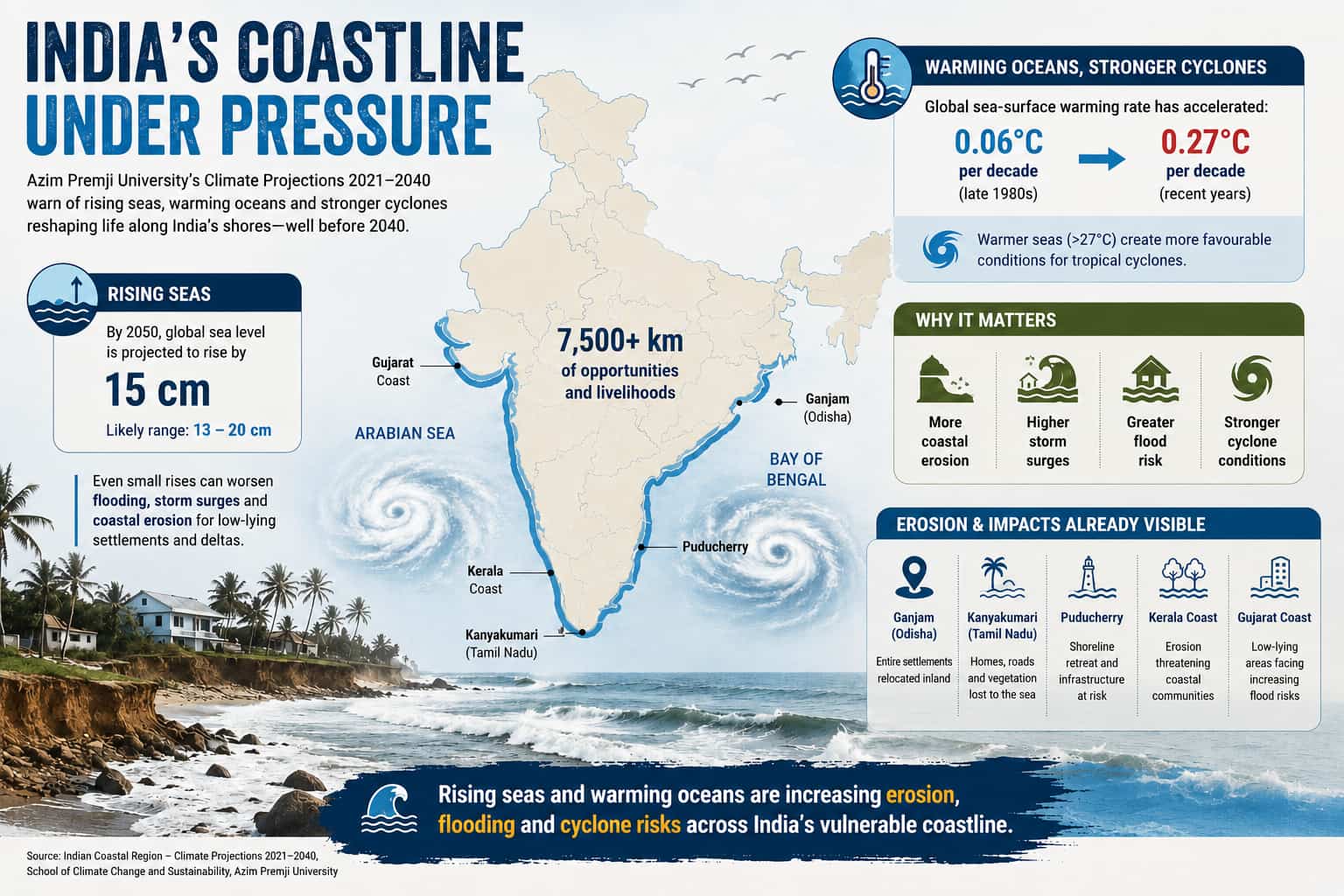
One of the most visible threats comes from rising seas. According to the projections, global sea levels could rise by around 15 centimetres between 2020 and 2050, with a likely range of 13-20 centimetres. That may sound modest, but for low-lying coastal settlements, deltas and islands, even small increases can dramatically worsen flooding, storm surges and coastal erosion.
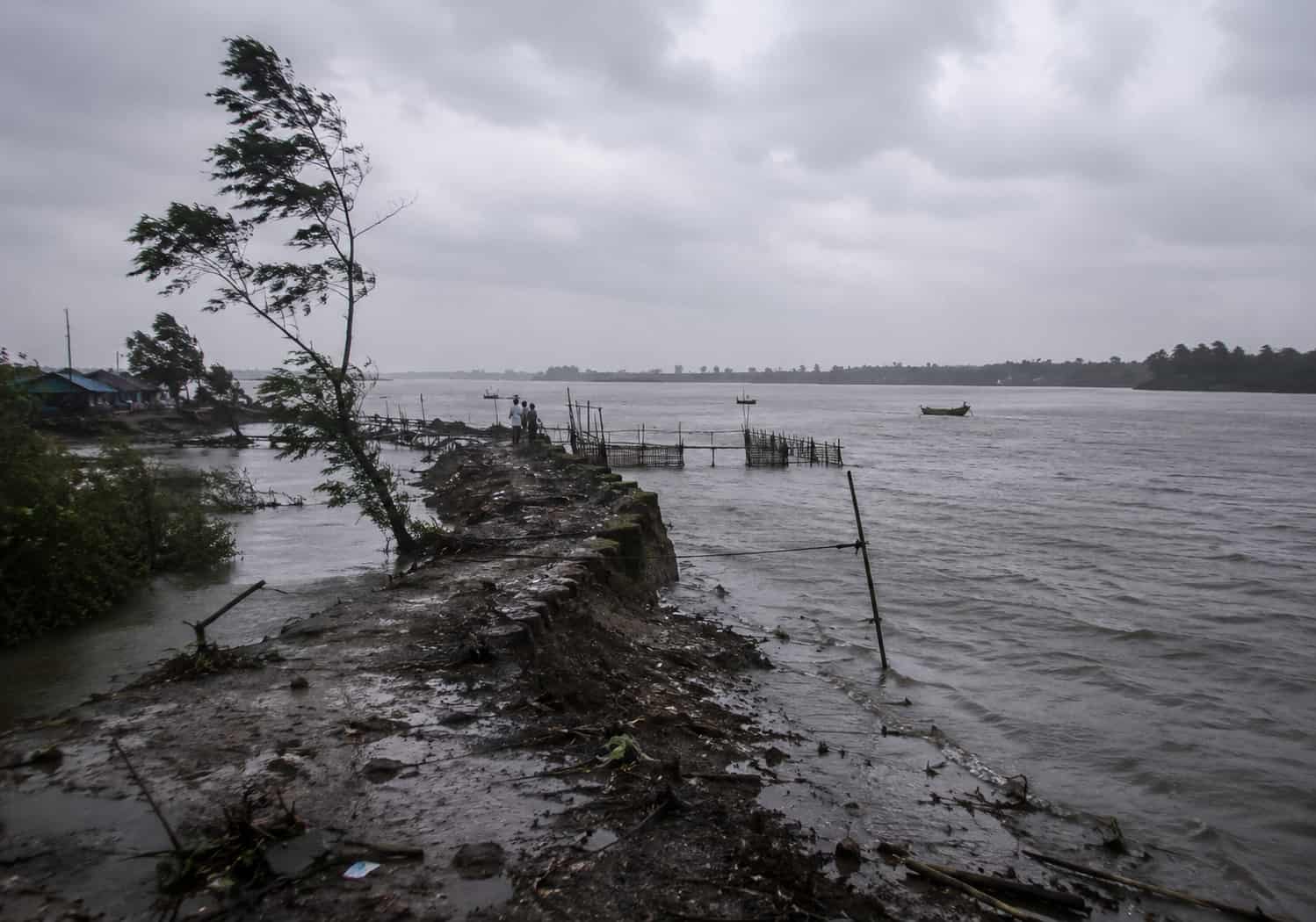
The report documents examples of erosion already affecting communities in Tamil Nadu, Odisha, Kerala, Andhra Pradesh, Gujarat and Puducherry. Roads, homes and protective vegetation have been steadily lost to advancing seas. In Odisha’s Ganjam district, entire settlements have had to be relocated further inland as erosion consumed coastal land.
The broader implication is that coastal adaptation may increasingly become a development challenge rather than merely an environmental one. Infrastructure planning, housing policy and disaster management could soon need to account for gradual but persistent shoreline retreat.
Warmer oceans, stronger cyclones
The Indian coastline faces another challenge from warming seas.
The report highlights research showing that global sea-surface warming has accelerated sharply over the past four decades.
The rate of warming has increased from around 0.06°C per decade during the late 1980s to approximately 0.27°C per decade in recent years. Since tropical cyclones typically require sea-surface temperatures of at least 27°C to form, warmer oceans create more favourable conditions for cyclone development.
For coastal India, this trend has enormous implications. Cyclones such as Amphan, Yaas, Nivar, Gaja and Remal have already demonstrated how destructive storm surges, flooding and high winds can be.
The projections suggest that future coastal communities may increasingly face a combination of rising sea levels and cyclone-driven flooding, a particularly dangerous mix for densely populated regions such as the Sundarbans, Chennai and parts of Odisha.
The report also draws attention to secondary impacts. In the Sundarbans, saline seawater intrusion following cyclones is already affecting groundwater quality and agriculture. Farmers have reported better resilience from traditional salt-tolerant crop varieties than from high-yield commercial seeds.
The great rainfall shift
Perhaps the most surprising finding is not simply that rainfall is increasing, but where and when it is expected to increase.
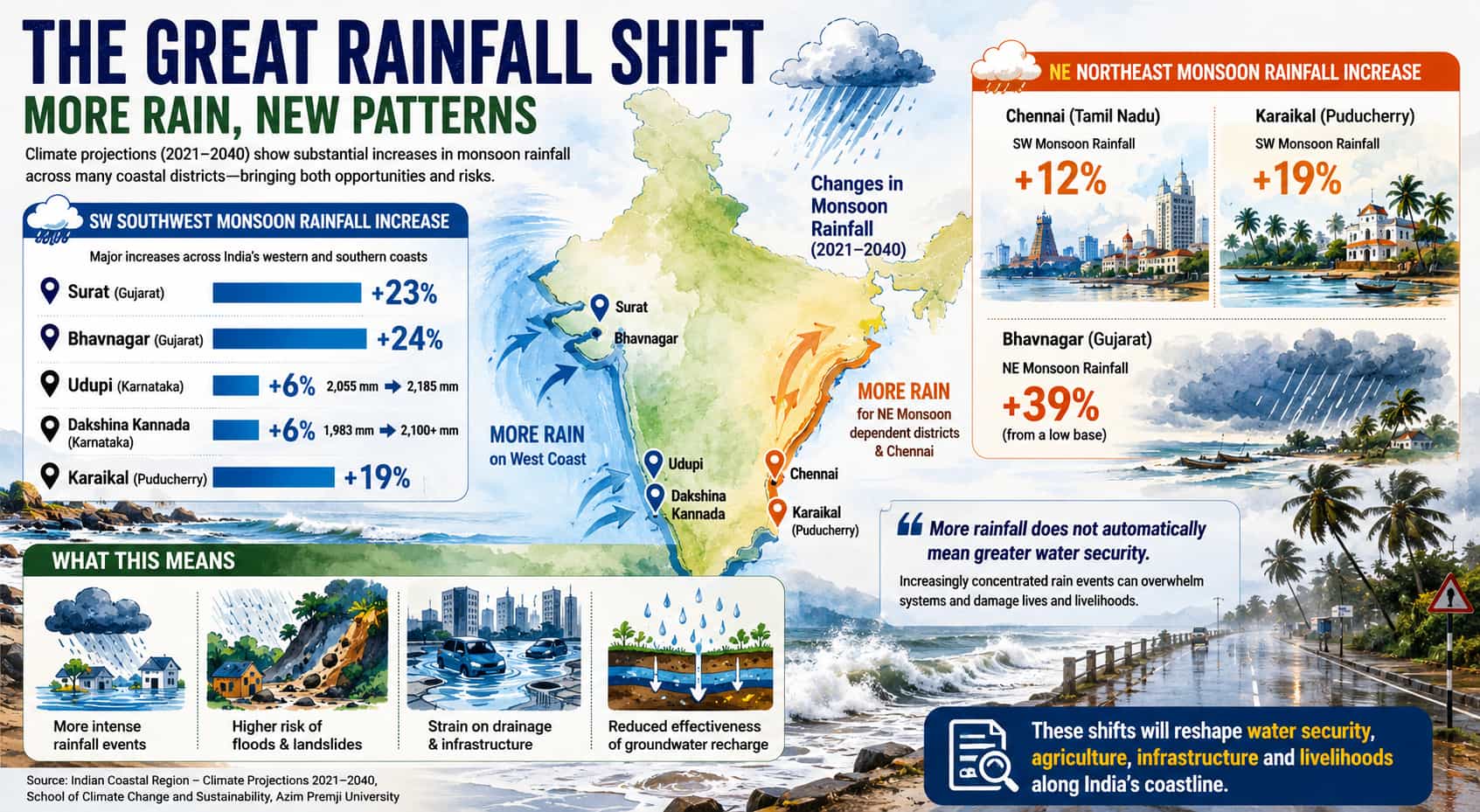
Coastal Gujarat and Maharashtra emerge as major hotspots for future rainfall growth. The projections indicate substantial increases in southwest monsoon rainfall across western coastal districts.
In Surat, southwest monsoon rainfall could rise by 23%, while Bhavnagar may experience a 24% increase. Northeast monsoon rainfall in Bhavnagar is projected to rise by an even larger 39%, albeit from a relatively low base.
Meanwhile, districts traditionally dependent on the northeast monsoon, including Chennai and Karaikal, are also expected to receive additional rainfall from the southwest monsoon. Chennai’s southwest monsoon rainfall could increase by 12%, while Karaikal could see a remarkable 19% rise.
The west coast, already among India’s wettest regions, may become wetter still. Udupi, which already receives around 2,055 mm of southwest monsoon rainfall historically, is projected to receive about 2,185 mm in the coming decades. Dakshina Kannada could see rainfall rise from 1,983 mm to more than 2,100 mm.
This raises an important question. More rainfall does not automatically mean greater water security. Increasingly concentrated rainfall events can overwhelm drainage systems, trigger landslides, damage infrastructure and reduce the effectiveness of groundwater recharge.
Kerala’s devastating floods in recent years offer a glimpse of what such a future could look like.
The hidden danger: Humidity
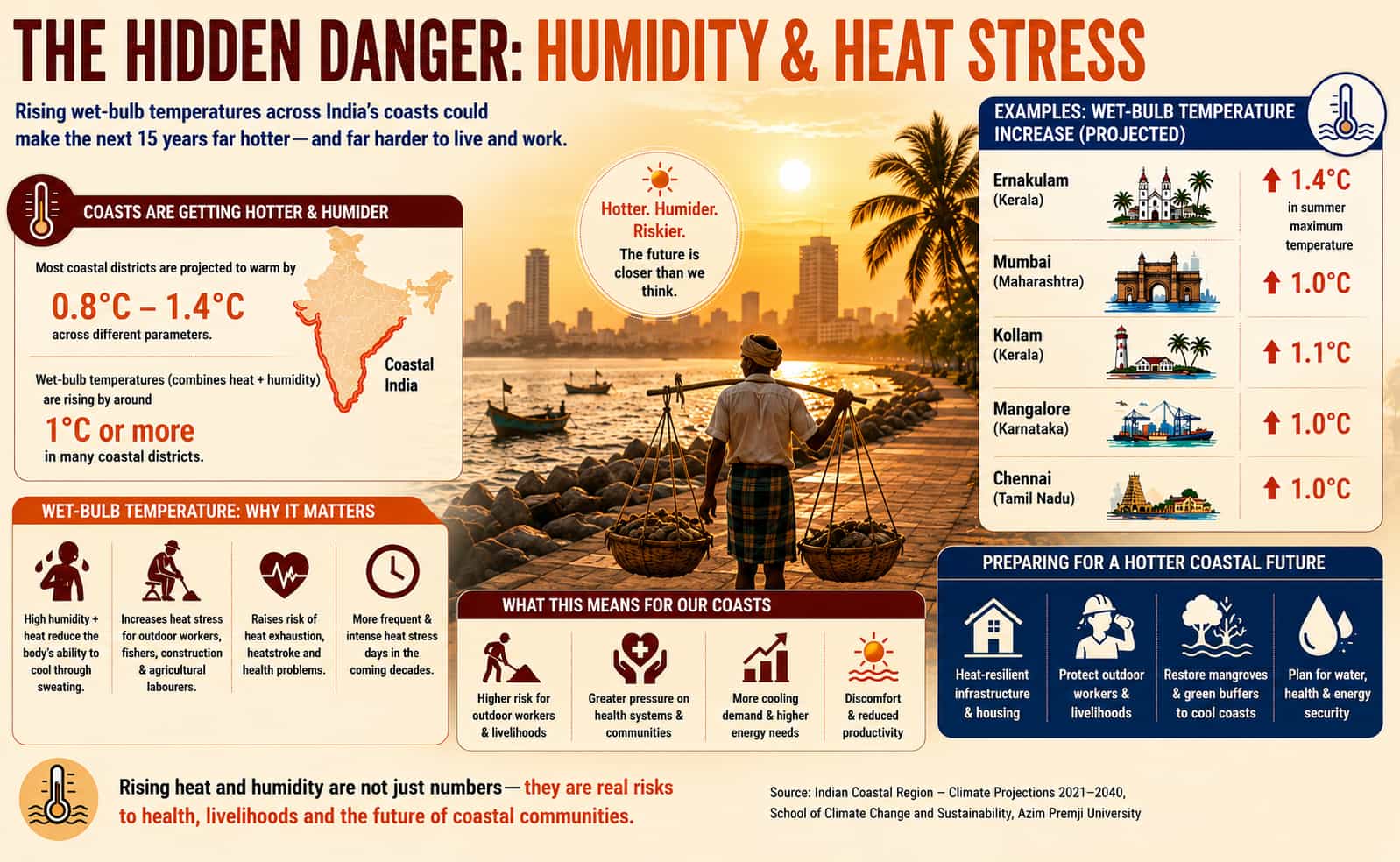
Temperature increases across coastal India may appear modest when viewed in isolation. Most districts are projected to warm by roughly 0.8°C to 1.4°C depending on the parameter being measured.
However, the report repeatedly highlights rising wet-bulb temperatures — a measure that combines heat and humidity.
This may be the most important climate indicator for coastal India. Unlike dry heat, high wet-bulb temperatures reduce the human body's ability to cool itself through sweating. Even relatively small increases can significantly increase heat stress, especially for outdoor workers, fishers, construction labourers and agricultural workers.
Several coastal districts are projected to see wet-bulb temperatures rise by around 1°C or more. Ernakulam could experience a 1.4°C increase in summer maximum temperature, while many districts across Gujarat, Kerala, Karnataka, Odisha and West Bengal show wet-bulb increases approaching or exceeding 1°C.
The report describes much of coastal Maharashtra and Gujarat as already experiencing extremely uncomfortable summer conditions because humidity amplifies heat stress. Along much of the east coast, summer temperatures already resemble what the report calls a ‘furnace.’
Livelihoods at the frontline
The projections are ultimately about people.
Several of the report’s most compelling observations concern livelihoods rather than climate statistics. Warming seas may push fish populations farther from shore, increasing fuel costs and reducing catches for small-scale fishers. Rising salinity threatens agriculture in vulnerable delta regions. Stronger rainfall events can damage homes, roads and public infrastructure. Coastal erosion may force communities to relocate.
Mangroves emerge as one of the few bright spots in the narrative. Examples from the Sundarbans and Tamil Nadu illustrate how these ecosystems can reduce storm impacts, stabilise coastlines and support biodiversity. Yet many mangrove systems themselves are increasingly exposed to cyclones, erosion and changing salinity patterns.
A future arriving early
The most significant takeaway from the projections is not that India’s coasts will become hotter, wetter and more vulnerable. It is that these changes are expected within a planning horizon relevant to today’s policymakers, investors, utilities and businesses.
Ports, industrial corridors, coastal power infrastructure, tourism hubs and urban centres such as Chennai, Mumbai, Kochi and Surat may all face growing climate risks before 2040.
At the same time, adaptation investments in resilient infrastructure, early-warning systems, mangrove restoration and climate-smart urban planning could become increasingly valuable.
The climate future outlined here is not a distant scenario for future generations. For India’s coastal regions, it is rapidly becoming a near-term economic and social reality.