

A report by Castrol about the ‘Future of the Electric Vehicle Industry’ reveals that electric vehicles will revolutionize mobility across the globe and play an important role in the decarbonization of the economy.
Though electric vehicle sales have been rising steadily, mainstream adoption is still a long way off with just one in 50 new cars being sold as an electric vehicle.
The report expects that Indians will increasingly buy the electric vehicle by 2022 and by 2025 the majority of new car purchases could be electric.
The report explored views of consumers, fleet managers, and industry specialists from eight of the world’s most important electric vehicle markets. Electric vehicle markets in China, France, Germany, India, Japan, Norway, the United Kingdom, and the United States were analyzed.
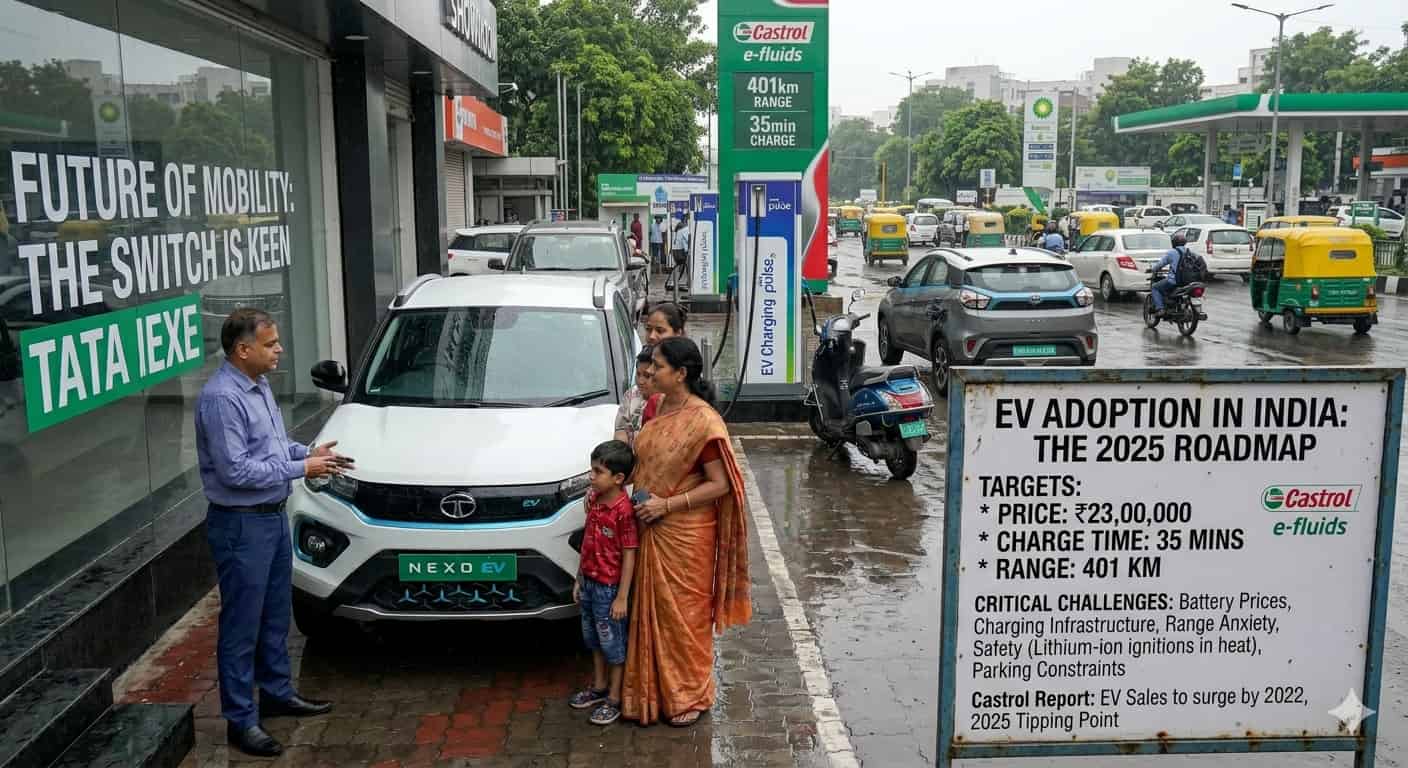
The report stated that a $36,000 price the point, a 31 minute charge time and a 469-kilometer range would rapidly accelerate the global electric vehicle market. On the other hand, a price point of ₹23, 00,000 ($31,000), 35 minute average charge time, and a range of 401 kilometers could propel a switch towards the adoption of electric vehicles in India.
Sandeep Sangwan, Managing Director, Castrol India Limited said Castrol’s global research revealed that consumers were ready to switch to electric vehicles and buyers in India were keen to do so earlier than in other markets. He said that though Indian consumers were price-sensitive and seeking lower rates, they were willing to adjust to longer charge time and slightly shorter range. He added that these market-specific nuances were important, and accelerating the evolution would provide a clear roadmap in the transition to electric vehicle adoption in India as well as in the world.
Mandhir Singh, Chief Executive Officer, Castrol spoke about the flexibility of the automotive industry which during the Covid-19 crisis turned its manpower to manufacture medical equipment. He said that with electric vehicle technology constantly improving, the new challenge would be to drive a low carbon recovery and accelerate the evolution towards electric vehicles as quickly as possible.
Castrol has been working with the automotive industry to develop unique e-fluid technology to support electric vehicles, from battery coolant e-fluid, e-greases, and transmission fluids. Bringing down the cost and charging time, increasing the range, building infrastructure will be critical to enticing customers to buy electric vehicles.
The study reveals that although global attitudes to electric vehicle adoption remain positive some markets such as those in India and China were more positive in buying electric vehicles. Manufacturers who can meet critical challenges relating to price, charge time, range, and infrastructure and vehicle choice are well placed to win the market share, the report said.
Interestingly, the National Electric Mobility Mission Plan had set an ambitious target of 6-7 million sales of hybrid and electric vehicles by 2020. This, however, didn’t happen with battery prices continuing to remain high. Analysts also pointed towards constraints in parking space and the safety of lithium batteries which would quickly reach ignition temperatures in hot conditions as challenges to be dealt with before moving towards mass adoption. Although union minister Nitin Gadkari once famously stated that he wanted oil-fuelled car sales in the country to come down drastically to curb the menace of air pollution, the journey is still a long one.