


Saudi Arabia restarted its East-West pipeline this week, with exports from the Red Sea port of Yanbu resuming on Tuesday. The 1,200-kilometre line, which normally moves 4 to 5 million barrels a day and lets the kingdom bypass the blockaded Strait of Hormuz, had been shut since drone strikes on 11 September damaged two of its eleven pumping stations. The attacks were traced to Iraqi territory, something Iran’s foreign ministry denied.
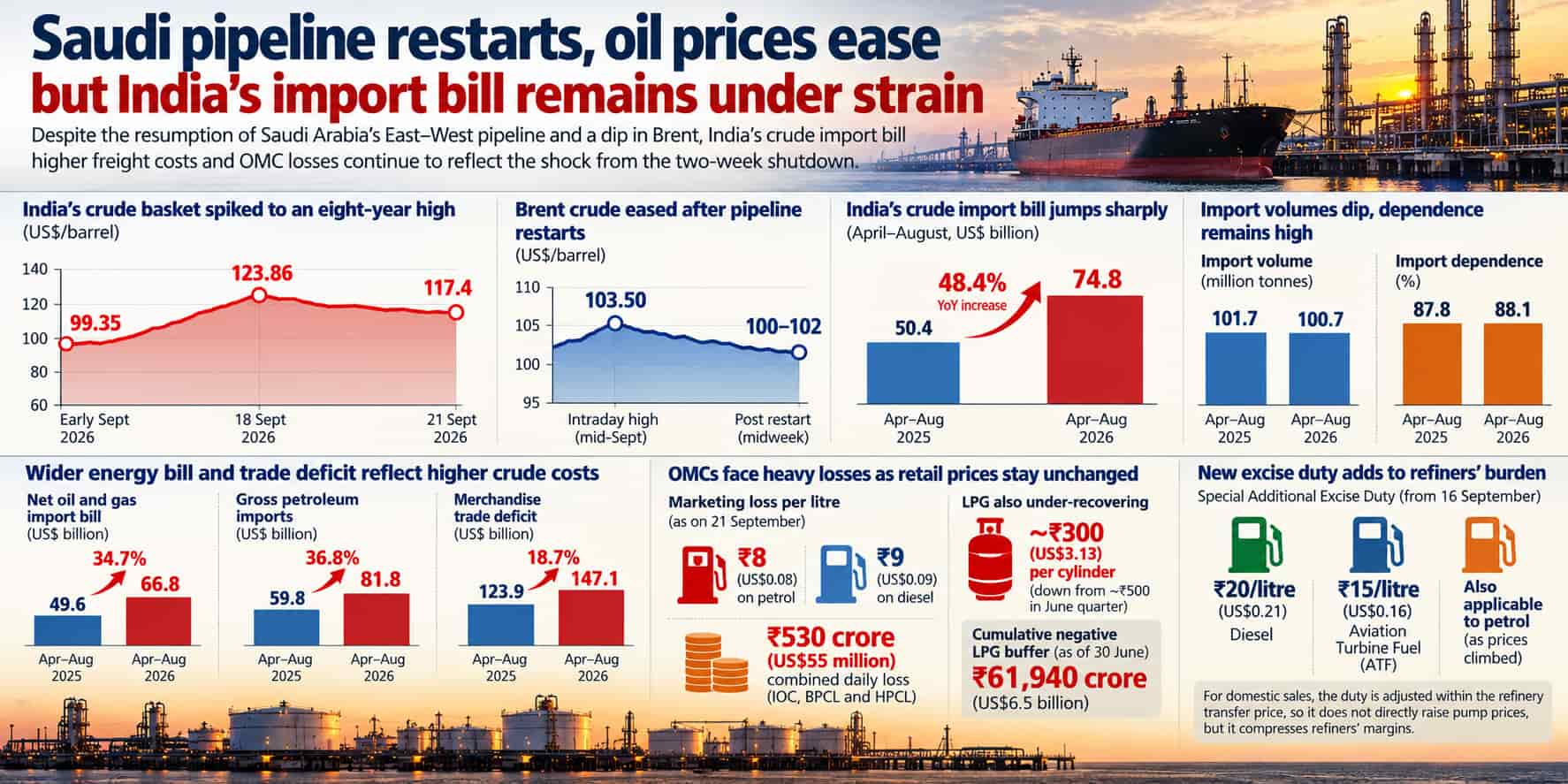
The restart drove Brent down by more than US$2 a barrel to its lowest level since 8 September, with the benchmark settling closer to US$100-102 by midweek after touching an intraday high of US$103.50 earlier. Talks between American and Iranian officials that Washington described as “very productive” added a further note of calm, even as President Trump kept his public rhetoric towards Tehran unchanged.
The relief should not be overstated. Saudi tanks at Yanbu had roughly four days of stored crude when the shutdown began, and repair estimates ranged from days, according to the US Energy Secretary, to months, according to independent analysts studying satellite images of the damage. A second closure would remove one of the few remaining Hormuz workarounds altogether.
India’s basket hits an eight-year high
India felt the shock more sharply than the headline Brent number suggests.
The Indian crude basket climbed to US$123.86 a barrel on 18 September, from US$99.35 a barrel just over two weeks earlier, before easing slightly to US$117.4 by 21 September as the pipeline news filtered through.
That the Indian basket briefly ran ahead of Brent is worth pausing on. India’s sour-heavy import mix, combined with freight and insurance costs on routes running past an active war zone, means the basket can spike harder than the international benchmark on which it is loosely priced. Freight rates on the key Ras Tanura-to-India route have risen more than 400% since the war began on 28 February, a cost that shows up in the landed price long before it appears in any Brent quote.
 Import bill balloons, trade deficit widens
The cumulative effect is now visible in the national accounts.
India’s crude import bill for April-August rose 48.4% year-on-year to US$74.8 billion, US$24.4 billion more than the same period last year, even as import volumes fell marginally to 100.7 million tonnes. Import dependence held at 88.1%, barely changed from a year earlier, while domestic crude output slipped to 11.4 million tonnes.
The wider energy bill tells the same story. India’s net oil and gas import bill rose 34.7% to US$66.8 billion, and gross petroleum imports climbed 36.8% to US$81.8 billion, now accounting for 22.5% of the country’s total merchandise imports.
The merchandise trade deficit widened to US$147.1 billion from US$123.9 billion a year earlier. “The price effect has completely swamped any gains from flat or falling volumes this year,” said an analyst tracking global crude markets.
OMCs bleed US$55m crore a day
Unchanged retail prices mean the burden has fallen on state refiners. Marketing margins turned negative to the tune of ₹8 a litre (USUS$0.08) on petrol and ₹9 a litre (USUS$0.09) on diesel by 21 September, taking the combined daily loss across Indian Oil, Bharat Petroleum and Hindustan Petroleum to an estimated ₹530 crore (US$55m), according to ratings agency ICRA. Domestic LPG cylinders are also under-recovering by roughly ₹300 (≈ US$3.13) each, though this has eased from around ₹500 (≈ US$5.22) in the June quarter; ICRA put the cumulative negative LPG buffer at ₹61,940 crore (USUS$6.5bn) as of 30 June.
Retail prices in Delhi have stayed at ₹102.12 (USUS$1.06) for petrol and ₹95.20 (USUS$0.99) for diesel since the last revision in May, even as Bengaluru, Mumbai and Kolkata continue to charge higher state-tax-adjusted rates.
“A change in retail prices now would only partly close the gap, since our sensitivity work shows losses stay meaningful even after a hike if crude holds above US$100,” said an executive at a leading Indian refiner.
ICRA’s own modelling backs this up, showing under-recoveries widening further in a US$105-115 scenario and turning sharply worse above US$130.
A new excise duty adds to the load
Adding to refiners’ costs, the government’s Special Additional Excise Duty, first introduced on diesel and aviation turbine fuel on 27 March, was extended and now stands at ₹20 a litre (USUS$0.21) on diesel and ₹15 a litre (USUS$0.16) on ATF from 16 September, with petrol also brought under the levy as product prices climbed.
For domestic sales the duty is adjusted within the refinery transfer price, so it does not directly raise the pump price, but it does compress the margin refiners can pass through to marketing companies at a time when that margin is already deeply negative.
What this means for India’s energy security
None of this has caused a physical shortage. Refiners’ stockpiled cargoes and diversified sourcing, a strategy examined in Indoen Energy’s earlier look at the sector’s response to the Hormuz standoff, have kept fuel flowing throughout the pipeline shutdown. But the week confirms that India’s 88% import dependence now shows up first as a fiscal and balance-sheet problem rather than a supply one, with state refiners effectively subsidising retail prices out of their own margins while the war drags on.