
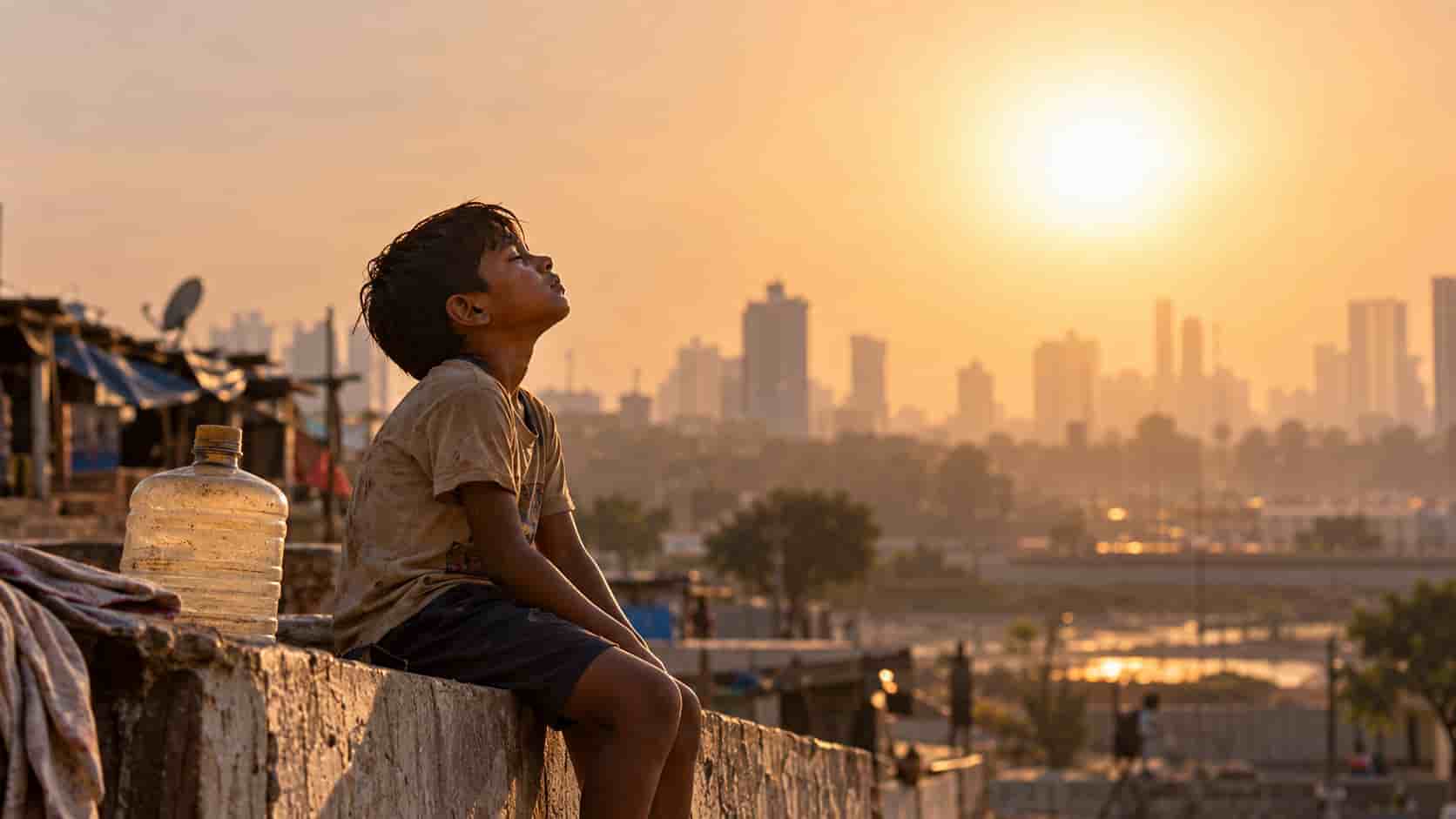
For most of India’s history, a child’s exposure to dangerous heat was seasonal, unpleasant, and largely unmeasured. That has changed.
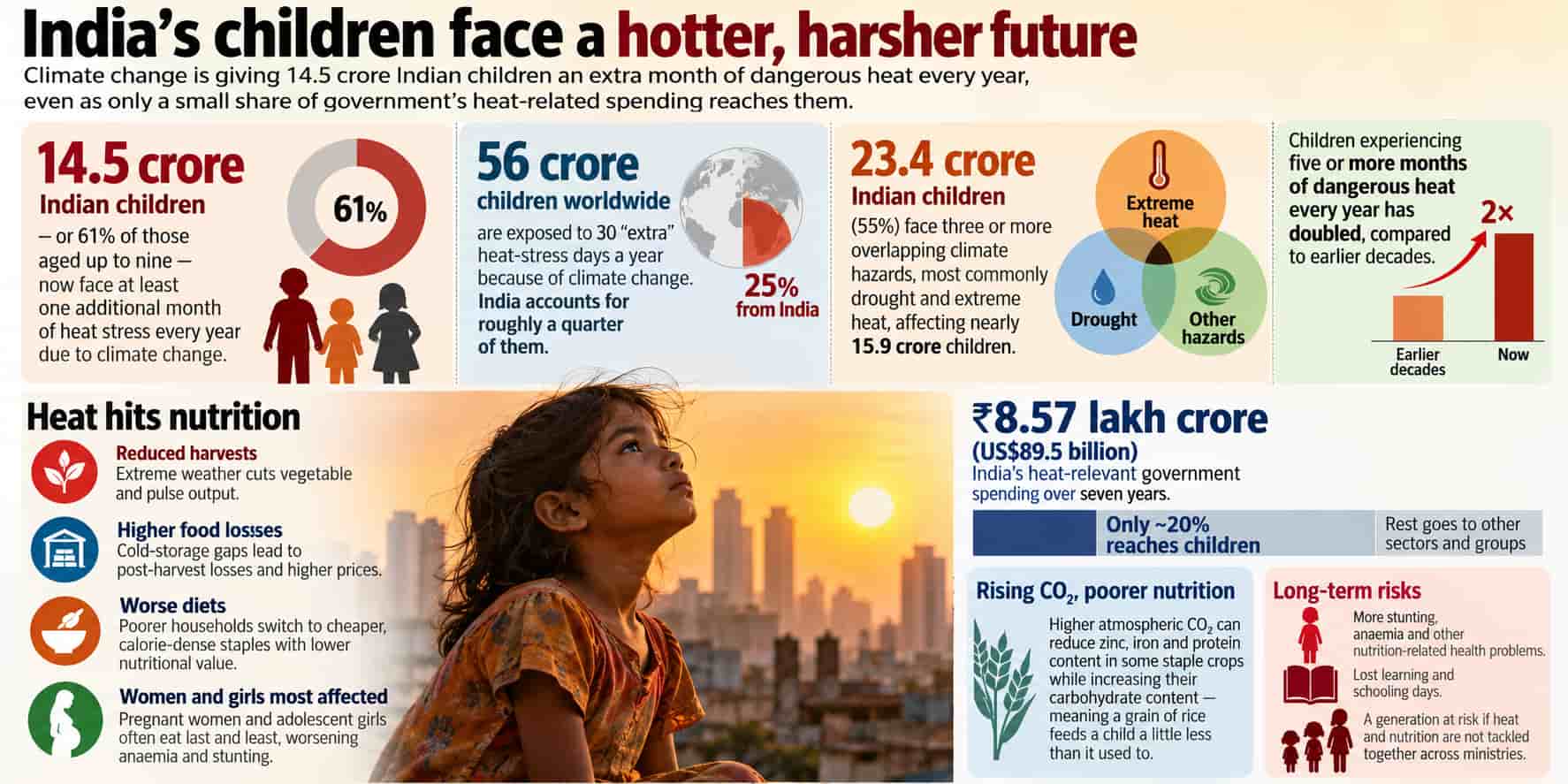
A new global study, the first to quantify heat exposure directly attributable to climate change across different age groups, finds that 14.5 crore Indian children, or 61% of those aged up to nine, now face at least one additional month of heat stress every year because of warming that would not otherwise have occurred, as per recent reporting. The number of children who experience five or more months of dangerous heat annually has already doubled.
Placed against the global picture, India’s share is disproportionate. Of the 56 crore children worldwide exposed to 30 “extra” heat-stress days a year because of climate change, India accounts for roughly a quarter, according to a media report on the underlying research. That is not a coincidence of geography alone. It reflects population density, informal housing, and a child population that is simply larger than almost anywhere else on earth.
A UNICEF assessment released in June found the exposure is rarely a single hazard. Some 23.4 crore Indian children, or 55% of the country’s child population, now face three or more overlapping climate hazards at once, most commonly drought layered on top of extreme heat, a combination affecting nearly 15.9 crore children, industry reports suggest. Heat, in other words, rarely arrives alone.
Heat becomes hunger
The consequence that gets least attention is nutritional, not thermal. India was already fighting stunting, wasting and anaemia even as obesity rises among adults, a contradiction nutritionists call the country’s “double burden”. Climate shocks are now adding a third layer.
Extreme weather reduces vegetable and pulse harvests, and India’s cold-storage gaps mean losses happen before produce even reaches a market, pushing prices up and pushing poorer households toward cheaper, calorie-dense staples that fill the stomach without meeting nutrient needs, as per recent reporting.
Pregnant women and adolescent girls absorb the sharpest end of this. When food gets costlier, women often eat last and least, entrenching iron and calcium deficiencies that carry into the next generation through pregnancy and birth outcomes.
“We are dealing with two nutrition problems that used to be treated as separate,” said a researcher at a New Delhi-based public health institute studying climate and diet.
“Stunting and anaemia have not gone away, and now rising temperatures are adding a supply shock on top of a demand-side crisis. Treating heat and treating nutrition can no longer sit in different ministries.”
There is a slower-moving threat buried in this too. Rising atmospheric carbon dioxide appears to reduce zinc, iron and protein content in some staple crops while raising their carbohydrate share, a change with little visible symptom but real consequence for cereal-dependent diets. It is the kind of finding that rarely makes headlines because nothing about it looks dramatic. A grain of rice does not look any different. It simply feeds a child a little less than it used to.
Where the US$89.5 billion actually goes
If the exposure is this large, the obvious question is what the state is doing about it. A budget analysis tracking seven years of Union spending across 130 government schemes, jointly produced by a climate research collaborative, found that only 27 of those schemes could reasonably be considered relevant to heat risk at all, industry reports suggest. Of the ₹8.57 lakh crore (roughly US$89.5 billion) tracked, most was never designed with heat in mind.
The gaps are specific enough to be uncomfortable. The health ministry has no dedicated scheme for heat-emergency preparedness. Its disaster-preparedness allocation was set at ₹94 crore (about US$10 million) for 2024-25, of which just ₹14.92 crore (roughly US$1.6 million) was actually spent, a utilisation rate of under 16%.
The science and technology ministry, whose early-warning systems are precisely the kind of low-cost tool that could protect the children in these studies, received no allocation for heat-relevant schemes from 2025-26 onward.
There is a policy shift underway that could change this.
The 16th Finance Commission has recommended classifying heatwaves as a national disaster, a reclassification that could unlock nearly ₹40,000 crore (about US$4.2 billion) from mitigation funds for states between 2026 and 2031, as per recent reporting. Whether that money reaches an anganwadi worker screening for anaemia, or simply sits in a state disaster fund the way earlier allocations have, is the story to watch over the next five years.
“The finance is not entirely absent, it is misdirected,” said a policy adviser familiar with subnational climate budgeting. “Money moves easily toward roads and infrastructure because that spending is legible and easy to audit. Spending on a child’s nutrition or a slum’s cooling need is harder to track, so it gets deprioritised even when the underlying need is larger.”
This is a variation on a theme Indoen Energy has tracked before: India’s climate finance keeps flowing toward assets that reduce emissions, not toward the people already bearing the damage. What is new here is the specificity. It is no longer an abstract mismatch between mitigation and adaptation. It is a 16% spending rate on a scheme meant to stop children from falling ill.
Paint, foil and a few hundred rupees
While formal budgets stall, an informal economy of heat-adaptation has quietly taken shape in the country’s poorest neighbourhoods.
In Shahbad Dairy, an informal settlement near Delhi, residents have begun coating tin roofs with limewash paint, a mixture of crushed limestone, water and natural minerals, after a disaster-management organisation found that industrial reflective paint added unwanted chemicals to the water supply and cost too much for most families to repeat each monsoon.
The organisation estimates the limewash treatment lowers indoor temperatures by six to seven degrees Celsius, and costs a little over US$10 a roof, cheap enough that a family can simply repaint after the rains wash it away, as per recent reporting. If two million low-income households adopted it, the organisation projects, Delhi’s urban heat islands could cool by a full degree overall. So far, roughly 1,400 roofs have been painted.
In Chennai, a separate initiative has trained local women to build insulating ceiling tiles out of discarded chip-packet foil, stuffed with forest grass and melted into reflective sheets. The women earn a wage doing it, several for the first time in their lives, while residents report being able to stay indoors through the hottest hours of the day rather than sitting outside until evening.
“What we are seeing on the ground is genuine innovation happening at a cost per household that no government scheme comes close to matching,” said an executive at a non-profit working on low-income housing resilience. “The risk is that it stays a pilot forever, because nobody has worked out how to fund it at the scale the exposure numbers demand.”
The financing question India can’t dodge
Zoom out, and India’s predicament sits inside a much larger global shortfall. The United Nations Environment Programme puts the international adaptation finance gap at between US$187 billion and US$359 billion a year, even as actual flows to developing countries rose only from US$22 billion to US$28 billion between 2021 and 2022. India’s own government estimate, made at 2014-15 prices, put the adaptation cost for agriculture, forestry, water and infrastructure alone at roughly US$206 billion through 2030. Newer industry estimates put India’s adaptation-specific need closer to US$800 billion by 2070.
A UNDP assessment published this month argues that the world has spent a decade setting climate targets and now needs to spend the next one financing them, warning that climate-vulnerable countries are already paying more in debt service than they receive in climate finance, industry reports suggest. That argument, made for a COP31 audience in Antalya, applies with unusual precision to India’s children.
The country has already shown, in its own reluctance to legislate around heat exposure, that political urgency has not caught up with physical urgency. The Finance Commission’s heatwave reclassification is the first sign that this might be shifting, at least on paper. Whether the ₹40,000 crore (about US$4.2 billion) actually reaches a nutrition counsellor or an early-warning sensor, rather than a state disaster account that sits unspent, will say more about India’s adaptation seriousness than any summit declaration.
For now, the most reliable heat-adaptation infrastructure India has built is not a scheme at all. It is a woman on a ladder in Shahbad Dairy, repainting her roof after every monsoon, because the money that was meant to reach her has not yet found the way.
Follow us on : X | LinkedIn | Facebook | Bluesky