
A new IISD report shows village-level solar can undercut grid tariffs by nearly half, but storage costs, seasonal surplus and DISCOM planning will decide whether rural solar villages actually work.
A new framework from the International Institute for Sustainable Development finds that solarising Indian villages can slash electricity costs well below state benchmarks, but only if utilities plan storage, surplus power and grid integration together rather than chasing rooftop installation targets village by village.
A policy gap hiding in plain sight
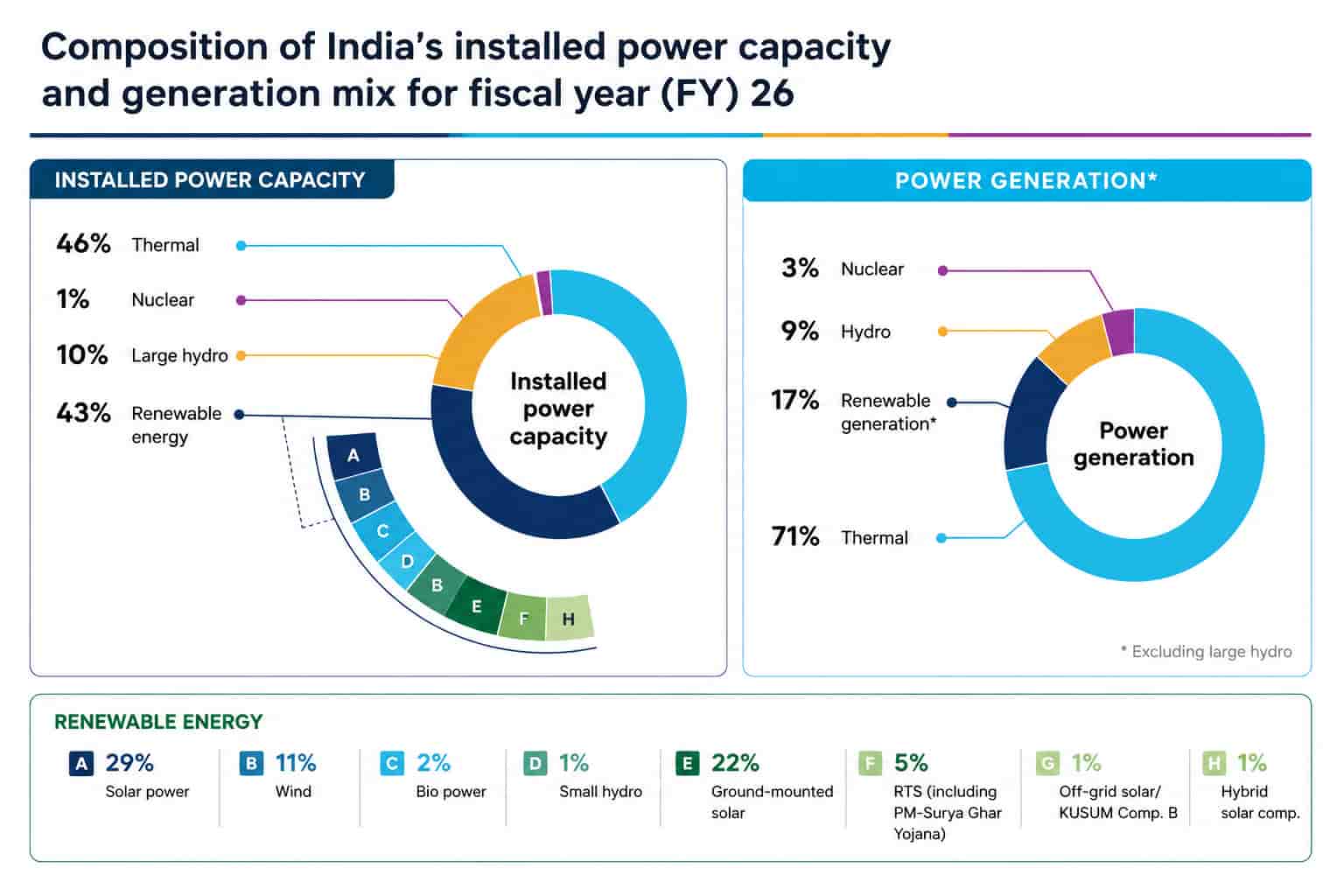
India's power capacity mix has shifted decisively towards renewables, with the country's installed base reaching roughly 542 gigawatts (GW) by end-May 2026, of which non-hydro renewables account for close to 283 GW. Within that, distributed renewable energy (DRE) — rooftop solar, off-grid systems, small hydro and biomass — makes up about 55 GW, or roughly a quarter of renewable capacity.
Yet, as the report argues, most of this growth has come through fragmented, scheme-led rooftop and pump-solarisation programmes rather than coordinated village-level system design.
That gap matters because India's flagship rural schemes, chiefly PM-KUSUM for agricultural solarisation and PM-Surya Ghar: Muft Bijli Yojana (PMSGMBY) for rooftop solar, have driven real uptake without addressing what happens once a whole village, not just individual households or pumps, tries to run on local generation.
PMSGMBY alone carries an outlay of roughly ₹75,021 crore (~US$7.9 billion), and central financial assistance disbursed so far has reached about ₹13,926 crore (~US$1.5 billion) across 24.35 lakh beneficiaries. Yet only about 26.38 lakh of the 1.45 crore registrations recorded by late 2024 had actually converted into completed installations, pointing to a persistent gap between digital sign-up and delivery on rooftops.
What two villages reveal about seasonal mismatch
The IISD study built detailed load and generation models for two villages: Hiware Bazar in Maharashtra, where demand is overwhelmingly agricultural and peaks by day during the irrigation season, and Bamun Sualkuchi in Assam, a weaving village where demand is residential and peaks after sunset.
In Hiware Bazar, a 980 kilowatt (kW) ground-mounted solar plant sized to meet the village's irrigation feeder produced an estimated levelised cost of electricity (LCOE) of ₹3.06 per unit (US$32.08 per MWh) with subsidy support, comfortably undercutting Maharashtra's average power purchase cost of ₹5.78 per unit (US$60.59 per MWh).
But the same daytime-heavy design produced surplus generation on 93 of 120 sampled days across the year — effectively every day outside the irrigation season — with average daily surplus exceeding 1,900 units.
Adding a 350 kW battery trimmed, but did not eliminate, that reverse flow, and pushed the blended cost to ₹5.44 per unit (US$57.02 per MWh), still below the state benchmark but with a payback period stretching to roughly 12 years.
Bamun Sualkuchi told the opposite story. A 1,318 kW mixed rooftop-and-ground-mounted system achieved an LCOE of ₹4.03 per unit (US$42.24 per MWh) against Assam's much higher average power purchase cost of ₹8.46 per unit (US$88.68 per MWh).
But because demand peaks in the evening, adding a 500 kW battery to smooth that mismatch actually pushed blended costs to ₹9.75 per unit (US$102.20 per MWh) — above the state benchmark — while a smaller 400 kW battery kept costs at ₹8.27 per unit (US$86.69 per MWh), just under it.
"Load typology has design implications for the sequencing of DRE interventions," the report notes, arguing that agriculture-heavy villages should prioritise solarising irrigation supply, while evening-peaking villages need grid interaction and storage built into the design from the outset rather than bolted on afterwards.
The uncomfortable maths of going fully off-grid
One of the report's more striking findings concerns what happens when villages try to cut the grid out entirely. For Bamun Sualkuchi, a fully islanded microgrid configuration would have required a larger 1,588 kW solar plant paired with roughly 4.6 megawatt-hours of battery storage to guarantee night-time supply, at an estimated capital cost of ₹14.82 crore (~US$1.6 million).
A comparable grid-connected solar-plus-battery system, by contrast, cost around ₹11.06 crore (~$1.2 million) — nearly 34% less — while also avoiding the reliability risks and heavier maintenance burden of running entirely alone.
As Indoen Energy has reported, this tension between solar abundance and grid flexibility is increasingly a national, not just a village-level, problem.
“A Panchayat-led generation model can lead to capacity planning and system sizing decisions that are optimised from a local perspective but do not adequately account for system-level constraints such as reverse power flows, feeder congestion, and balancing requirements,” an energy policy adviser familiar with distribution-utility planning noted, reflecting the report's core concern that costs pushed onto DISCOMs rarely appear in village-level cost-benefit calculations.
Older solar villages offer cautionary lessons
The report's fieldwork in Manyachiwadi, Maharashtra's first officially declared ‘solar village,’ and Odanthurai in Tamil Nadu, an early adopter dating to 2000, underscores that hardware alone rarely sustains rural energy projects.
In Manyachiwadi, rooftop systems cost the vendor rate of ₹92,000 per kW (US$ 965) against a benchmark of ₹60,000 (US$629), with the gap covered by a mix of central subsidy and Gram Panchayat savings, leaving households paying only about ₹7,000 each (US$73).
Odanthurai's Panchayat-owned wind turbine, financed partly through a bank loan, generated enough revenue over 18 years — a total of roughly ₹236.8 lakh (~US$248,000) from the DISCOM — to repay its debt, even though its locked-in tariff of ₹2.70 per unit (US$28.30 per MWh) later looked inadequate and payment delays from the utility strained routine maintenance budgets.
Those experiences inform the framework's central institutional recommendation: DISCOMs, not Panchayats or private developers alone, should anchor system design, grid integration and long-term asset ownership, while village energy committees handle community consultation, demand aggregation and grievance redress.
As Indoen Energy has covered separately, this split between who benefits from rooftop solar and who bears its integration costs is already visible in India's wider solar economy, not just its villages.
Building a genuine playbook, not just another scheme
The proposed Model DRE Village Framework would sit alongside, not replace, the existing Model Solar Village component of PMSGMBY, which currently allocates roughly ₹800 crore (~US$84 million), or about ₹1 crore (US$104,822) per village, towards solar-powered model villages in each district.
The framework calls for a national steering committee under the Ministry of New and Renewable Energy, state-level implementation cells jointly run by state nodal agencies and DISCOMs, and a standardised Village Energy Plan that captures load typology, storage siting and financing responsibility before a single panel goes up.
Whether this translates into practice will depend heavily on regulatory detail that varies sharply by state. Virtual net metering, for instance, remains restricted to housing societies in Maharashtra but extends more broadly to residential consumers in Assam — a difference that alone can determine whether shared rooftop arrangements are commercially viable for scattered rural households.
The report is candid that its two-village sample cannot be generalised nationally without further piloting, and that it deliberately excludes an assessment of the full system-level value of storage, such as avoided peak power purchases, leaving DISCOMs to weigh battery investments on incomplete information for now.
Follow us on : X | LinkedIn | Facebook | Bluesky