

Agastya Green Energy $815m towards 12 GW solar ingot and wafer plant in Kurnool
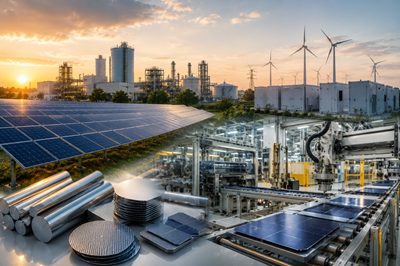
Agastya Green Energy Limited, part of the Anubhav Agarwal Group, has announced an investment of ₹7,800 crore (US$815m) to establish integrated 12 GW ingot and wafer manufacturing capacities at the Orvakal Industrial Area in Kurnool district, Andhra Pradesh, with the foundation ceremony held on Independence Day, 15 August 2026.
The facility is designed to complement the company's existing solar cell and module manufacturing capabilities, creating an integrated production platform that spans ingots, wafers, cells and modules under a single operational umbrella.
The project is expected to generate more than 3,500 direct employment opportunities and has been anchored at Orvakal — an established industrial zone with infrastructure connectivity — with active support from the Andhra Pradesh government.
The structural significance of this investment lies not in its scale alone but in its position within the solar manufacturing value chain.
India's domestic solar manufacturing base has grown substantially in recent years, but it has remained anchored primarily at the module assembly stage, with cell manufacturing emerging more recently through PLI-backed capacity additions.
Ingots and wafers — the upstream stages where polysilicon is converted into crystalline structures that are then sliced into the thin substrates on which solar cells are built — remain almost entirely absent from India's domestic production base.
China's dominance at these stages is near-total: Chinese manufacturers account for approximately 97% of global wafer production, and the absence of domestic ingot and wafer capacity means that even PLI-backed Indian cell and module plants are exposed to upstream supply-chain dependence on Chinese imports.
A fully integrated facility with 12 GW of ingot and wafer capacity at Orvakal would, if commissioned at scale, represent one of the largest upstream solar manufacturing investments outside China.
The choice of Independence Day for the foundation ceremony is politically deliberate — the investment is explicitly framed within the government's Make in India and Atmanirbhar Bharat frameworks, and Andhra Pradesh's Chief Minister N. Chandrababu Naidu, alongside ministers Nara Lokesh and T.G. Bharath, participated in the ceremony, signalling active state-level political endorsement.
For Andhra Pradesh, which has been aggressively positioning itself as a manufacturing destination through the Orvakal and Sri City industrial clusters, the Agastya commitment adds a major clean-energy manufacturing anchor to an industrial base historically rooted in conventional manufacturing.
The ₹7,800 crore (US$815m) commitment also represents a meaningful capital test: ingot and wafer manufacturing is technically demanding, energy-intensive (polysilicon melting and crystallisation require sustained high-temperature processes), and subject to intense cost competition from Chinese producers operating at scale economies that have driven global wafer prices to historic lows.
Agastya's ability to achieve internationally competitive production costs will determine whether this facility becomes a genuine upstream anchor for India's solar manufacturing ecosystem or a high-cost outlier in the domestic supply chain.
ITA selects 11 projects targeting over $18bn in clean industry investment
The Industrial Transition Accelerator (ITA) — a global multi-stakeholder initiative launched at COP28 — has selected 11 Indian projects for its India Project Support Programme, representing more than $18 billion in potential investment and over 7.8 million tonnes of potential annual carbon abatement.
The selected projects span steel decarbonisation, chemicals, sustainable aviation fuels and industrial process transformation, with lead companies including Jindal Steel, JSW Steel, ACME Group, Yamna, Circular Urban Energy (CUE) and ReNew.
One of the highlighted projects involves processing approximately 3,500 tonnes of municipal and residual waste per day to produce around 1,000 barrels of sustainable aviation fuel (SAF) through an advanced thermochemical process — a project that directly links urban waste management with aviation decarbonisation.
The ITA's function is not to provide capital but to provide structured, expert support to help projects clear the barriers between announcement and Final Investment Decision (FID).
As ITA Managing Director James Schofield noted, many projects are commercially viable but face obstacles that sit outside developers' direct control — regulatory bottlenecks, offtake uncertainty, financing structure complexity and infrastructure gaps.
The India selection is significant because it comes against a documented backdrop of underperformance in converting India's clean industry ambitions into committed capital.
A mid-2025 report by the Mission Possible Partnership found that India's clean industrial project pipeline was valued at $89 billion, but only US$13 billion had been secured as committed investment — far below China's US$61 billion and the United States' US$54 billion — with just one project reaching FID in the preceding six months.
ITA's structured intervention is one of the few globally tested mechanisms for compressing this announcement-to-FID gap.
The inclusion of Jindal Steel and JSW Steel — India's two largest private steel producers — in an industrial decarbonisation support programme is structurally material. Steel accounts for approximately 7–8% of India's total greenhouse gas emissions, and the economics of green steel production — using green hydrogen or direct reduction processes rather than coking coal blast furnaces — remain deeply uncertain at Indian cost structures.
If ITA support can help either company reach FID on a hydrogen-based or low-carbon steelmaking project at even a fraction of their installed capacity, the implications for India's industrial emissions trajectory would be significant.
Across its in-country programmes in Brazil, UAE, India and Egypt, ITA is currently supporting 39 projects with US$60–65 billion in combined investment potential, making India's 11-project selection the largest country portfolio in the programme.
Amara Raja Energy's additional $58m for a 16 GWh lithium-ion cell plant in Telangana
Battery manufacturer Amara Raja Energy & Mobility has approved additional investments totalling ₹5.5 billion ($58m) in two wholly owned subsidiaries — ₹5 billion (US$52m) in Amara Raja Advanced Cell Technologies (ARACT) for gigafactory development, and ₹500 million (US$5.2m) in Amara Raja Power Systems (ARPSL) for electronics and charging solutions manufacturing.
The ARACT investment is in addition to an existing board approval of ₹20 billion, taking the total approved investment in the cell manufacturing subsidiary to ₹25 billion (US$262m).
The facility under development at Divitipally, Telangana, has a long-term target capacity of up to 16 GWh for lithium-ion cell and battery-pack manufacturing. Investments in both subsidiaries can be deployed through loans, equity or other instruments across one or more tranches.
Amara Raja's strategic positioning within India's battery ecosystem differs from the dominant EPC-and-pack model that characterises most of the country's battery sector.
The company is pursuing lithium-ion cell manufacturing — the technically and capital-intensive production step that precedes pack assembly and at which China, Japan and South Korea have overwhelming global dominance. India's cumulative installed BESS capacity reached 5.9 GWh as of March 2026, having added 4.6 GWh in Q1 2026 alone — a 941% increase from Q4 2025 — but virtually all the cells in these systems are imported.
Domestic cell manufacturing at the ARACT scale would directly address the supply-chain gap that currently makes India's grid storage buildout dependent on external cell sourcing, with the concentration risks that implies given China's dominance of the global lithium-ion cell supply chain.
The simultaneous investment in ARPSL — which covers EV charger assembly including 7.4 kW Type-1 AC chargers at the Tirupati facility — reflects a vertical integration logic that runs from cell production at Divitipally through pack assembly (1.5 GWh mobility and 1.2 GWh stationary at existing plants) to end-use charging infrastructure.
This is distinct from the single-stage model of most Indian battery players and positions Amara Raja Energy & Mobility as a company building for the full electrification value chain rather than optimising for near-term margins in one segment.
The company's February 2026 approval of up to $5m for a US subsidiary, ARE&M US Inc, operating in the energy and mobility segment, also signals early-stage international market positioning — a directional signal rather than a material capital deployment, but one that indicates the company's management is thinking beyond India's domestic growth runway.
Hinduja Group commits $262m to Tamil Nadu across renewables and electric mobility
The Hinduja Group has signed a Memorandum of Understanding with the Government of Tamil Nadu to invest ₹2,500 crore (US$262m) across renewable energy, electric mobility, automotive, battery charging infrastructure, financial services and digital mobility solutions.
The centrepiece renewable commitment is the development of more than 200 MW of solar, wind and battery projects by Hinduja Renewables Energy Private Limited (HREPL), with land and grid connectivity support sought in Tirunelveli, Thoothukudi, Virudhunagar, Madurai and Coimbatore — districts that form Tamil Nadu's renewable energy catchment zone in the southern and western parts of the state.
In parallel, OHM Global Mobility Ltd will operationalise electric buses for public transport and expand its mobility solutions value chain across the state.
The investment sits within a broader and now substantial Hinduja Group commitment to Tamil Nadu that has been built up over three tranches since September 2025.
Hinduja Group UK signed a ₹7,500 crore ($785m) MoU with the Tamil Nadu government in September 2025 for investments covering battery manufacturing, battery energy storage systems and charging infrastructure;
Ashok Leyland broke ground on a ₹500 crore (US$52m) greenfield battery pack manufacturing facility at Pillaipakkam near Chennai in March 2026; and now this ₹2,500 crore MoU takes the cumulative pledge to over ₹10,500 crore (US$1.1bn).
What distinguishes this from a generic MoU is the operational logic that connects the commitments: HREPL generates clean power, OHM Mobility deploys electric buses that can be charged using that power, and Ashok Leyland supplies the battery packs that go into those buses — a vertically integrated clean mobility and energy ecosystem anchored within a single Indian state.
For Tamil Nadu, the Hinduja accumulation validates the state government's strategy of using EV policy, land allocation, port access, and a deep automotive industrial base to attract large-scale, integrated clean-energy mobility investments rather than single-technology plays.
Tamil Nadu already hosts Ola Electric's Futurefactory, TVS Motor, Ford's former Chennai facility repurposed for EV manufacturing, and multiple EV component suppliers.
The Hinduja ecosystem would add a renewable generation-to-bus-charging vertical that few other states can yet demonstrate.
The MoU was formalised at a signing ceremony attended by Tamil Nadu Chief Minister Thiru C. Joseph Vijay, Ashok Hinduja and Dheeraj Hinduja, Chairman of Ashok Leyland, signalling political visibility and state-level commitment to facilitating the investment on both sides.
Waaree Transpower enters global BESS supply chain with $17m export order for IEC-compliant MV skids
Waaree Transpower Private Limited, a subsidiary of Waaree Energies, has secured an order valued at approximately ₹160 crore (US$17m) from an unnamed global energy storage technology and solutions provider for the supply of 8.3 MVA Medium Voltage (MV) Skids for Battery Energy Storage System applications.
The product is an IEC-standard-compliant, plug-and-play, containerised solution integrated into a 20-foot unit, designed for stackable, shippable deployment across large-scale international BESS projects. Shipments commenced in July 2026.
The order arrives as Waaree Energies has deepened its commitment to Waaree Transpower — the board approved an increase in its holding to 75.1% in March 2026 — and as Waaree Renewable Technologies separately expanded in the transmission and distribution segment, with its acquisition of Associated Power Structures generating T&D orders exceeding ₹3,300 crore in Q1 FY27.
The ₹160 crore order value is modest, but the supply chain positioning it represents is structurally significant. Waaree Transpower, formerly Kotsons, has more than four decades of experience in power equipment manufacturing — transformers, substations, distribution equipment — giving it a manufacturing credential and IEC certification track record that distinguishes it from newer market entrants.
MV skids are the electrical integration layer of a utility-scale BESS: they convert the DC output of battery stacks into medium-voltage AC for grid interconnection systems, and they must comply with market-specific grid codes and international standards.
Entry into this segment as a global export supplier — not merely a domestic contractor — means Waaree Transpower is now competing in a market where the main incumbents are European and Chinese power electronics and electrical equipment companies.
For India's broader energy equipment manufacturing ambitions, the Waaree Transpower order is a proof-of-concept signal: an Indian power equipment company is capable of producing IEC-compliant, containerised BESS electrical infrastructure at a cost structure and quality level that a global storage technology company finds commercially attractive.
As the global BESS market scales from roughly $17 billion today toward multiples of that by the early 2030s, the electrical balance-of-system supply chain — transformers, MV skids, switchgear, protection systems — represents a significant addressable market in which Indian manufacturers with transformer and switchgear heritage are credibly positioned.
The unnamed customer's willingness to commence shipments immediately also indicates this is an operational export relationship, not a developmental contract — the product exists, meets standards, and is already moving. That operational confirmation is what separates this from the announcement-only investment stories that dominate Indian energy manufacturing coverage.