
India’s civil nuclear sector has waited decades for a moment like this one. The SHANTI Act, passed last year, ended a state monopoly that had kept private and foreign capital out of nuclear power since 1962.
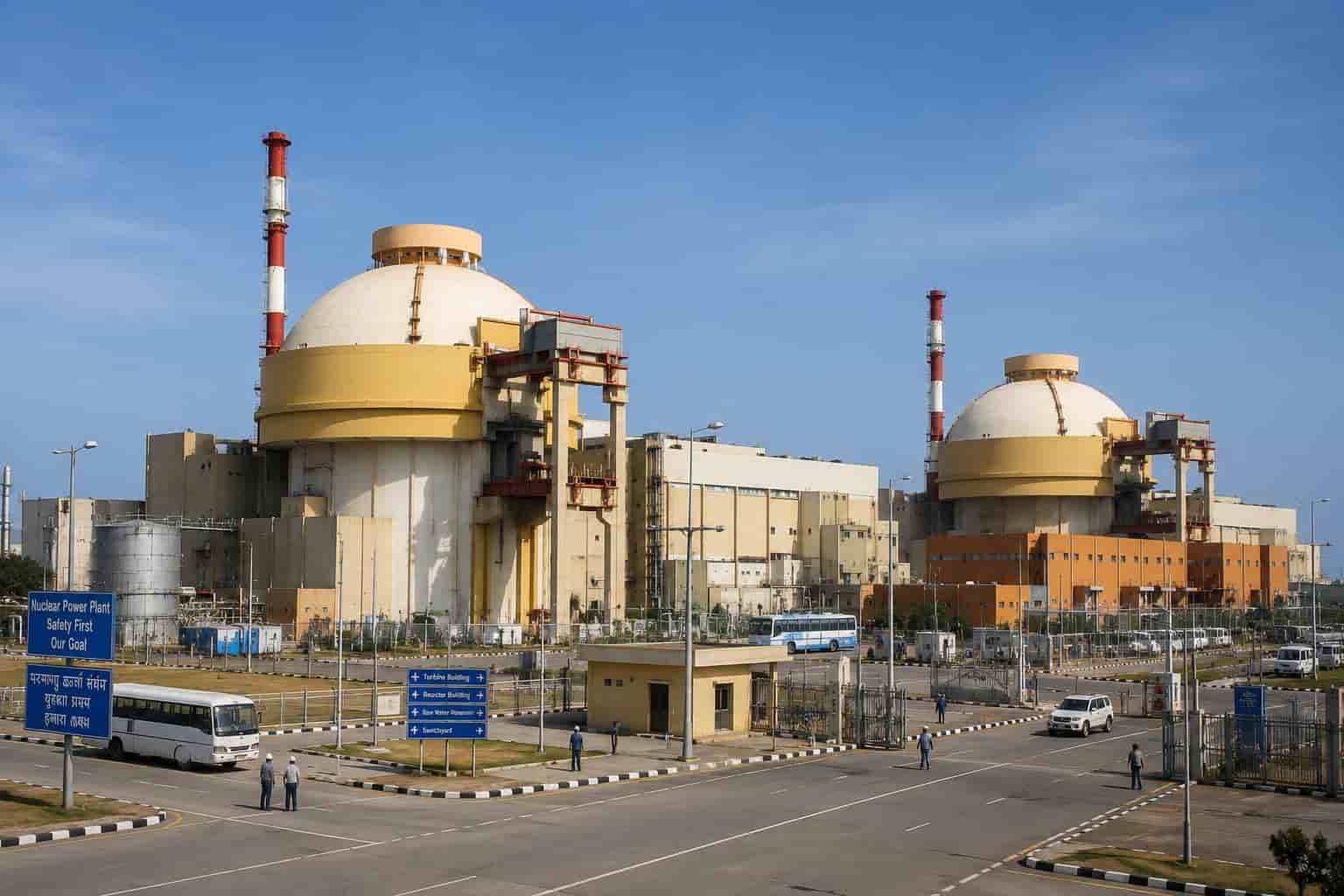
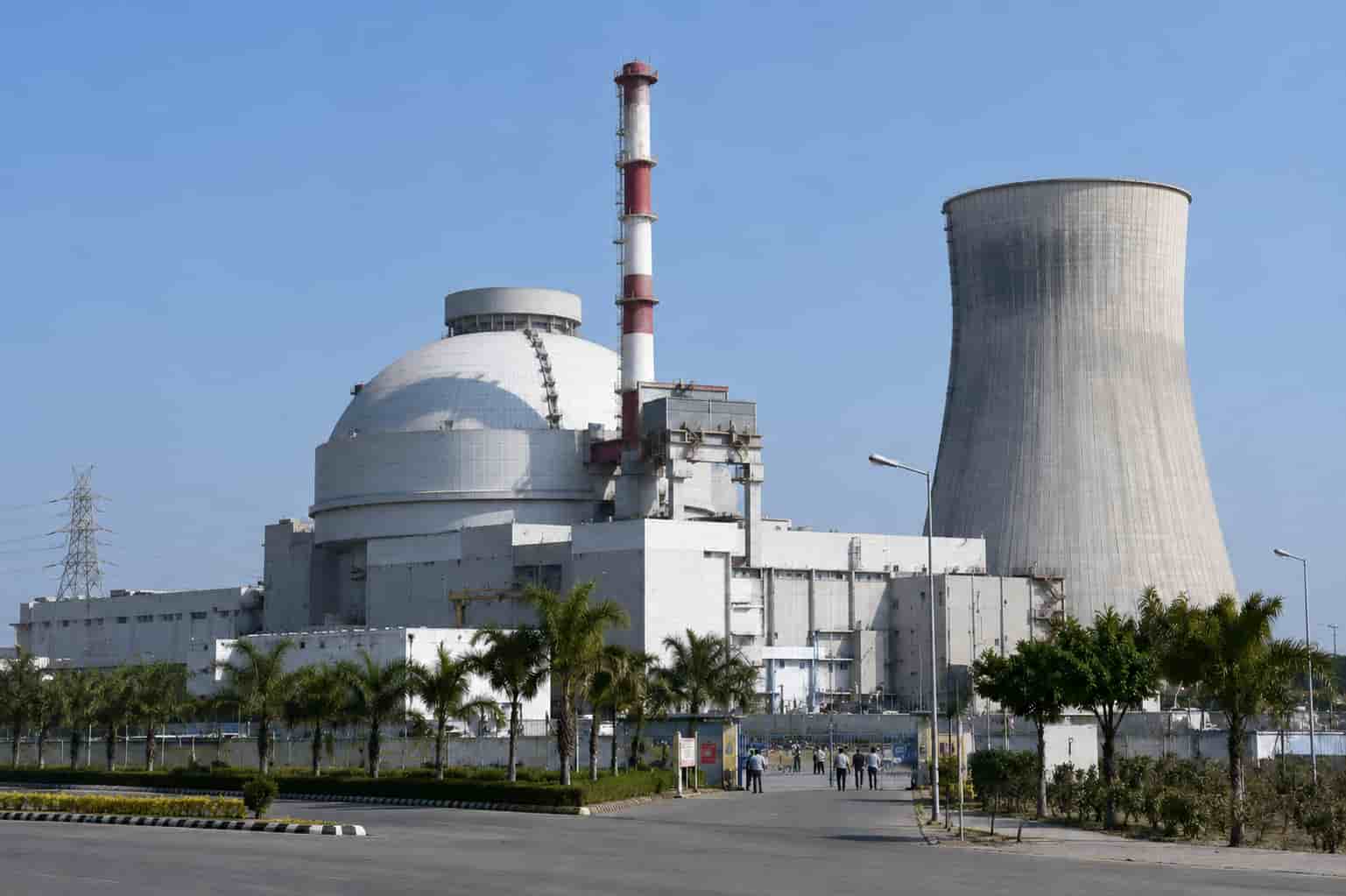
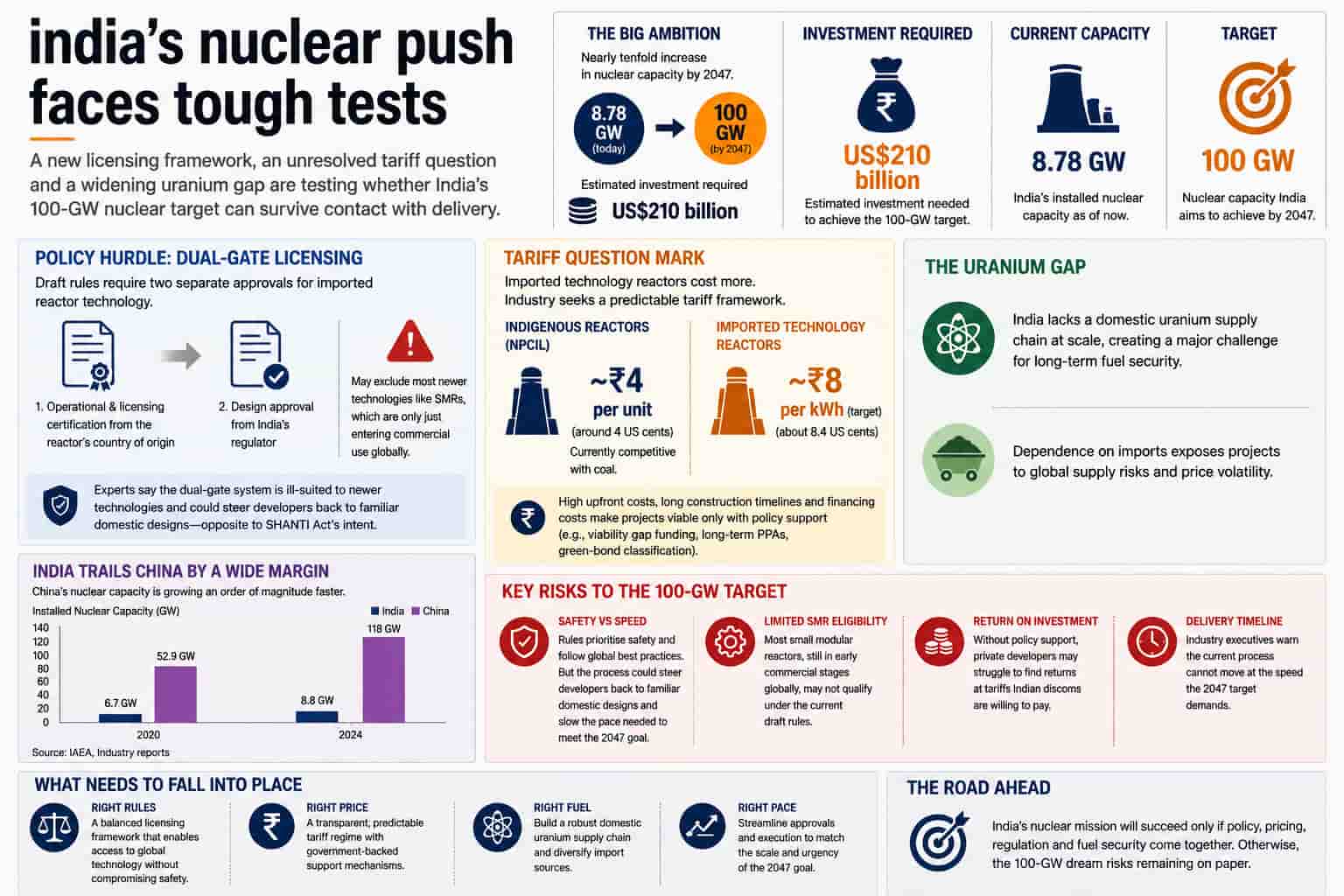
Government officials framed it as India’s most consequential energy reform in a generation, built around a headline ambition: raising nuclear capacity from 8.78 GW today to 100 GW by 2047, a nearly tenfold jump that industry estimates will require around US$210 billion in investment — the scale of ambition this platform has tracked building since Kudankulam’s latest approvals.
Then came the draft rules meant to operationalise the law, and the mood shifted.
The Department of Atomic Energy’s draft framework requires companies bringing in imported reactor technology to first secure operational and licensing certification from the reactor’s country of origin, and only then apply separately for design approval from India’s own regulator. Industry executives argue this dual-gate structure, calibrated for reactor designs with decades of commercial operating history, is poorly suited to newer technology.
Small modular reactors, the compact designs India has repeatedly identified as central to faster, cheaper deployment, are only just beginning commercial operation anywhere in the world, according to a media report. Under the proposed rules, most would struggle to qualify at all.
A senior government official involved in drafting the framework has said it prioritises safety and mirrors international regulatory practice. That is a defensible starting position for a sector where the cost of getting things wrong is measured in generations, not balance sheets. But it also risks an outcome opposite to what SHANTI intended: steering developers back towards familiar domestic designs and away from the imported technology and capital the reform was written to attract, industry reports suggest.
“The irony is that we spent two decades trying to open this sector up, and the first implementation document risks doing the opposite,” said a senior executive at one of India’s leading engineering conglomerates involved in nuclear component manufacturing. “Nobody disputes that safety comes first. The question is whether the process can move at the speed the 2047 target demands.”
The tariff arithmetic nobody has settled
Regulatory friction is only half the problem. The other half is price.
Nuclear Power Corporation of India’s (NPCIL’s) indigenous pressurised heavy water reactors currently generate power at an average tariff of around ₹4 per unit (roughly 4 US cents), a genuinely competitive number against coal.
Reactors built with imported technology cost meaningfully more, and industry has been explicit about what it needs in return for taking on that cost: a transparent, predictable tariff framework with a levelised cost of electricity capped at around ₹8 per kWh (about 8.4 US cents), according to industry representatives cited in recent reporting.
That is a reasonable ask on paper. It is a much harder one to deliver in practice, because nuclear projects carry a cost structure renewables do not: enormous upfront capital, multi-year construction timelines, and financing costs that compound for every year a reactor is not generating revenue.
Without government-backed mechanisms such as viability gap funding, long-term power purchase guarantees or green-bond classification of the kind Europe has extended to nuclear assets, private developers may simply find the return-on-capital maths does not work at the tariffs Indian discoms are willing to pay.
This is precisely the gap Indoen Energy has flagged before as nuclear’s unresolved commercial question — the difference is that the numbers now attached to it are specific enough to be tested against real projects, not theoretical ones.
 Uranium: The constraint nobody quantified until now
Even if the regulatory and tariff questions resolve favourably, India faces a third constraint that has received far less attention: fuel.
A parliamentary Committee on Public Undertakings has estimated that India’s future fleet of pressurised heavy water reactors — roughly 25 GW of the eventual 100-GW target — will require around 5,400 tonnes of uranium oxide every year. Domestic production, led by the Uranium Corporation of India, is projected to meet only about 30% of that requirement. The remainder depends on imports from Kazakhstan, Russia, Uzbekistan and Canada, according to a parliamentary panel’s assessment reported this month.
India does have identified uranium resources of around 4.31 lakh tonnes, a reserve base large enough on paper to last decades. But converting geological resource into dependable annual fuel supply requires mining and processing capacity India has not yet built.
UCIL has targeted doubling production by 2031-32, which, even if achieved on schedule, would still leave substantial import dependency baked into a programme simultaneously being pitched as a pillar of energy security.
A programme meant to reduce reliance on imported fuel — coal, LNG, crude — cannot afford to quietly recreate the same dependency in uranium.
The pace problem: What 100 GW by 2047 actually requires
The clearest way to size India’s challenge is not through policy documents but through a straightforward comparison.
China has added 27 operational nuclear units since the end of 2016, nearly doubling its installed capacity in under a decade, using a state-directed model that keeps heavy components such as steam generators and reactor cores in continuous production ahead of site readiness, according to a recent industry account. The United States, still the world’s largest nuclear operator by installed capacity, added just two units in the same period, hampered by financing delays and cost overruns.
India, by comparison, currently operates 24 reactors totalling 8.78 GW, with nine more units — a combined 7.5 GW — under construction. NPCIL is separately pursuing a 14-GW expansion through 2032. Even taken together, that pipeline is a fraction of what a 100-GW target by 2047 implies, and it says something about the scale of the remaining task that global capital requirements for nuclear tripling worldwide are estimated at US$250 billion a year through 2050 — a sum the World Nuclear Association describes not as a shortage of capital but as a shortage of “confidence, capability and investment architecture” able to direct that capital at scale, per a global industry report published in August.
“India’s target is not unreasonable by global standards — China and others have shown the pace is technically achievable,” said a policy researcher at a New Delhi-based energy think tank. “What is unresolved is whether India’s specific mix of regulatory caution, tariff uncertainty and fuel dependency can be reconciled quickly enough to compress two decades of typical nuclear gestation into the time actually available.”
Private capital is circling, but the invitation is conditional
None of this has deterred interest from abroad. American nuclear industry bodies, including the Nuclear Energy Institute and the US-India Strategic Partnership Forum, have made comprehensive submissions on the draft SHANTI rules and led high-level delegations to New Delhi this year, according to industry statements.
Indian conglomerates including Tata Power, Adani Power and Reliance Industries have signalled interest alongside foreign majors such as Rosatom, EDF and GE Hitachi.
What that interest cannot resolve on its own is the sequencing problem at the centre of India’s nuclear ambition. Capital, technology and fuel are each individually available in the global market. What remains unresolved is whether India’s own framework — the licensing rules, the tariff structure, the fuel-security plan — can be finalised quickly enough, and coherently enough, to let that capital actually convert into reactors on the ground before 2047 arrives.
India’s nuclear story has, for months, been told as one of policy intent finally catching up with strategic need. The material emerging through August tells a narrower and more useful story: intent has arrived, and the harder test — whether execution can keep pace with ambition — has only just begun.
Follow us on : X | LinkedIn | Facebook | Bluesky