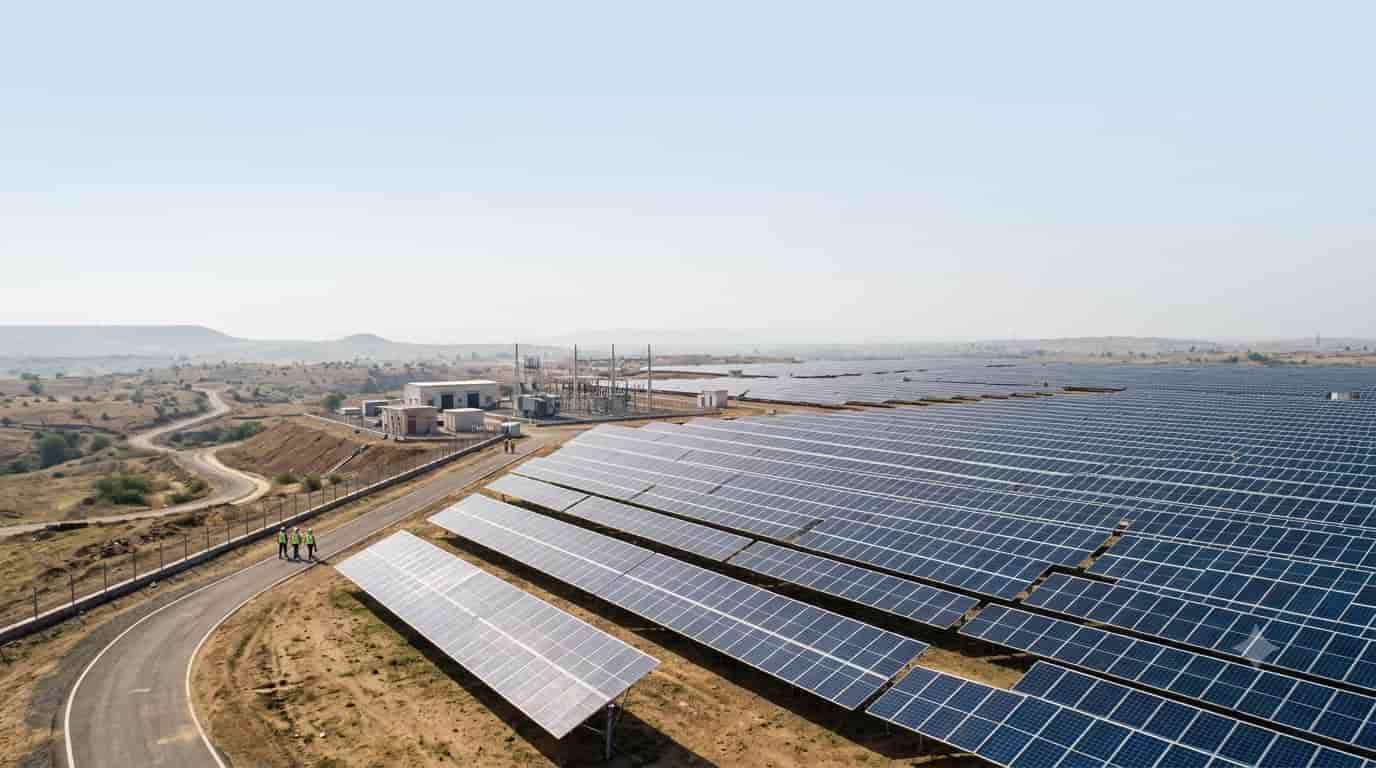


India’s rapid renewable energy expansion is beginning to reshape the country’s power market—but not always in predictable ways. With installed renewable capacity crossing 250 GW and the country emerging as the world’s third-largest clean energy producer, supply growth is no longer the constraint. The real question now is whether the market can absorb it efficiently.
This shift marks a turning point. For much of the past decade, India’s energy transition was driven by capacity creation—adding solar and wind at scale. That phase is largely underway. The next phase is being defined by market integration, pricing pressures, and demand alignment, as renewable additions accelerate alongside rising electricity demand and policy ambition.
Supply surge meets demand and grid constraints
India’s renewable capacity pipeline remains strong, supported by policy incentives and declining technology costs. But as more projects come online, signs of stress are emerging across the system. In several regions, grid infrastructure and transmission capacity are struggling to keep pace with renewable additions, raising the risk of curtailment and underutilisation of assets.
At the same time, power distribution companies (DISCOMs)—the primary buyers of electricity—continue to face financial stress, often delaying payments and limiting their ability to contract additional renewable supply. These structural weaknesses are beginning to influence market behaviour, forcing developers to price in higher risk premiums and reconsider exposure to weaker state utilities.
Pricing pressures and evolving power economics
The surge in renewable supply is also reshaping price signals in the power market. Competitive bidding has pushed solar tariffs to historically low levels, intensifying pressure on project margins even as financing costs rise.
While low tariffs benefit consumers, they also raise concerns around long-term project viability, particularly in a market where cost recovery depends heavily on timely payments and stable demand. Meanwhile, coal continues to account for a significant share of generation, reflecting the ongoing reliance on conventional sources for grid stability despite renewable growth.
This duality highlights a deeper market reality: India’s transition is not replacing fossil fuels immediately but layering renewables on top of an existing system that still depends on thermal power for reliability.
Policy signals and investment flows
Government policy continues to favour renewable expansion, with strong targets and increasing capital flows into the sector. India is tracking thousands of renewable projects worth hundreds of billions of dollars, signalling sustained investor interest and long-term growth potential.
At the same time, global fossil fuel disruptions are reinforcing the strategic case for renewables by exposing India’s vulnerability to imported energy price shocks. This has strengthened the policy push for domestic clean energy capacity, even as implementation challenges persist.
However, investment is becoming more selective. Developers and financiers are prioritising projects with strong power purchase agreements, reliable counterparties, and favourable state-level policies—indicating a shift from aggressive expansion to risk-aware capital allocation.
A fragmented market: State-level divergence
One of the defining features of India’s energy market today is its unevenness. Transition progress varies significantly across states, driven by differences in institutional capacity, financial health of utilities, and policy execution.
Some states are rapidly scaling renewable integration, while others lag due to weak distribution companies and infrastructure bottlenecks. This divergence is creating a fragmented market landscape where risks and returns are highly localised, reinforcing the idea that India’s power market operates as a collection of sub-markets rather than a single unified system.
The emerging market shift
Taken together, these trends point to a fundamental shift in India’s energy market. The constraint is no longer building capacity—it is ensuring that capacity translates into reliable, bankable, and efficiently utilised power.
This transition—from expansion to optimisation—will define the next phase of growth. It will require not just more renewable projects, but stronger grid infrastructure, healthier DISCOMs, better demand visibility and clearer price signals. Without these, capacity growth risks outpacing system readiness.
The bottom line
India’s renewable surge is real, but it is also reshaping market dynamics in complex ways. Supply is growing faster than the system’s ability to absorb it, creating new risks around pricing, utilisation and financial viability.
For the energy market, the story is no longer about how much capacity is added—but about whether that capacity can find stable demand, fair pricing, and reliable integration in an increasingly complex and fragmented power system.
Cover image: AI-generated (representative)