

India’s battery storage needs hit 236 GWh by FY32, requiring $36.1bn
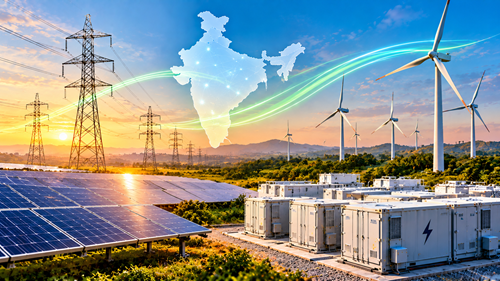
A Rubix Data Sciences report estimates India’s battery storage requirement at 236.22 GWh by FY2031-32, up from 34.72 GWh in FY2026-27. The required investment is about ₹3.49 lakh crore (US$36.1bn). The projection is based on the National Electricity Plan 2022-32.
The pipeline is large but largely unbuilt. Operational capacity is 9.08 GWh as of August 2026, with 79.92 GWh under construction, 24.13 GWh awarded and 63.53 GWh under tender.
That totals 176.66 GWh, roughly 75% of the FY32 requirement. Additions in the first half of 2026 reached 8.2 GWh, compared with less than 100 MWh a year earlier. Policy supports this through rising storage obligations, viability gap funding and PM-DHARA’s ₹50,000 crore (US$5.2bn) for 50 GWh.
The report also flags the fault lines. About 75% of the allocated two-hour capacity is classified as at risk, following the lowest 2025 tariff of ₹1.48 lakh per MW per month (US$1,530), indicating aggressive bidding.
Lithium-ion imports rose from US$3.0bn in FY25 to US$4.7bn in FY26, with about 84% from China. The storage build-out is therefore as much a question of bid discipline and supply-chain dependence as of capacity. Indoen’s recent coverage of the Union Cabinet’s transmission corridor, with its 50 GWh storage component, addresses the policy side. This brief addresses market delivery risk.
India’s battery storage needs hit 236 GWh by FY32, requiring $36.1bn
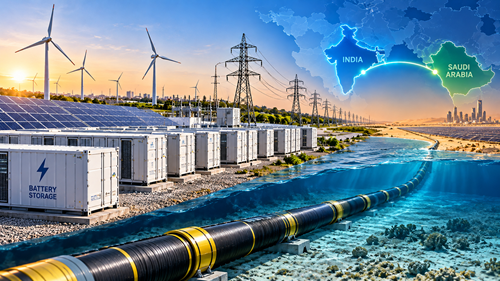
A completed feasibility study estimates the India–Saudi Arabia undersea transmission cable at 2,100 km, 3 GW, and $9bn, up from an earlier $5bn estimate. Talks on cost-reduction strategies were scheduled for 5 October.
The project falls under the “One Sun One World One Grid” framework and follows recent investment and energy agreements between the two countries. The sources reviewed have not reported the outcome of the October talks.
An 80% increase in the estimate matters more than the cable itself. Subsea high-voltage links are costly and have few suppliers. A 3 GW capacity on a $9bn bill implies a high cost per delivered kilowatt unless utilisation is very high.
Whether the economics work depends on who pays for the asset, the tariff structure governing flows, and whether India is a net importer or exporter at different times of day. None of that is settled in the source.
The geopolitical logic is clearer. A physical grid tie would add a power dimension to a relationship built largely on crude and capital flows and would extend India’s westward evacuation of cheap solar power.
For now, it reads better as a test of how far India’s grid-interconnection ambitions can go before a realistic price tag stops them.