
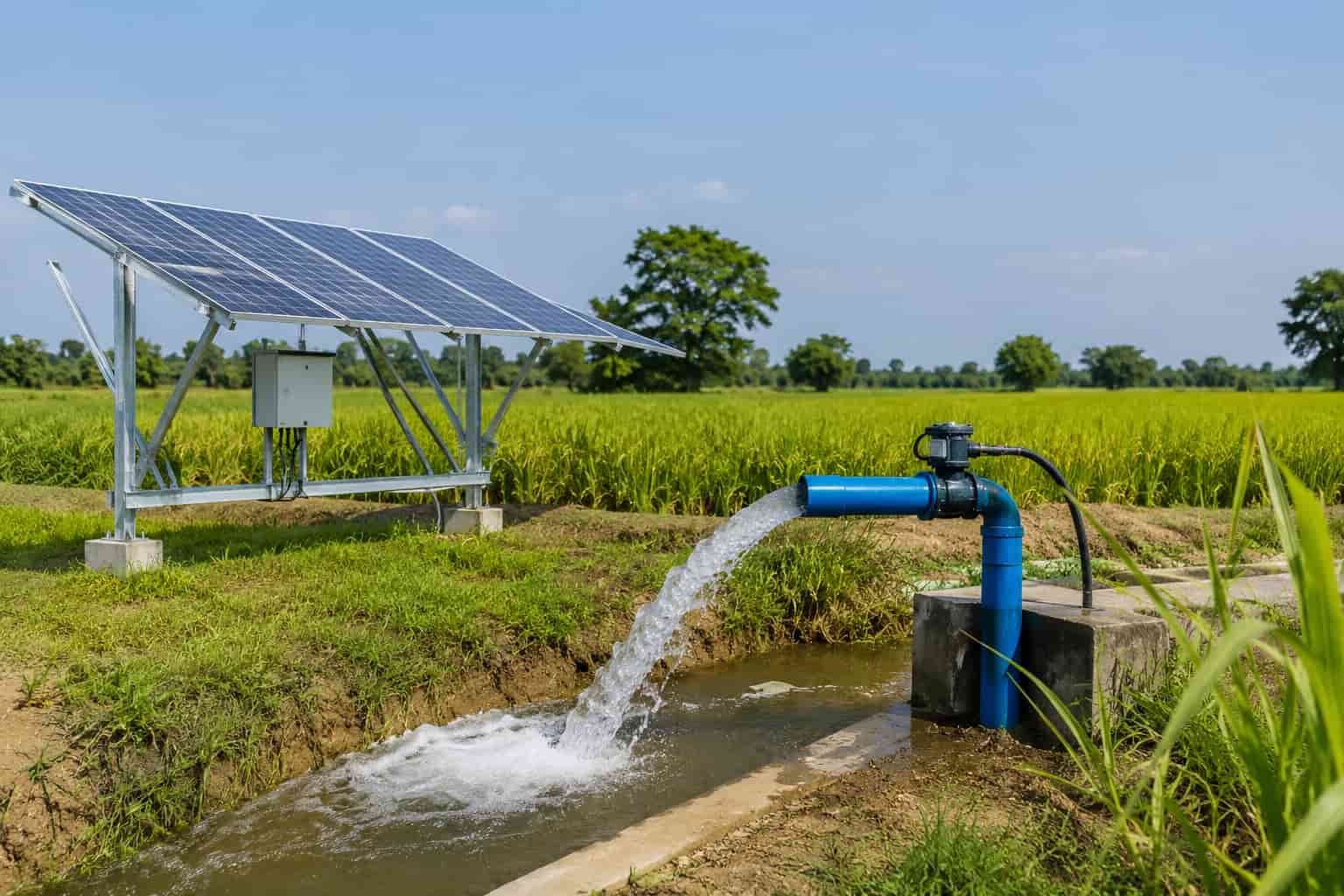
For a farmer in rural India, water has always cost something to pump — diesel, or a metered electricity bill. Pradhan Mantri Kisan Urja Suraksha evam Utthaan Mahabhiyan, better known as PM-KUSUM, was designed to remove that cost altogether.
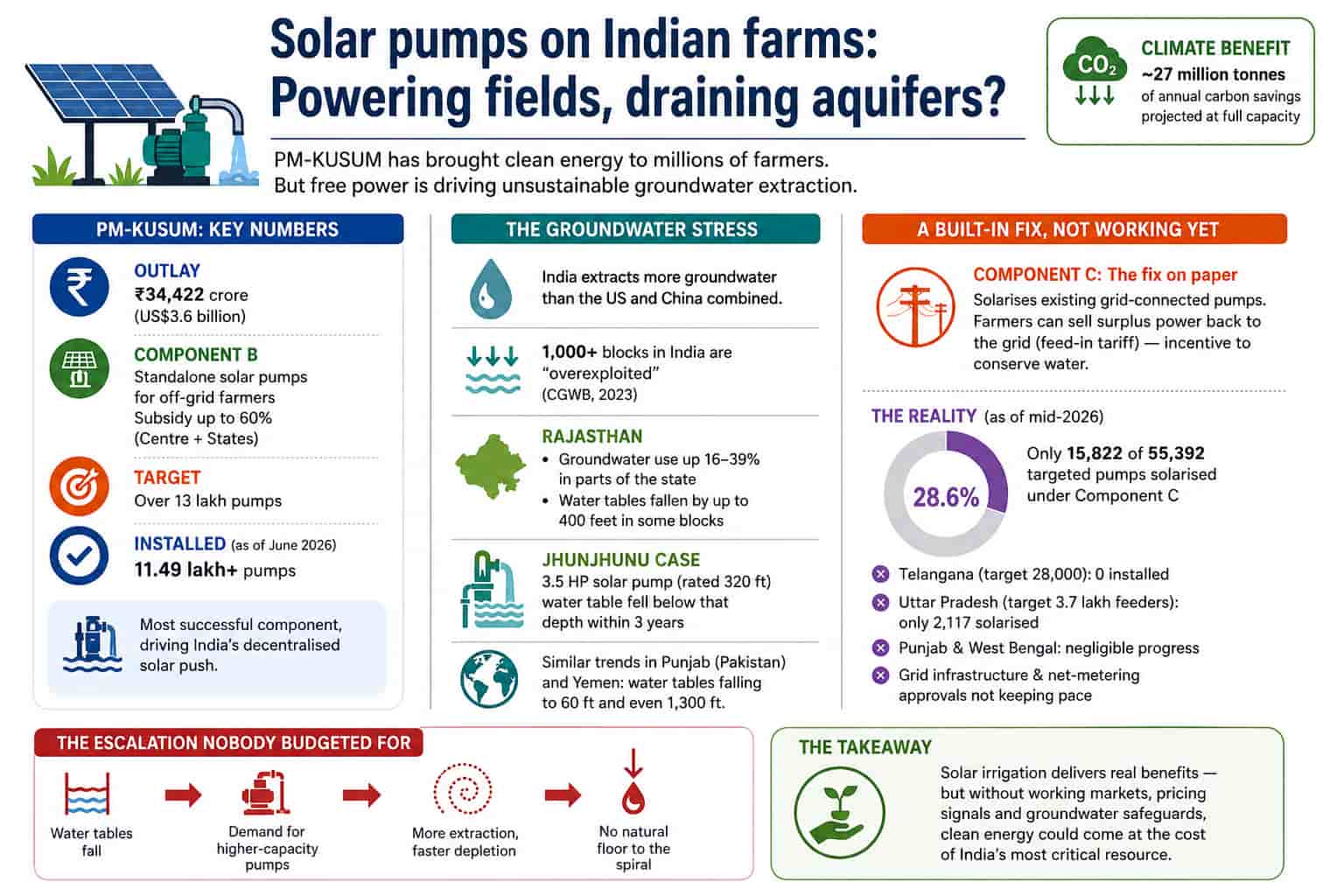
Launched in 2019 with a central outlay of ₹34,422 crore (US$3.6 billion), the scheme’s Component B subsidises standalone solar pumps for farmers with no reliable grid connection, covering up to 60% of the cost between the Centre and the states, with the rest available as a bank loan.
It has been the scheme’s most successful component by far. Against a sanctioned target of over 13 lakh pumps, more than 11.49 lakh had been installed by the end of June 2026, according to the ministry’s own dashboard.
The Ministry of New and Renewable Energy is reportedly aiming to add roughly two million more pumps this year, and to convert a further 1.5 million existing pumps to solar, according to recent commentary from the Kleinman Centre for Energy Policy.
That is, by any measure, a decarbonisation success story: diesel displaced, farm incomes protected from fuel-price shocks, daytime power that does not depend on an overstretched grid. Indoen Energy has previously tracked how distributed solar’s rooftop and KUSUM components have surged even as their overall share of the renewables mix stays flat.
What is less discussed is the resource that absorbs the consequences once the panels are installed and the running cost of pumping drops to zero.
The aquifers picking up the bill
India already extracts more groundwater than the United States and China combined, and a 2023 assessment by the Central Ground Water Board found more than 1,000 administrative blocks nationally classified as “overexploited” — extraction outpacing natural recharge — concentrated in Punjab, Haryana, Rajasthan and parts of central India, according to reporting that reviewed the CGWB findings.
Rajasthan illustrates the mechanism starkly. Reported research cited by a recent industry feature on the state of solar irrigation found groundwater usage rising by 16-39% in parts of the state since solar pumps became widespread, with water tables falling by as much as 400 feet in some blocks.
A documented case from Jhunjhunu district shows a farmer who installed a subsidised 3.5 HP solar pump in 2013, rated to draw from 320 feet, only to find the water table had dropped below that depth within three years — a problem now familiar across the state’s overexploited blocks, where farmers are pushing for higher-horsepower pumps that reach deeper still.
“Every additional foot a pump has to reach is a foot closer to the aquifer running out in that block,” said a researcher at a New Delhi-based energy think tank. “The subsidy was designed around the cost of the panel. Nobody priced in the cost of what happens once the water is essentially free to pump.”
The pattern is not unique to India. The same reporting on solar irrigation found Punjab, on the Pakistani side of the border, recording water tables below 60 feet — a 25% increase in depth since 2020 — while parts of Yemen, another enthusiastic adopter of solar pumps, have pushed extraction to depths of 1,300 feet. The common thread across all three is the same: once the marginal cost of running a pump falls to nothing, the only constraint left on extraction is the depth of the borewell.
 A scheme with its own answer, stuck in the pipeline
PM-KUSUM was not designed blind to this risk. Component C, which solarises existing grid-connected pumps rather than installing standalone ones, is built around a “prosumer” model: farmers who use less power than their panels generate can sell the surplus back to the grid at a feed-in tariff, in theory creating a financial incentive to conserve water rather than pump it all.
A policy analysis published by IMPRI’s insights desk describes this as the scheme’s built-in corrective — a price signal reintroduced through the back door, after the front door had removed it.
In practice, that corrective is barely functioning. Component C’s Individual Pump Solarisation target stands at 55,392 pumps; only 15,822, or 28.6%, had been solarised as of mid-2026, according to a review of state-wise progress data. Telangana, allocated the largest share at 28,000 pumps, has yet to report a single completed installation. Uttar Pradesh has solarised just 2,117 of a targeted 3.7 lakh feeders. Punjab and West Bengal show similarly negligible progress.
“The buy-back model works on paper, but a farmer cannot sell power back to a grid that hasn’t been wired to receive it,” said a policy adviser familiar with state-level renewable energy implementation. “Net-metering approvals and feeder-level infrastructure haven’t kept pace with the pace of pump installation itself, so the incentive to conserve simply isn’t reaching most farmers yet.”
That gap matters because of where the growth is concentrated. Component B, the unmetered standalone-pump programme with no equivalent buy-back safeguard, remains by far the fastest-growing part of the scheme and the one the ministry is pushing hardest to expand. Component C, the part explicitly designed to blunt overextraction, is the one lagging furthest behind.
The escalation nobody budgeted for
There is a subtler contradiction here too. As water tables fall below a pump’s rated depth, the standard response — in Rajasthan and elsewhere — has been to press for higher-capacity pumps that can reach further down.
Experts studying the state’s implementation have warned this simply resets the clock on the same problem: a bigger pump extracts more water faster, deepening the very depletion that made the upgrade necessary in the first place.
It is a spiral with no natural floor, because unlike a diesel pump rationed by fuel cost, a solar pump’s only limiting factor is how deep its motor can reach.
None of this argues for abandoning solar irrigation — the diesel savings, emissions reductions and daytime energy security it delivers are real, and roughly 27 million tonnes of annual carbon savings are projected once the scheme reaches full capacity.
States such as Gujarat and, more recently, Rajasthan itself have experimented with feeder separation and progressive power pricing as a way to reintroduce some cost discipline without reverting to diesel. But those measures depend on DISCOM infrastructure and state-level political will that, on the current evidence, is moving far slower than the pumps themselves.
For a country whose next energy-security challenge is increasingly about resources rather than fuel, the KUSUM experience is a reminder that decarbonisation and sustainability are not automatically the same thing. Cutting emissions at the wellhead means little if the water beneath it runs out first.
Follow us on : X | LinkedIn | Facebook | Bluesky