
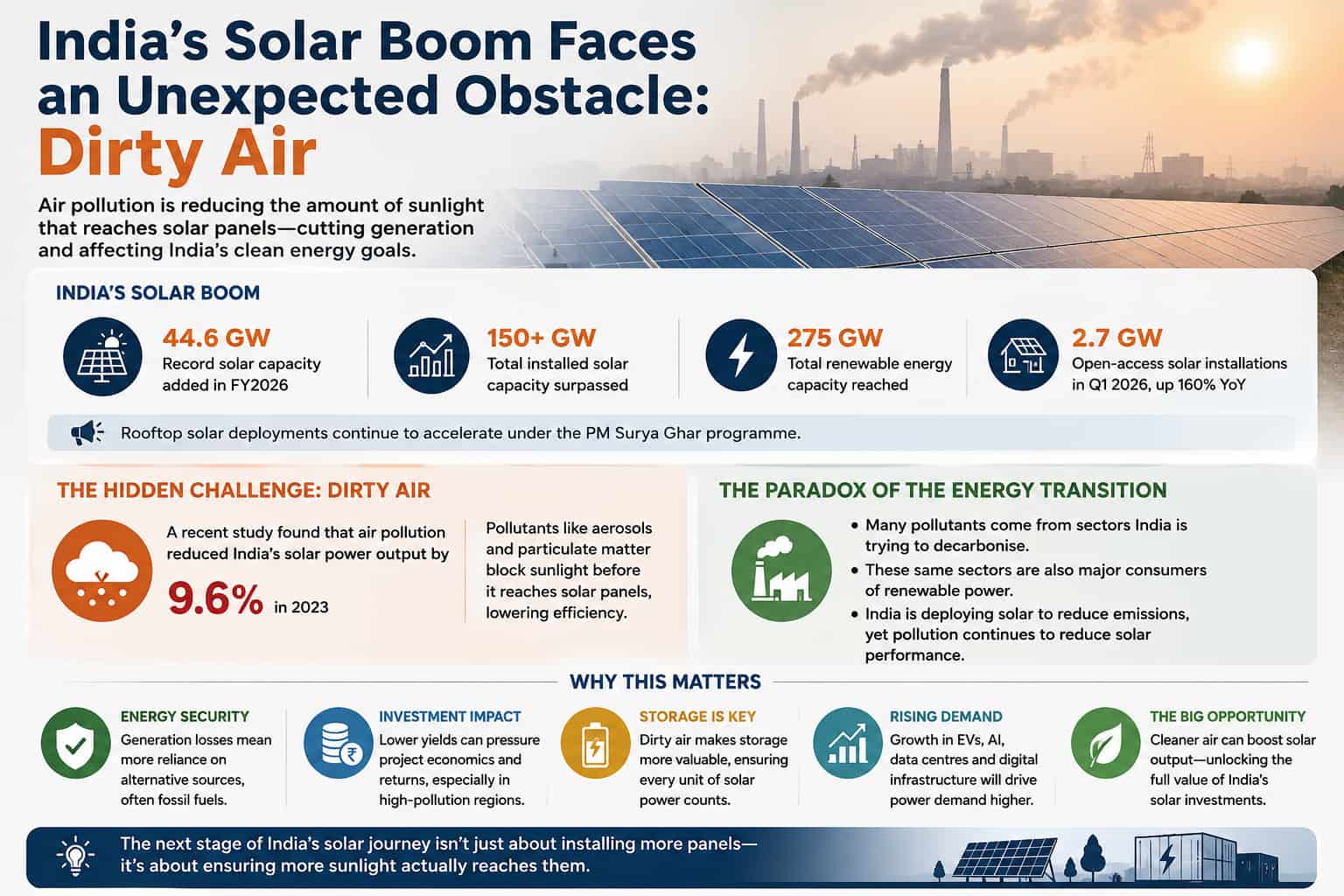
India’s solar sector is experiencing one of the fastest expansions in its history. The country added a record 44.6 GW of solar capacity in FY2026, taking total installed solar capacity beyond 150 GW and helping push overall renewable energy capacity to around 275 GW.
Open-access solar installations surged 160% year-on-year to 2.7 GW in the first quarter of 2026 alone, while rooftop solar deployments continue to accelerate under the PM Surya Ghar programme.
Yet beneath the optimism surrounding India’s solar revolution lies a less-discussed challenge. The very air above many of the country’s solar installations is quietly reducing their effectiveness.
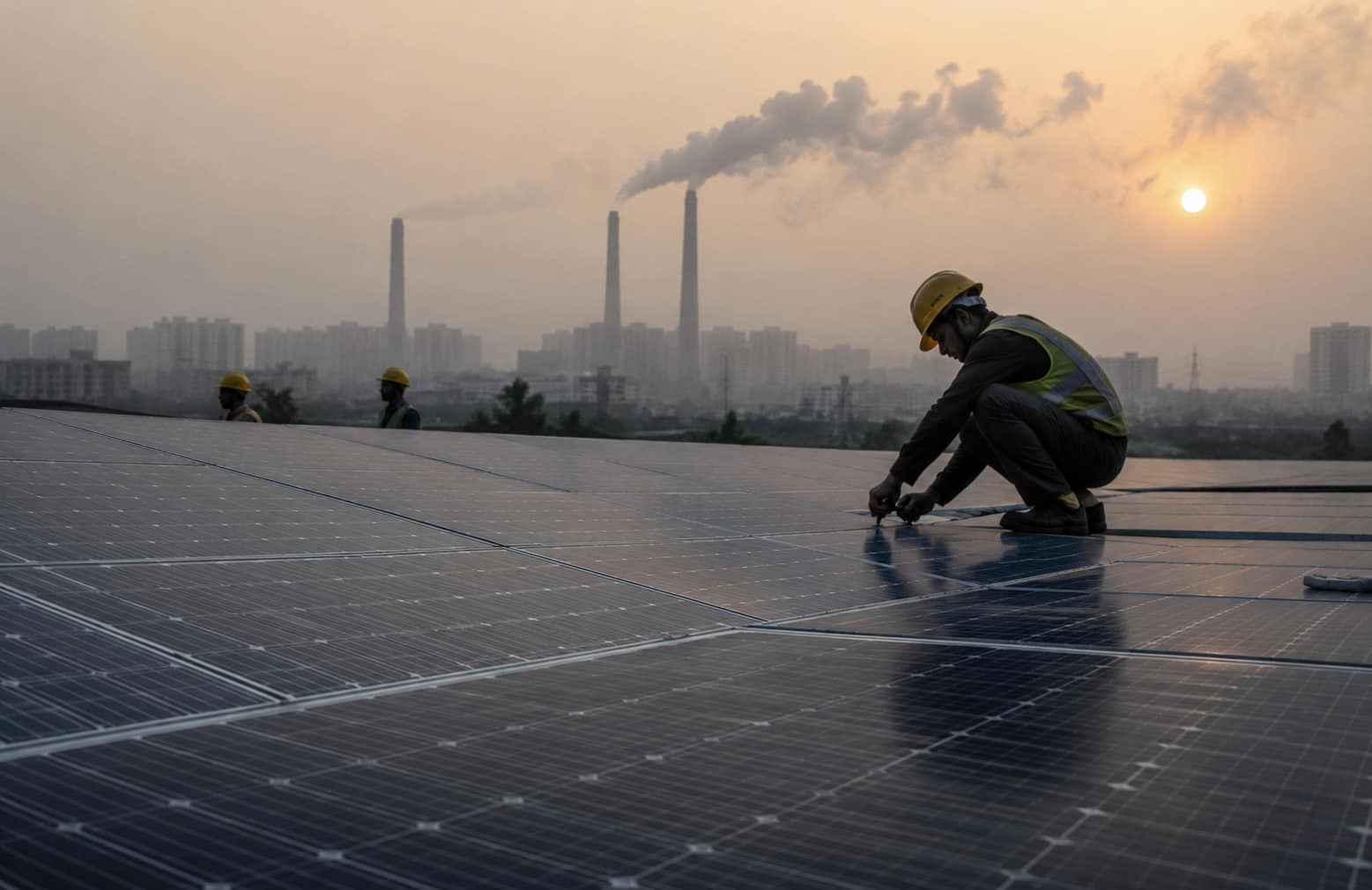
A recent study found that air pollution reduced India’s solar power output by 9.6% in 2023, highlighting an emerging contradiction at the heart of the country’s energy transition. India is investing billions of rupees in harnessing sunlight, but airborne pollutants are diminishing the amount of sunlight that reaches solar panels in the first place.
This is no longer merely an environmental issue. It is increasingly becoming an energy security, investment and power-sector efficiency challenge.
Capacity versus generation
India’s renewable energy conversation has traditionally revolved around installed capacity. Governments announce gigawatts. Developers bid aggressively for projects. Investors track additions and commissioning milestones.
But electricity systems do not operate on installed capacity alone. What ultimately matters is actual electricity generation.
The distinction is becoming increasingly important as India enters a new phase of renewable deployment.
The country added 2.7 GW of solar open-access capacity during the first quarter of 2026, representing the second-highest quarterly addition ever recorded in the segment. Rajasthan alone accounted for nearly 39% of new installations as commercial and industrial consumers rushed to secure cheaper renewable electricity.
At the same time, however, researchers are increasingly warning that aerosols, particulate matter and atmospheric pollution reduce solar irradiation reaching photovoltaic modules.
Unlike visible dust accumulating on panels, atmospheric pollution affects solar generation before sunlight even reaches the surface.
The consequences may appear modest on paper. Yet when applied across a solar fleet exceeding 150 GW, even a single-digit percentage reduction translates into enormous amounts of lost electricity over a year.
That electricity must ultimately be replaced by alternative sources, often fossil-fuel generation during periods of peak demand.
The paradox of the energy transition
The irony is difficult to ignore. Many of the pollutants responsible for reduced solar efficiency originate from sectors India is simultaneously trying to decarbonise.
Coal-fired power plants, industrial facilities, construction activity, transport emissions and biomass burning all contribute to particulate pollution. Some of these same sectors are also among the largest consumers of renewable power through open-access arrangements.
The result is a feedback loop rarely discussed in energy policy circles.
India is deploying solar to reduce emissions. Yet emissions and pollution continue to reduce solar performance.
The issue becomes even more significant when viewed through the lens of investment.
India has become one of the world's most attractive solar markets. New manufacturing mandates are expected to encourage billions of rupees in domestic investment across wafers, ingots, cells and modules as the government seeks to reduce dependence on imported supply chains.
For investors, however, generation yields are just as important as installation volumes. If pollution-related losses persist or worsen, project economics could gradually come under pressure, particularly in regions experiencing severe air-quality deterioration.
Why storage is becoming part of the answer
The pollution challenge is emerging just as the economics of solar itself are evolving.
For more than a decade, India’s solar success was built on one principle: build the cheapest possible generation capacity.
That model is now being questioned.
Industry analysts increasingly argue that standalone solar is losing some of its competitive advantage because power is not always generated when demand is highest. Policymakers have begun encouraging renewable-plus-storage projects, while newer procurement models increasingly favour firm and dispatchable renewable energy.
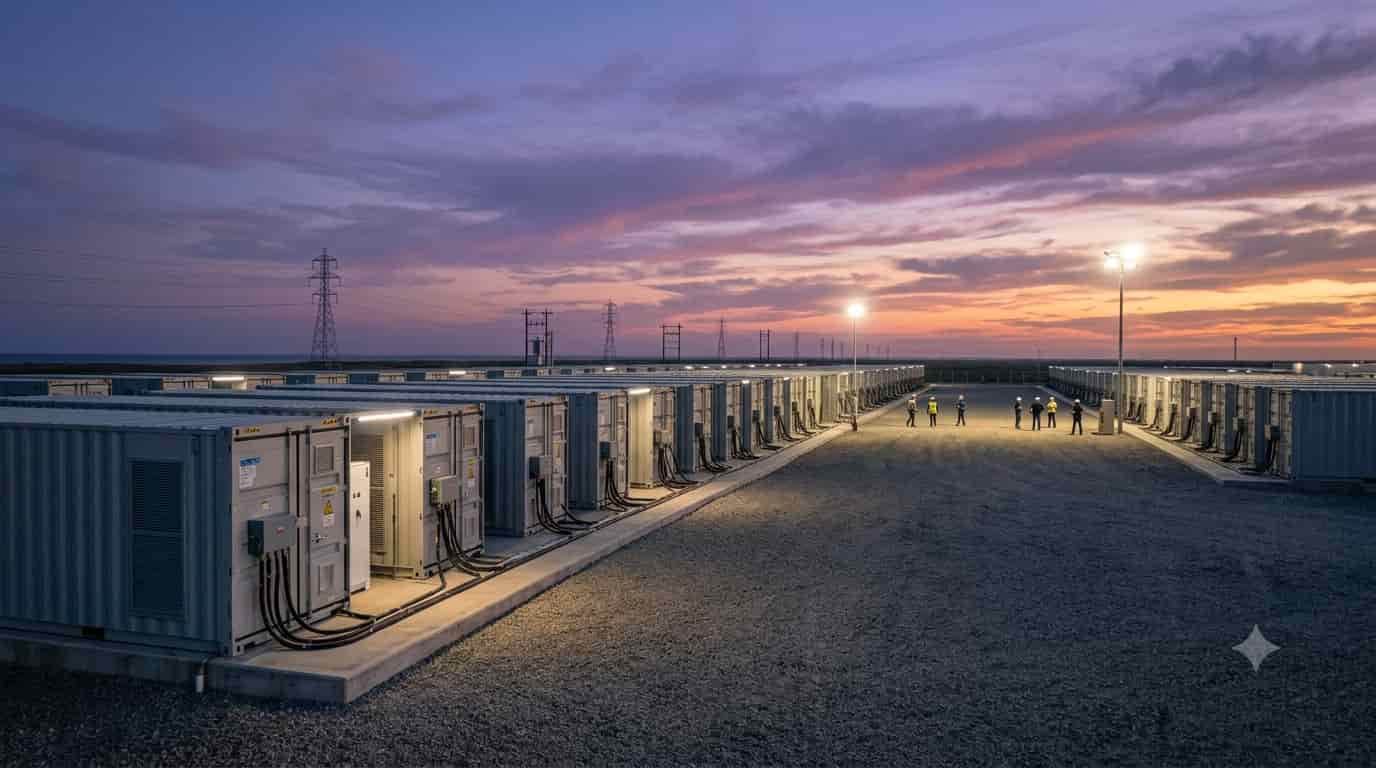
Dirty air adds another layer to this debate. If pollution reduces solar output during critical daylight hours, storage systems become even more valuable because every unit of renewable electricity generated becomes more important.
This helps explain why global solar companies are increasingly investing in battery manufacturing and integrated energy storage solutions rather than focusing solely on photovoltaic panels.
AI, EVs and the coming electricity surge
Another emerging factor is demand growth. India’s passenger vehicle market continues to shift gradually towards electrification.
At the same time, artificial intelligence, data centres and digital infrastructure are expected to increase electricity consumption significantly over the coming decade.
The challenge facing policymakers is therefore changing.
The central question is no longer whether India can build enough solar capacity. The question is whether India can maximise the value of every unit of solar electricity generated.
In that context, air quality becomes an energy-sector issue rather than merely an environmental one.
A one-percentage-point improvement in solar generation efficiency across a vast national fleet could potentially deliver benefits comparable to building additional generation capacity, but without acquiring land, constructing transmission infrastructure or securing project financing.
That is a powerful and often overlooked economic argument.
An underappreciated risk
Globally, researchers have identified similar concerns in China, parts of the Middle East and heavily industrialised urban regions. However, India’s scale makes the issue particularly important.
The country aims to achieve 500 GW of non-fossil fuel power capacity by 2030 and is projected to continue expanding solar installations at an unprecedented pace.
If pollution-related generation losses remain near current levels, India could find itself in a situation where adding capacity alone does not fully deliver the expected gains in electricity output.
This does not undermine the case for solar. On the contrary, it strengthens the argument for a more integrated energy strategy involving cleaner air, smarter grids, energy storage, transmission upgrades and better system planning.
India’s solar boom remains one of the most remarkable energy stories of the decade. But the next stage of that story may not be about how many panels the country installs.
It may be about how much sunlight actually reaches them.