
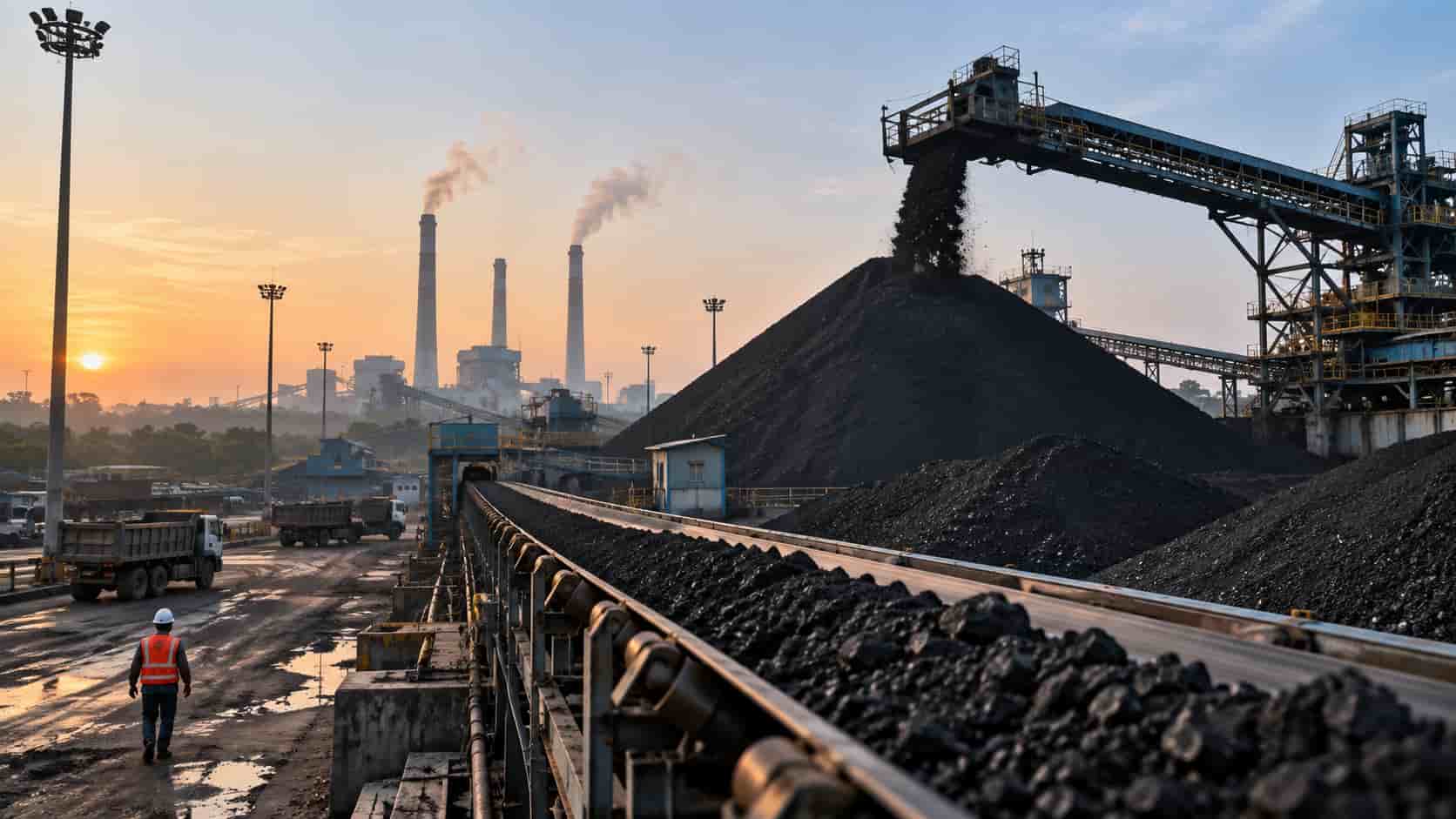

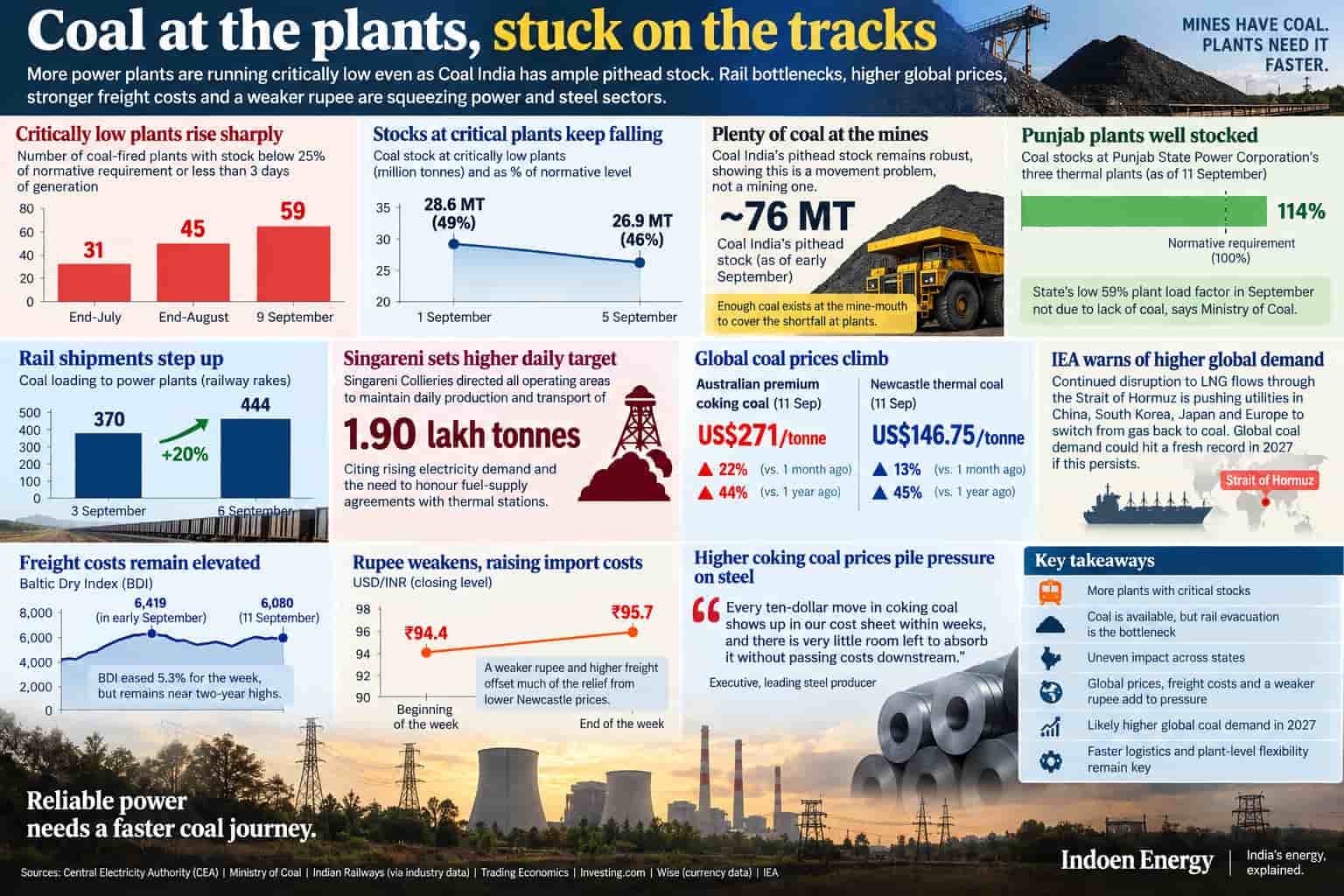
The power-plant stock situation kept deteriorating through the window. Fifty-nine coal-fired plants were classified as critically low as of 9 September, up sharply from forty-five at the end of August and just thirty-one at the end of July, government-linked data shows.
The Central Electricity Authority treats a plant as critical when its stock falls below 25% of the normative requirement or covers less than three days of generation. Stocks at these stations fell from about 28.6 million tonnes on 1 September, equivalent to 49% of the normative level, to around 26.9 million tonnes by 5 September, or 46%.
“We are seeing depletion at plants that were comfortable barely a month ago, and it is happening faster than the seasonal pattern would suggest,” an executive at a leading thermal utility said.
The pithead paradox
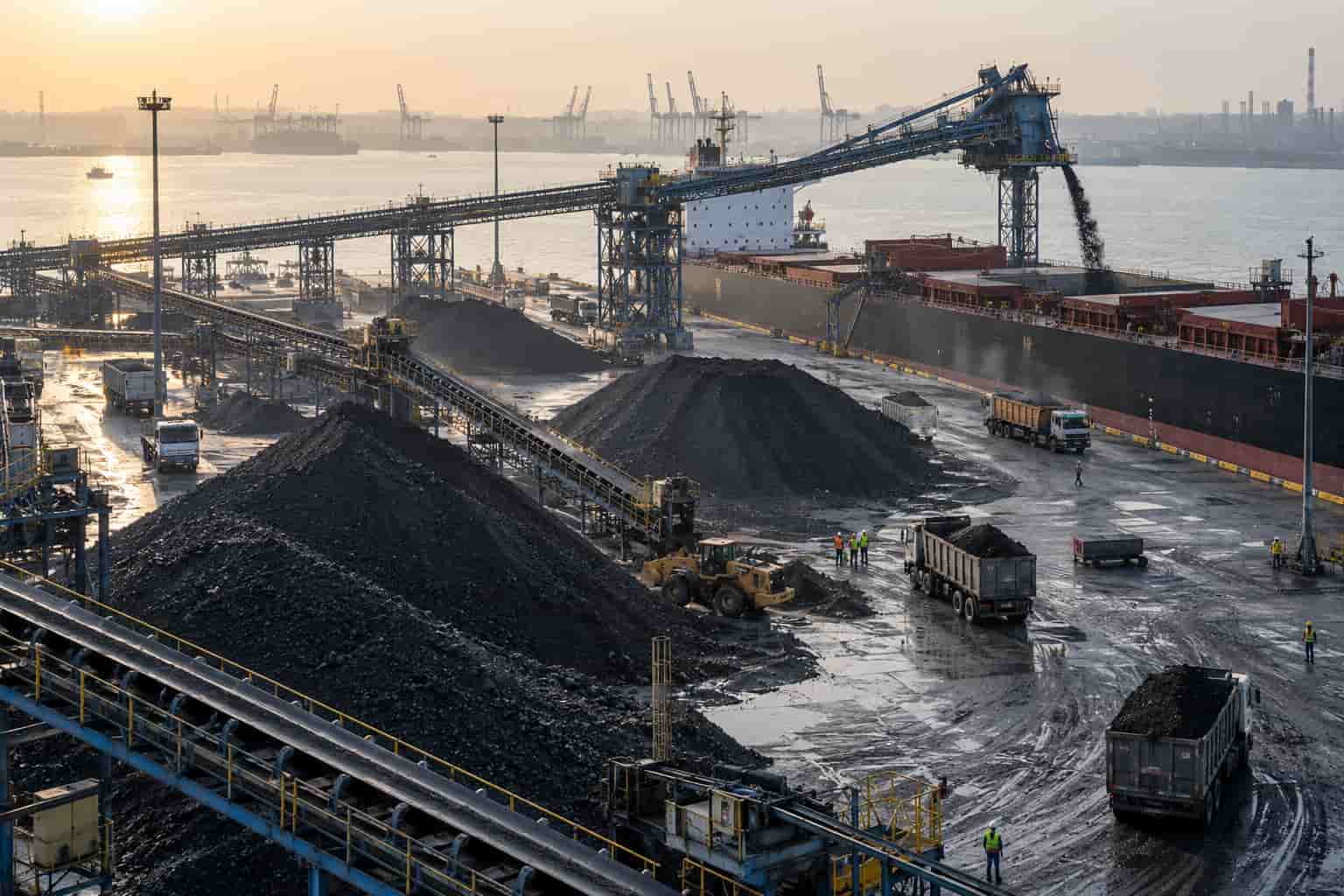
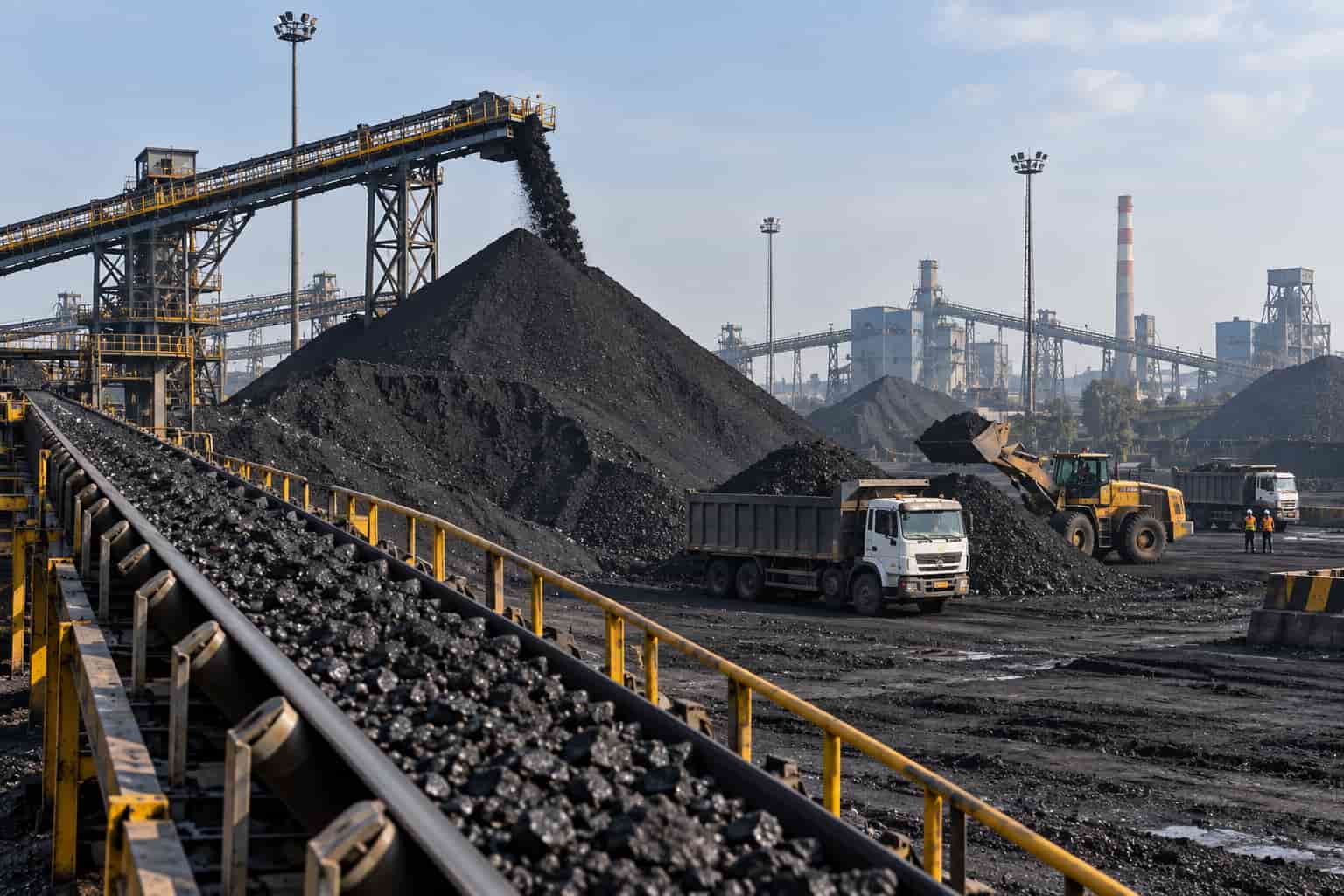
Coal India continues to hold roughly 76 million tonnes of coal at its pitheads, the same government-linked reporting notes. That is not a small cushion; it is proof that this is fundamentally a movement problem, not a mining one.
Coal exists in the ground and at the mine-mouth in quantities that would comfortably cover the shortfall at the plant end. What is missing is the wagon capacity and rail slots to move it there fast enough, a distinction that matters enormously for how policymakers should respond, since building more mining capacity would do little to fix a rail-evacuation bottleneck.
 A patchier picture than the headline suggests
The national narrative also needs a counterweight. Coal stocks at Punjab State Power Corporation’s three thermal plants stood at around 114% of the normative requirement as of 11 September, and the Ministry of Coal explicitly clarified that the state’s unusually low 59% plant load factor during the month could not be attributed to inadequate coal availability, ministry-linked reporting confirms.
In other words, the crisis is geographically uneven, concentrated in specific evacuation corridors rather than uniform across the grid, and low generation in at least one large state has other causes entirely.
Railways and Singareni answer the call
The policy and operational response this week centred on logistics rather than fresh notifications. Coal loading to power plants rose from 370 railway rakes on 3 September to 444 rakes by 6 September, sector-tracking data shows, as the Ministries of Coal, Power and Railways coordinated to accelerate deliveries ahead of any generation impact.
Separately, Singareni Collieries’ chairman directed general managers across all operating areas to sustain daily production and transport of 1.90 lakh tonnes, citing rising electricity demand and the need to honour fuel-supply agreements with thermal stations, company-linked reporting indicates. It is a reminder that India’s second-largest coal producer, often overshadowed by Coal India in weekly coverage, is being leaned on just as hard during this stretch.
Coking coal’s sharper climb piles pressure on steel
Globally, coking coal has moved further and faster than thermal coal this week. Australian premium coking coal touched US271 a tonne on 11 September, up 22% over the past month and 44% higher than a year earlier, commodity market data shows. That is a considerably sharper move than thermal coal has managed, and it lands directly on Indian blast-furnace producers who import the overwhelming majority of their metallurgical coal needs.
“Every ten-dollar move in coking coal shows up in our cost sheet within weeks, and there is very little room left to absorb it without passing costs downstream,” an executive at a leading steel producer said.
Newcastle eases, but Hormuz risk lurks
Thermal coal itself gave back a little ground. Newcastle coal eased to US146.75 a tonne by 11 September, down modestly from the multi-month high touched earlier in the month, though still up over 13% for the month and 45% year-on-year, commodity data indicates.
The more consequential signal was the International Energy Agency’s warning that continued disruption to LNG flows through the Strait of Hormuz is pushing utilities in China, South Korea, Japan and Europe to switch from gas back to coal, with global coal demand potentially hitting a fresh record in 2027 if that persists.
For India, this matters twice over: it keeps a floor under seaborne coal prices just as the domestic stock position is stretched, and it raises the odds that any renewed LNG price spike pushes Indian gas-based generation towards coal as well.
Freight and the rupee both turn against importers
Landed cost moved unfavourably this week. The Baltic Dry Index and capesize rates touched their highest levels in roughly two years in early September, driven by strong Australian and Indonesian coal-cargo demand in the Pacific basin, before easing back by 5.3% for the week to 6,080 points by 11 September, shipping market data shows.
Compounding that, the rupee weakened from around ₹94.4 to nearly ₹95.7 against the dollar over the week, reversing the previous week’s modest appreciation, currency-tracking data shows. Together, elevated freight and a softer rupee offset much of the relief from Newcastle’s small pullback.
The wider debate keeps running underneath
None of this changes the structural questions Indoen Energy has tracked in recent weeks about coal’s place in India’s transition, nor the case for greater plant-level flexibility as renewables scale.
But this week’s data adds a sharper point: India’s coal problem right now is less about how much coal exists than about how quickly it can be moved from pithead to power plant, a distinction policymakers will need to keep in view as the autumn restocking push continues.