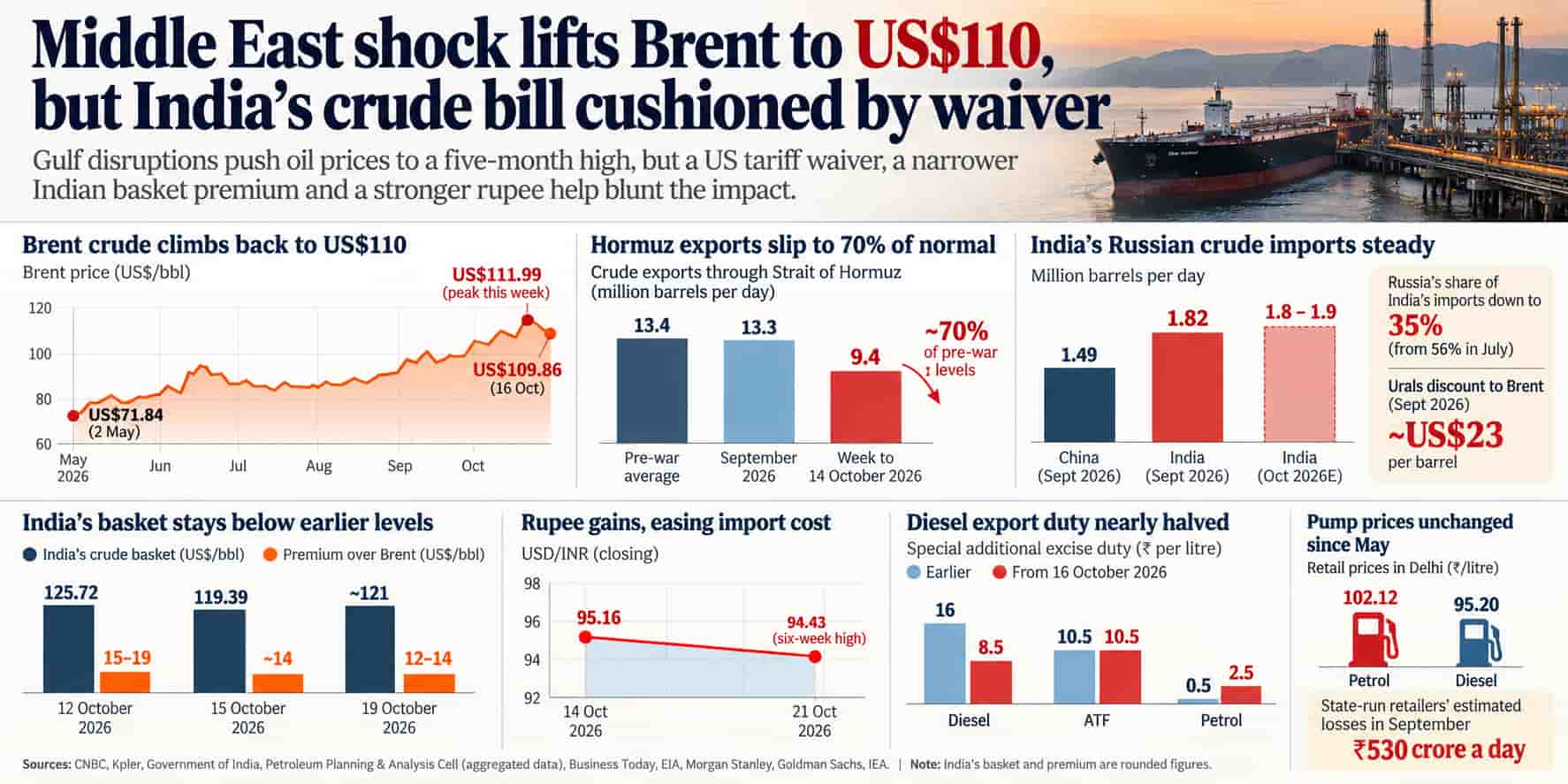
Brent rose 3.7% to US$109.86 a barrel on 16 October, touching US$110 for the first time since May. On Tuesday it swung more than US$6 in one session. It peaked at US$111.99, then settled at US$108.79 after Iran-Pakistan mediation talks. It was back near US$110 on Wednesday.
The cause was physical, not just political. Crude exports through Hormuz fell to about 9.4 million barrels a day in the week to 14 October, roughly 70% of the pre-war average, after touching pre-war levels in September. Iran’s Revolutionary Guards said mines had stopped three tankers. At least nine ships were attacked in five days. US crude stocks also fell by over 8 million barrels in the week to 9 October.
That undoes the Gulf recovery we tracked earlier this month. For India, each US$1 on the basket adds about ₹8,578 crore (USUS$910m) to the annual import bill.
Washington waives the tariff law
Last week we noted that Washington had not decided on a waiver for India. The answer came late on 16 October. An executive order suspended the tariffs in the Lindsey O. Graham Sanctioning Russia and Iran Act, a day before 100% duties were due on the five largest buyers of Russian energy. The waiver is not India-specific, and Washington can withdraw it at any time.
Kpler data shows India took about 1.82 million barrels a day of Russian crude in September, against 1.49 million for China. It expects October at 1.8-1.9 million. Russia’s share of India’s imports has slipped from as high as 56% in July to about 35%, while US shipments tracked for October reached 568,000 barrels a day. Analysts put September’s Urals discount to Brent at about US$23 a barrel.
That discount explains why refiners will not walk away. “The waiver is a pause, not a guarantee, so refiners will keep diversifying while the Russian discount lasts,” said an analyst tracking global crude markets. Ukraine has also vowed to keep striking Russian refineries.
 The basket’s premium shrinks
India’s basket fell while Brent rose. It was US$119.39 on 15 October and about US$121 on 19 October, as per aggregated price data, against US$125.72 on 12 October. With Brent near US$110, the premium over futures has narrowed to about US$12-14, from US$15-19 a week earlier.
Grade prices explain part of it. Saudi Arab Light, a staple for Indian refiners, was assessed near US$98.6 on 19 October, against US$113.4 for the UAE’s Murban, according to the same data. Aramco’s deep Asia discounts help explain that gap. Elevated shipping costs can also widen differentials between grades and squeeze refining margins, an investment bank warned this week.
The rupee helped too. It closed at ₹94.43 on 21 October, a six-week high, on Jio Platforms IPO inflows and Reserve Bank of India support. A week earlier it was ₹95.16.
Export duty cut, pumps frozen
From 16 October, the special additional excise duty on diesel exports fell to ₹8.5 a litre (USUS$0.09) from ₹16 (USUS$0.17). The duty on aviation turbine fuel (ATF) stayed at ₹10.5 (USUS$0.11). Petrol exports now pay ₹2.5 (USUS$0.03), up from ₹0.5 (USUS$0.01). Domestic duties are unchanged.
The duty is reviewed every fortnight and follows export margins.
The move therefore points to cooler diesel margins and warmer petrol ones. It also lets private exporters keep more of the diesel premium. “We review export duties each fortnight as margins move; retail prices involve wider considerations,” said a senior official at the Ministry of Petroleum and Natural Gas.
At the pump, nothing has changed. Delhi still pays ₹102.12 (USUS$1.08) for petrol and ₹95.20 (USUS$1.01) for diesel, unchanged since late May. ICRA estimated state-run retailers’ September losses at ₹530 crore (USUS$56m) a day. The basket is higher now.
Near term, forecasters expect prices to stay high through winter. The US Energy Information Administration (EIA) sees Brent averaging US$105 a barrel in the fourth quarter. Morgan Stanley is also at US$105 for the quarter and US$100 for the first quarter of 2027, while Goldman Sachs has raised its December target to US$90. The International Energy Agency (IEA) expects the market to stay in deficit to year-end, with diesel tight well into 2027.
The long view is softer. The EIA expects Brent to average US$84 in 2027. Goldman, which puts the war premium at more than US$20 a barrel, sees US$80, and Brent for December 2027 settled at US$86.69 on 16 October, about US$23 below the front month. A poll of 30 analysts puts this year’s average at US$89.05, with most expecting a 2027 surplus if shipping improves and Gulf and non-OPEC supply recover. If the basket moves with Brent, the US$21 gap between US$105 and US$84 is worth about ₹1.8 lakh crore (US$19.1 billion) a year, on the same rule of thumb.
The energy security test
The week exposed three weak points at once. Sourcing rests on a waiver that can be revoked. Supply rests on Gulf flows that have slipped back to about 70% of normal. Retail stability rests on state-run balance sheets. With 88% import dependence, India feels each of these as a pricing problem before it becomes a physical one.
The next checkpoint is 1 November, when the export duty is reviewed and OPEC+ meets.